INTERVIEW: ‘I could feel the trophy in my hands before the final’ — Shahid Afridi on 2009 World T20 glory
Out strode a tiger, unfazed by the occasion or the massive task at hand.
It was the 2009 T20 World Cup final against Sri Lanka at a jam-packed Lord’s. Shahid Khan Afridi, a maverick of the game, was ready for a once-in-a-lifetime opportunity.
“Half an hour of Afridi, game over, tournament over, Boom Boom wins it for you,” quipped former England captain Nasser Hussain on the television commentary.
The situation demanded otherwise, though: excruciating levels of patience and precision — something this phenomenal striker of the ball, who was given the moniker ‘Boom Boom’, was never known for. Pakistan were chasing a modest, yet tricky 139.
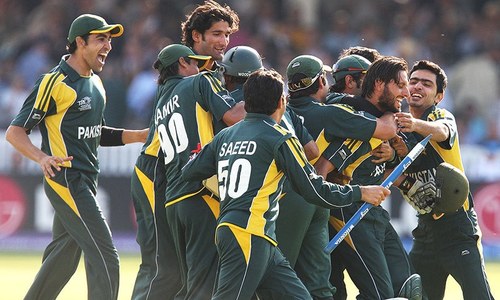
For Pakistan, luckily, it was Afridi’s day. While checking his traditionally flamboyant willow work, Afridi embraced wisdom early, rotating the strike with Shoaib Malik before launching into his traditional onslaught to steer the Younis Khan-led team to a memorable eight-wicket triumph at cricket’s headquarters.
A shaky start
The all-rounder, like his team, had started off the World Cup campaign in very ordinary fashion. As the event progressed, however, he showcased his ability both with bat and ball, before peaking in the semi-final and the grand finale.
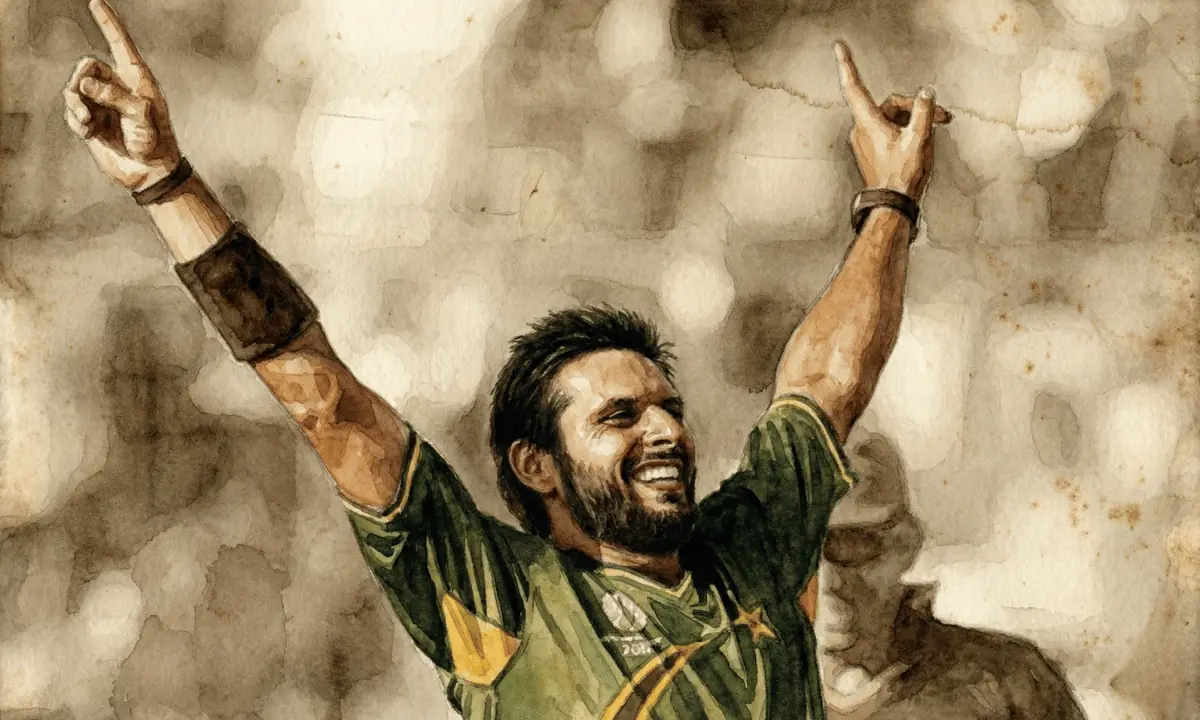
“In my mind, I had planned to celebrate the victory [in the final] in my signature style [both arms raised] while I was batting in the middle,” the former all-rounder told Dawn in an interview ahead of this year’s World Cup, in which he reminisced extensively about the Green-shirts’ magnificent triumph in 2009.
A pristine, self-nurtured confidence — which was sometimes self-destructive and seriously lacking logic — was Afridi’s instinct. But this incomparable speciality did wonders for him many more times, including in that final, where he top-scored with a 40-ball 54-not-out batting at number three, completing Pakistan’s chase in a penultimate over bowled by pacer Lasith Malinga.
“I could feel the trophy in my hands before the final,” quipped the 45-year-old. “I was very confident even before the semi-final [where his all-round excellence shone and he was awarded player-of-the-match], and had entered the field [to bat] with a positive mindset.
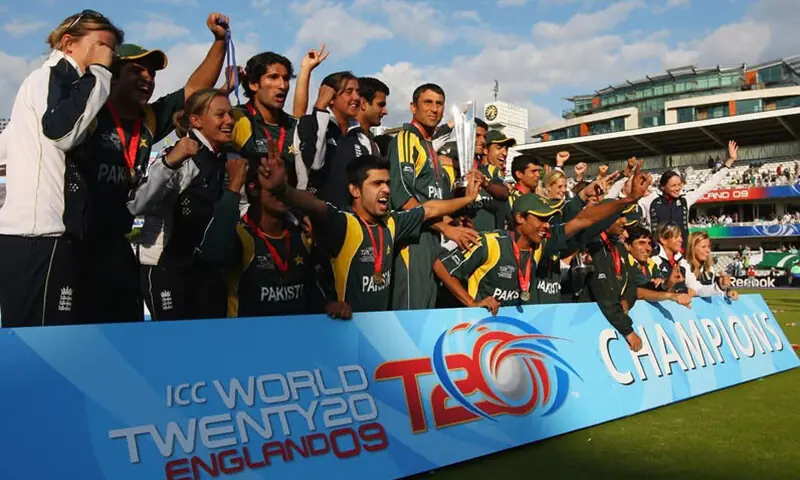
“You get opportunities to perform and win matches for your country in big games; if you stay confident, you definitely earn positive results.
“We had a decent start [of 48] with [opener] Kamran Akmal (37) contributing solidly. The target was not that big, but still, I batted sensibly, taking singles here and there, plus hitting occasional boundaries. In this way, Malik (24 not out) and I kept the scoreboard moving.”
Remarkably, heading into the tournament, Afridi hadn’t been Pakistan’s first choice at number three in the batting order. He was moved from six to three only in the group match against Ireland at The Oval; the decision proved a bonanza for Pakistan till the final.
“It was Younis’s decision who, after discussing the matter with me, told me to bat up the order,” reflected Afridi. “I also wanted the same, but there wasn’t any big hitter in our team down the order.
“That changed when Abdul Razzaq joined the squad later [to replace injured Yasir Arafat]. Younis’s timely decision to change my batting position worked for us.”
Bigger mission
That triumph remains Pakistan’s sole title at the event, and for the team, as Afridi recalls, there was no shortage of motivation as there were bigger things at play.
“Just a few months before the World Cup, the Sri Lankan cricket team members had endured that terrible terror attack in Lahore,” he remembered. “It was a horrific incident that dented Pakistan’s image badly and resulted in foreign teams refusing to come to play in our country.
“In that scenario, we, the players, under the captaincy of Younis, had decided that we would deliver our very best to win the World Cup so that international cricket could be brought back to our country.
“We did not have a good start [losing two out of the first three games]. However, later, some strong individual performances by all the players led to an outstanding victory. Under the able leadership of Younis, the team played like a dedicated unit which had one target: winning the title for Pakistan.”
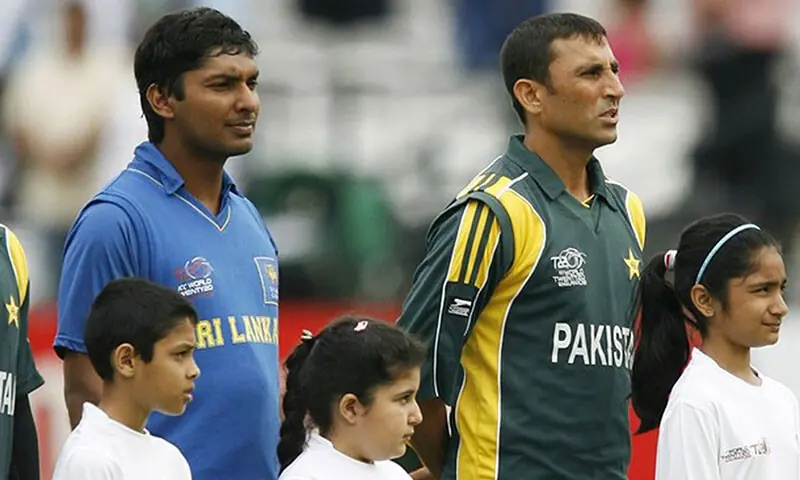
While belting fours was a regular attribute of his breathtaking batting, Afridi had all the rights of smashing ruthless sixes — regardless of the size of the ground, the bowler and the situation — reserved in his name.
The most astonishing aspect is that this striking ability did not diminish at any stage during an international career spanning over 20 years. And this very trait enabled Afridi to remain a fearsome opponent against all opponents.
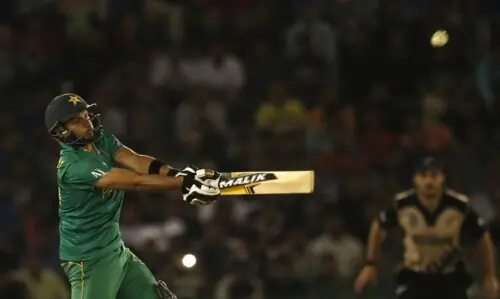
The right-hander cracked two towering sixes in the Lord’s final — one each against off-spin wizard Muttiah Muralitharan and paceman Isuru Udana, in the 14th and 18th overs, respectively.
On which one was more significant, he reckoned both were equally productive.
“Big shots were required on both occasions when I hit those sixes. So, both were equally important. I tried to be particularly aggressive against Muralitharan rather than just taking singles, or it would have become tough for us to complete the chase,” he recalled.
Compared to what turned out to be a lop-sided final, Pakistan’s semi-final clash against South Africa in Nottingham was a more intense affair, with Younis and his men getting over the line by just seven runs at Trent Bridge.
Primed for the big occasion, Afridi blazed with bat and ball. His 51 off just 34 balls, featuring eight bullet-like fours on a slowish track, was pure gold as Pakistan, electing to bat first, posted a decent 149-4.
Afridi sounded very Afridi on how he managed to bat briskly on a slow track where stroke-making was tough.
“There are different types of pitches in international cricket. If one thinks [too much] about the type and condition of the pitch, he remains double-minded. I had a clear stance that one has to play a T20 [innings] like this format demands; had I focused too much on [the] pitch condition, I would have slowed down,” he said.
“My prime strength has always been attacking cricket, and the team required a [fast] innings from the top order. Moreover, at that time, I had a strong belief in myself to perform because I had been given the chance up the order. I thought that I could win this semi-final for Pakistan. The mindset with which a batter enters the ground matters the most.”
Kallis spat
Recalling his brief verbal spat with none other than legendary Jacques Kallis as the latter bowled during the semi-final, the former Pakistan captain said that he had resolved to boss the fast bowler around.
“Kallis was a world-class player; I regard him as one of the best all-rounders in the game. Top players [like Kallis] have egos, and [therefore] at times they make mistakes also,” he said.
“Plus, he was bowling to the line and length of my liking. I took the advantage of the sluggish pitch and struck boundaries off his bowling with some belligerent strokeplay.”
Afridi’s job, though, was still half done. When South Africa came out to bat, the wily leg-spinner looked to mesmerise the opponents. With some skilful bowling, he got the important scalps of Herschelle Gibbs and AB de Villiers — cleaning up both of them — when the Proteas were cruising at 46-1 in the seventh over.
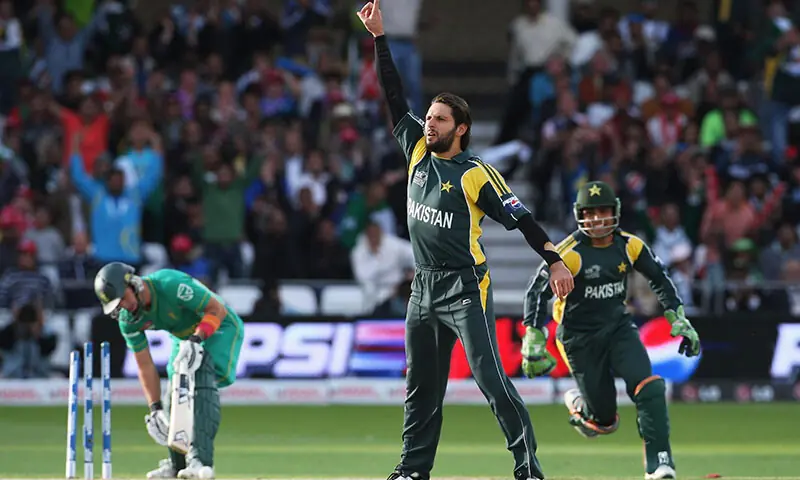
The double blow hurt South Africa hard, and they never got going after getting restricted to 50-3 in the ninth over.
“I have always had simple bowling plans during my career,” said Afridi. “I sought to get the process right, and to achieve this, I tried to ensure that my balls have pace, drift, and they remain wicket-to-wicket as much as possible, which increased the chances of the batter getting cleaned up or trapped in front.
“I also tried to avoid conceding boundaries to major batters who got frustrated when boundaries did not come easily. In the context of the semi-final, the wickets of de Villiers and Gibbs, who were in good form, were extremely important for us.”
To say that the sturdy all-rounder was equally potent as a bowler as he was bankable as a batter would not be an understatement. His tally of 11 wickets in the same T20 spectacle is a testament to this.
“Bowling always remained my top priority as I started playing cricket mainly as a bowler. However, as I began opening for Pakistan [back in the 1990s and beyond], it clicked, and my aggressive style of batting became more productive for Pakistan and prominent among fans; it became my strong point,” he elaborated.
“Moreover, while playing for Pakistan [early in the career], I rarely got the chance to bowl a full quota of overs; or you can say that my main focus was not bowling at that time. Therefore, my batting got highlighted more than bowling.
“However, later, when I realised that I wasn’t as consistent as a batter, I myself made bowling as my [primary] strength … and you can see my contribution as a bowler as after legendary bowlers Wasim Akram (502) and Waqar Younis (416), I have the third-highest number (395) of ODI wickets for Pakistan,” he noted.
“As far as the 2009 World Cup is concerned, my bowling performance remained quite impressive, while batting was my plus point as batting fast up the order was required by the team in this World Cup.”
Complete package
While the tournament brought glory to team Pakistan, it was a complete package for Afridi, who bedazzled fans with his fielding on many occasions in his career.
At the tournament, he had a moment in the field too: the jaw-dropping catch he took off Scott Styris — New Zealand’s top-scorer at The Oval — while running backwards towards long-on.
“Oh yes, that catch has remained memorable to date; its video clip is still shared across social media,” Afridi agreed. “Umar Gul bowled a great spell [taking a record five wickets for six runs in three overs] in that game, and it was an important wicket.
“During my career, I always tried to do something special with my fielding. I never took fielding as a burden; rather, I enjoyed every bit of it.”
From Nairobi to Kanpur, from Chennai to Sharjah, from Faisalabad to Toronto, from Lahore to Dambulla, Afridi left his mark at many venues around the world during a fluctuating yet lively career. But his all-round excellence at the 2009 World Cup will always be held in higher esteem.
It wasn’t just memorable — it was iconic. Afridi’s all-round display encapsulated his unique blend of aggression and guile. His match-winning contributions with bat, ball and in the field not only propelled Pakistan into the final but helped deliver the country’s sole T20 world title to date, etching his name among the tournament’s most celebrated performers.
Ibrahim Farooqi is a Karachi-based reporter for Dawn with over two decades of experience in mainstream media. He primarily covers sports, with a specific focus on cricket.