Pakistan’s middle-order problems laid bare in opening T20 win over Australia
Pakistan’s middle-order problems fail to go away and were laid bare by Australia’s second-string bowling attack, which included two debutants, in the first T20I on a sunny afternoon in Lahore on Thursday.
They hosts eventually posted 168-8, which was enough for a 22-run victory, but their middle order will need to step up in the next two matches — their last competitive fixtures before the Twenty20 World Cup.
Among the 12 full-member nations that play Test cricket, the combined average of Pakistan batters from numbers four to seven of 19.68 is the second-worst and their strike rate of 121.85 is the third-worst since the conclusion of the 2024 T20 World Cup.
Pakistan have named six specialist batters — including wicketkeepers Usman Khan and Khawaja Nafay — and all of them have made their careers by batting in top-three.
There is a notion in this Pakistan dressing room that batting orders in T20 cricket should be fluid. That’s how most of the successful T20 teams operate in leagues and even in international cricket nowadays. Such luxury, however, is only afforded to those who possess batters who have the ability to bat across different phases of an innings.
Pakistan made a bold call by slotting captain Salman Ali Agha, at number three, where his numbers have been phenomenal — a strike rate beyond 165 with an average of 35.40 before this match. Though Salman had looked to establish himself at number three when he was handed the reins of the side, he had to relinquish that spot after Babar Azam was recalled into the side following the Asia Cup.
Thursday was the first time that Salman came out to bat after the fall of the first wicket with Babar also in the line-up. And following his steady knock of 39 off 27 — which stabilised Pakistan after Sahibzada Farhan handed an easy return catch to Xavier Bartlett on the first ball of the innings — the management and selectors would be happy with Salman to continue at the position.
The purpose of this series, after all, is to nail their combinations, something the Pakistan captain alluded to in the pre-series press conference. And that Pakistan now has a reliable number three in Salman and, as such, locks their top-order ahead of the T20 World Cup will give relief to Pakistan.
Saim Ayub started his innings with a towering six off Bartlett and went on to make 40 off 22, in which he punished the Australian debutants Jack Edwards and Mahli Beardman when they erred in their lines. This was his highest score in the last nine T20I innings and was much needed after he had an underwhelming BPL.
Saim and Salman scored at 10 an over and Pakistan seemed on course to post a total in excess of 190 until both fell in a span of 10 balls to Adam Zampa. What followed was the familiar scoring rate woes for Pakistan with Babar and Fakhar Zaman — the two batters struggling for runs of late — at the crease together.
Pakistan scored at 9.44 by the end of the ninth over and their run-rate fell over the next overs to 9.20 in the 10th, 9.18 in the 11th, 9.16 in the 12th, and to 8.84 in the 13th.
Already under the weight of intense scrutiny, Babar, coming in the 10th over, largely struggled to time the ball. It took him 17 balls to go beyond the scoring rate of run-a-ball, which he did with a classy drive over mid-off’s head, but he soon fell trying to reverse sweep against Zampa after he had hit him for a six.
It has been a while since Fakhar has lived up to the expectations. The highest he had scored in the last three innings was five and he struggled to score runs in the ILT20, where he accumulated 260 runs in 12 innings, 69 of which came in a single innings.
With Nafay — a hard-hitting, but another top-order batter — warming the bench, the merits of batting Babar (24 off 20) and Fakhar (10 off 16) bat at number four and five have come under scrutiny. Nafay was brought into Pakistan’s T20I set up earlier in the month for his power-hitting abilities and he proved his selection right with a 15-ball 26 in a 12-over shootout in Dambulla.
Designated finishers Usman, Mohammad Nawaz, and Shadab Khan failed to provide their side the whirlwind closure to the innings as Pakistan managed only a six and a four in the 19th and 20th overs respectively as they could add only 31 more runs in the last five overs.
The total that Pakistan set in the end proved to be enough as Australia, missing Mitch Marsh, Josh Inglis, Tim David, and Glenn Maxwell, provided little resistance.
Pakistan spinner Abrar Ahmed, who took two wickets, indicated the presence of dew towards the end of the second innings.
In the next two matches and during the T20 World Cup, Pakistan will have to dew-proof their scores. And for that, their middle order would have to bat better.
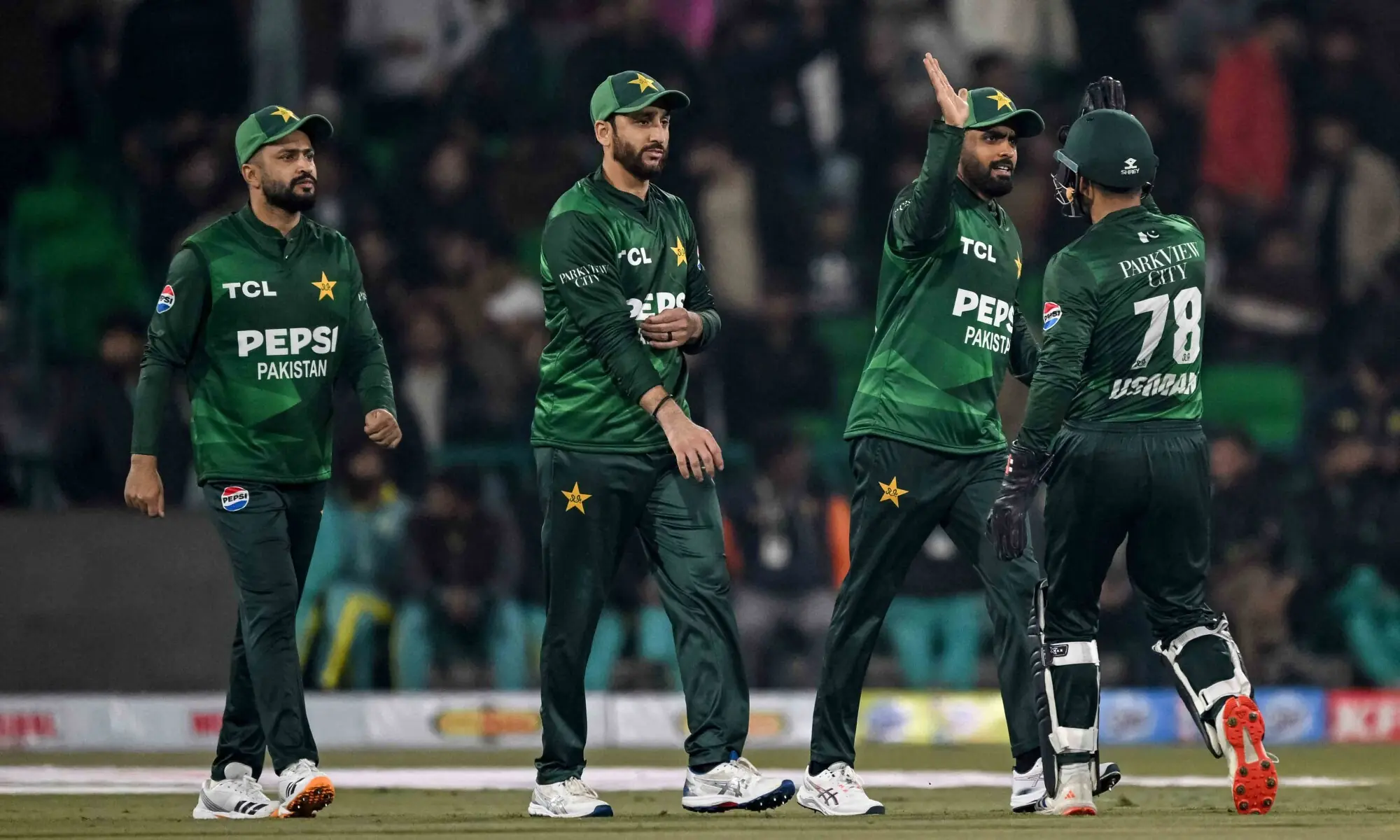
Header image: Pakistan’s players celebrate after the dismissal of Australia’s Cooper Connolly during the first Twenty20 international cricket match between Pakistan and Australia at the Gaddafi Stadium in Lahore on January 29. — AFP
A former Dawn.com staffer, Ahsan Iftikhar Nagi is a cricket writer. He has been published in Al Jazeera, BBC, Geo Digital and various international and local publications. He has worked as Pakistan correspondent for Cricbuzz. He is former senior media manager at the Pakistan Cricket Board and has worked with the Pakistan’s men’s and women’s international cricket teams as team media manager. Nagi can be reached over email (ahsannagi@gmail.com) or X: @ahsannagi.