Pakistan’s Babar problem — and why it’s not just about strike rate
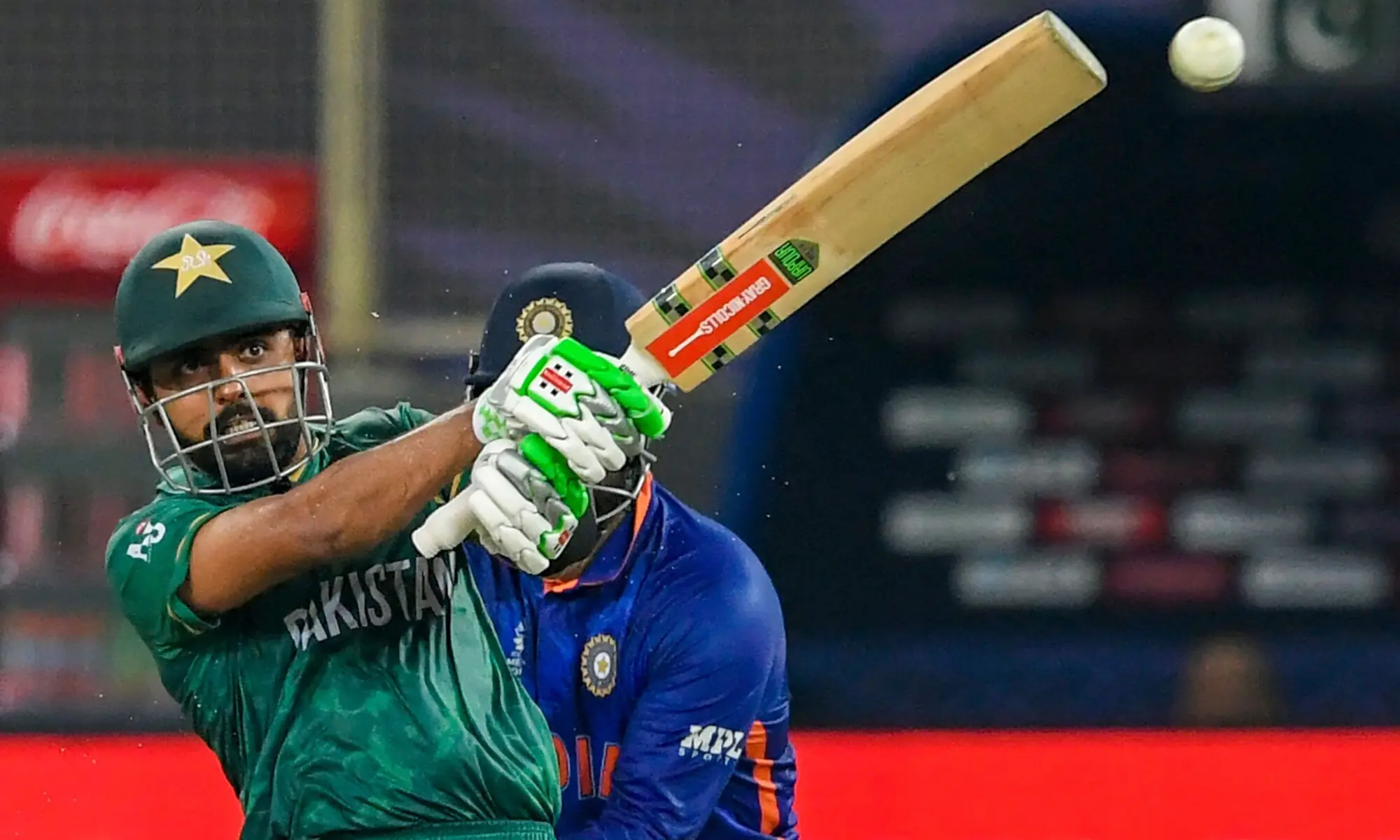
No batter has scored more runs than Babar Azam in T20 internationals (4,429). Nobody has crossed the 50-run mark more often than him (41 times) in the format’s 21-year history. His 466 fours are also the most that a batter has hit in the format. But his strike rate of 128.45 denies him the bragging rights to be the best batter to have ever played the format. It is the worst for the batters who have scored at least 3,500 runs in the format.
There had been doubts around Babar’s place in Pakistan’s side for next month’s T20 World Cup. The doubts arose when Pakistan decided against taking him to Dambulla for T20I series against Sri Lanka earlier in the month. Babar, like the rest in the side, had never played a T20I in Sri Lanka and this series — which was not part of the future tours programme — was only organised to provide Pakistan crucial match practice in the conditions they will encounter next month.
The uncertainty gathered momentum after Babar had a horrible season in Australia’s Big Bash League, scoring only 202 runs in 11 innings at a strike rate of 103.06. He hit only three sixes in the season and made 14 or less — including a duck in the last match — in eight games. (One match was abandoned after five overs because of rain).
Pakistan had axed Babar from the T20I setup altogether for the first half of 2025 as they sought more aggression at the top of the order. But he was recalled to the side after the Asia Cup. It might have been due to the realisation that his alternatives were not good enough to front the pressure of international cricket. In the Asia Cup, Pakistan’s top order (1-3) averaged 22.02 — only better than UAE, Afghanistan, and Hong Kong — and only the United Arab Emirates and Hong Kong scored at a slower rate than Pakistan’s 118.36.
Since his return, Babar has scored two 50s and registered three ducks in eight T20I matches. His half-centuries have come against a weak South African side in the chase of 140 in Lahore and against Zimbabwe in Rawalpindi. And, his scoring rate has been a meek 114.44 — falling 14.01 runs below his overall strike rate in the format.
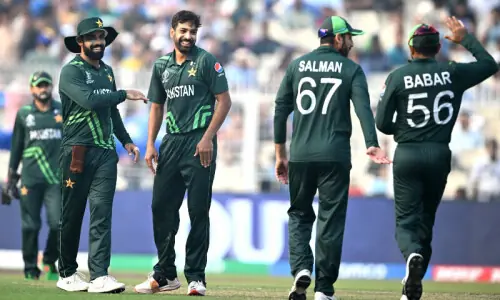
Flanked by captain Salman Ali Agha and head coach Mike Hesson, Aaqib Javed, one of the selectors, said the “specific” Sri Lankan conditions were the reason behind Babar’s selection for the T20 World Cup squad.
Salman was more emphatic in justifying Babar’s place in the side. “He has not done that poorly, how you and the people show,” he said. “He has won a player of the match award since his comeback. He scored a fifty against South Africa when the series was on the line and made 70-odd against Zimbabwe.
“He did not perform up to the mark in Big Bash but we are not going to encounter such conditions [as in Australia]. He has been performing well since his comeback for Pakistan and that is what matters to me,” he said.
But Babar’s return to the side raises a tactical concern for Pakistan and Salman.
His absence during the T20Is against Sri Lanka allowed Salman to move up the order and bat at number three, where he has initially looked to establish himself after being handed the reins of the T20I side. Salman batted at three in the first four T20Is in New Zealand after he was officially appointed as the captain and made 18 off 20, 46 off 28, 51 not out off 31, and 1 off 5. This was also the first series after Pakistan decided to do away with Babar and Mohammad Rizwan.
Ten months later, with Babar again not in the squad, Salman returned to number three in Dambulla and laid a claim to the position with a sensational 12-ball 45 in the 12-over shootout.
Salman — like Babar — has been considered too slow for this format, which was underscored by his strike rate of only 115.31 in 2025. But with what can certainly qualify to be the best knock that a Pakistan batter has played in the format in recent times, Salman somewhat dispelled that notion.
Both batters are bracketed as anchors because of their ability to hold an end as their teammates can score rapidly from the other. But, such batters can only bat at the top as teams have to stack power-hitters in the middle and lower orders to maximise boundary-hitting (read scoring) opportunities in the latter overs.
In modern-day T20s, teams have even started to slot aggressive batters at the top order. This allows them to maximise the powerplay and accumulate as many runs as possible when the ball is hard and the field restrictions are in place.
But, Pakistan have preferred to go with anchors at the top. Babar, who had been trusted with that role for most of Pakistan’s recent T20I history, has often ended up building more pressure on his partners because of his slower scoring rates and denied his side the opportunities to reach the full batting potential.
On the other hand, Salman, as a top-order batter, has demonstrated he can be an orthodox anchor and also the aggressor. He is at his best in T20Is when he bats at number three as his strike rate shoots up to 165.42, a massive surge from his overall scoring rate of 117.19. No other Pakistan batter – with at least 150 runs – has a better strike rate at number three. At this position, his batting average also goes up by 11.66 runs to 35.40 from his career’s 23.74.
Salman Ali Agha in T20Is | |||
Batting position | Three | Four | Five |
Runs | 177 | 430 | 100 |
Strike Rate | 165.42 | 108.04 | 102.04 |
With Pakistan playing all their T20 World Cup games in Sri Lanka where powerplay maximisation will be of utmost importance for batting sides as the pitches will be slow and low, Salman, based on his numbers, becomes a reliable number three for Pakistan. But, considering the past pattern, he may vacate that spot for Babar. With Salman’s scoring rate and average also taking a hit when he moves down the order, it essentially means that Pakistan will be playing two anchors in their top five with Babar back at three.
Babar Azam in T20Is | ||
Batting position | Opener | Three |
Runs | 2,973 | 1,372 |
Strike Rate | 130.56 | 125.64 |
Babar has a solid T20 record in Sri Lanka, something Salman, Hesson or Aaqib could have mentioned. In the 2023 edition of the Lanka Premier League, Babar made 261 runs — the second most in the season — at 132.48. His strike rate was only bettered by top-scorer Wanindu Hasaranga, who made 279 runs at a sizzling rate of 189.79. He was the sole centurion that season and hit the most fours (25). But all these runs were scored as an opener for Colombo strikers — who finished at the bottom of the five-team table. It is unlikely that Pakistan will tinker with the opening combination after giving a longer run to Sahibzada Farhan and Saim Ayub.
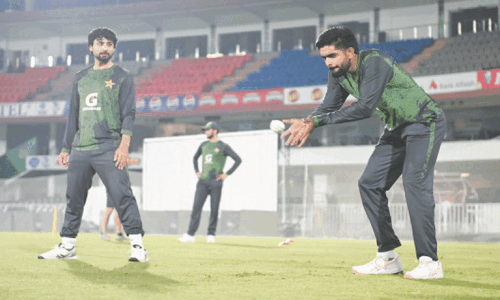
Babar made 78 off 45 — hitting six sixes and five fours — in an intra-squad practice match three days out of the first T20I. “There is criticism when you don’t do well for Pakistan,” Shadab Khan said of Babar after the practice match.
“The bigger the player, the more criticism. Babar is Pakistan’s biggest player and he has not done well recently. We focus on the results, but he has a process [behind the scenes], which I have seen. Once you have a good process, which he does, you start to get consistent results after one success.”
A repeat of such a performance later in the week against Australia will make selectors and fans more comfortable with Babar’s presence in the 15 for T20 World Cup.
A former Dawn.com staffer, Ahsan Iftikhar Nagi is a cricket writer. He has been published in Al Jazeera, BBC, Geo Digital and various international and local publications. He has worked as Pakistan correspondent for Cricbuzz. He is former senior media manager at the Pakistan Cricket Board and has worked with the Pakistan’s men’s and women’s international cricket teams as team media manager. Nagi can be reached over email (ahsannagi@gmail.com) or X: @ahsannagi.