Bangladesh standoff exposes ICC’s governance crisis ahead of T20 World Cup
WITH less than three weeks to go before the T20 World Cup starts, the cricketing world looks on as the sport’s global governing body deals with yet another crisis. The latest, too, involves India — the country from where the International Cricket Council’s chairman and the CEO come from — naturally as the co-hosts of the 20-team showpiece.
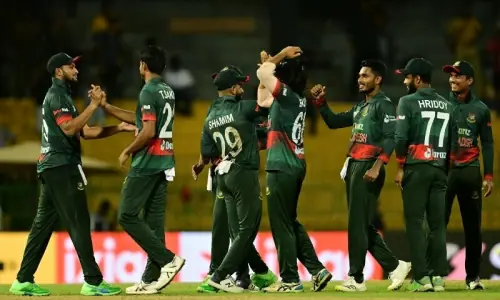
Bangladesh don’t want to play their matches in India and want them to be shifted to co-hosts Sri Lanka.
Things have come to this point after worsening political relations between the two countries over the last 12 months saw Bangladesh’s star pacer Mustafizur Rahman being withdrawn from Indian Premier League franchise Kolkata Knight Riders’ squad on the directives of the country’s cricket board.
The Board of Control for Cricket in India (BCCI) secretary Devajit Saikia cited “recent developments” as the reason for Mustafizur’s ouster. Bangladesh Cricket Board (BCB) responded strongly, deciding not to play in India with security having become a major concern.
While the BCB said on Wednesday that the “ICC has conveyed its willingness to work closely” with the board to resolve the issue, the latter itself has chosen to not comment on the issue with reports emerging on Monday that Chennai and Thirivananthapuram have been put forward as venue to host Bangladesh’s matches.
There also remains a possibility of Bangladesh not participating in the tournament.
The ICC, while trying to negotiate with the BCB, has not been able to show any kind of muscle as a governing body, especially against the host nation’s board for letting cricket be affected by politics.
This raises question marks over the ICC’s standing as a governing body in the face of India’s dominance via producing the major chunk of revenue that runs it.
The body is led by Bharatiya Janata Party leader and India’s Home Minister Amit Shah’s son Jay, while ICC CEO Sanjog Gupta is also Indian. As former ICC president and Pakistan Cricket Board chairman Ehsan Mani views it, “the BCCI follows the political agenda of the BJP”.
“The ICC should have a clear policy of not allowing member countries’ politics to interfere with the game,” he told Dawn last week.
Identifying the involvement of politics in the making of the decisions that run the sport as the most important concern, Mani claimed other strong cricket boards were not serious about taking it on.
“Unfortunately, ECB [England and Wales Cricket Board] and CA [Cricket Australia] together with BCCI are not prepared to address this and other serious governance issues and together they have prevented ICC from carrying out a governance review which I was pushing for as chairman of PCB,” he said. “The ICC board is terribly conflicted, with each director looking after his country’s interest before considering what is good for the game as a whole.
Mani said he expected the Bangladesh situation to be resolved through “a fudged solution, which will be engineered without addressing the governance failings of the ICC”.
Former West Indies Cricket Board (WICB) chairman Dave Cameron, who served in the ICC’s Finance and Commercial Affairs committee between 2013-19, echoed Mani’s views, saying that the ICC needed to switch from being “a group of members” to becoming a proper governing body.
“Part of the challenge is that the ICC is not a governing council but is rather made up of countries that sit together as a members’ group, and this is unfortunate,” Cameron told Dawn. “As a governing council, there are some requirements, it’s not being used in that way, which is the detriment at this point.”
PAKISTAN’S OPPORTUNITY
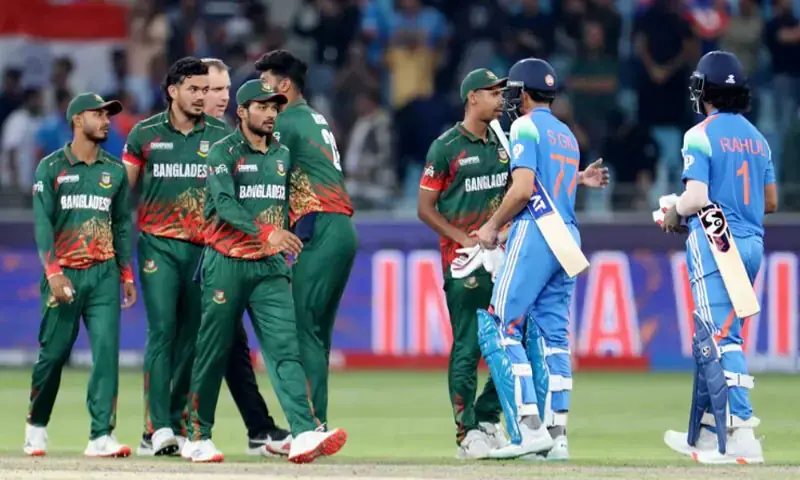
It is not the first time that security concerns triggered by political tensions between India and another country have come to put a tournament at risk. When India hosted the 50-over Cricket World Cup in 2023, the PCB was convinced days before the event to send the national team across the border. A stronger deadlock emerged ahead of last year’s Champions Trophy — of which the official hosts were Pakistan — with India refusing to return their neighbours’ 2023 gesture.
The ICC had to come up with a “hybrid model” to resolve the Champions Trophy matter and decided that Pakistan and India will play at neutral venues if the global tournament is being hosted by either of the two nations. That decision was hailed as Pakistan’s psychological win in the backdrop of the Indian financial and administrative muscle.
With the recent political shift in Bangladesh triggered by Sheikh Hasina’s ouster as the country’s prime minister and a consequential change of regime in the BCB, the PCB, led by Pakistan interior minister Mohsin Naqvi, has got closer to the latter.
Naqvi — also the Asian Cricket Council chief currently — and BCB president Aminul Islam were also reportedly at the forefront in making the 2025 Asia Cup happen amid calls for a boycott coming from India.
Former PCB chairman Najam Sethi, who himself has been in the midst of the Pakistan-India cricket issues during his previous tenure, the ongoing tensions are an opportunity for the PCB to form a pressure bloc within the ICC along with the BCB.
“Earlier, on any issue, Pakistan could not count on support from any ICC member if its stance differed from India’s, now it will have Bangladesh on its side,” Sethi told Dawn. “Their joint clout will be greater than the sum of their parts.”
The Pakistan cricket leadership seemed to have sensed the opportunity after Mustafizur was snubbed by the BCCI as it the PCB announced zealously days after the fast bowler’s registration for the Pakistan Super League’s players’ draft.
Social media feeds on Sunday, meanwhile, carried unconfirmed reports of the PCB offering to host Bangladesh’s T20 World Cup matches in Karachi, Lahore and Rawalpindi.
“PCB and BCB should scratch each other’s shoulders in their respective leagues to cobble a common front against the rest of the Boards,” Sethi said.
By Monday evening, BCCI secretary Saikia, as per reports, confirmed no communication was made by the ICC over a potential change of venues for the Bangladesh matches. Henceforth, as the clock ticked and the T20 World Cup neared, uncertainty prevailed and so did the ICC’s deafening silence.
Published in Dawn, January 13th, 2026
Mir Shabbar Ali is a sports reporter primarily covering cricket for Dawn. He tweets at @shabbar_mir