

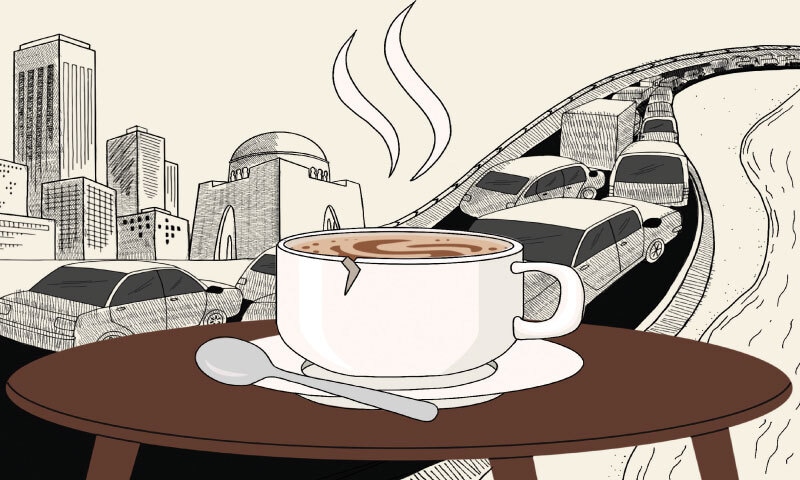
CHAI AND THE CITY
It is the smell of petrol and cardamom, of sea salt carried by lazy breezes and fried samosas from roadside stalls. It clings to your clothes, your memories, and your soul. And at the centre of it all, like a warm relief after a long day, is chai.
Chai in Karachi isn’t just a drink. It is a punctuation mark — a pause, a peace offering, a promise. It sizzles in old and dented kettles, dances into chipped cups and hushes even the loudest of evenings. It’s what binds lovers and labourers, students and saints, all on the same wooden tables and plastic chairs, their hands curled around cups, their hearts just a little lighter.
I’m Wahid, by the way. Chacha Wahid to most. The owner, server, listener and — on interesting and dramatic days — the therapist of this chai hotel. It’s not a fancy place. God forbid, some customers still ask for almond milk. But it’s honest. The chairs wobble, the fans rattle, and the tea is unapologetically karrak. Like me.
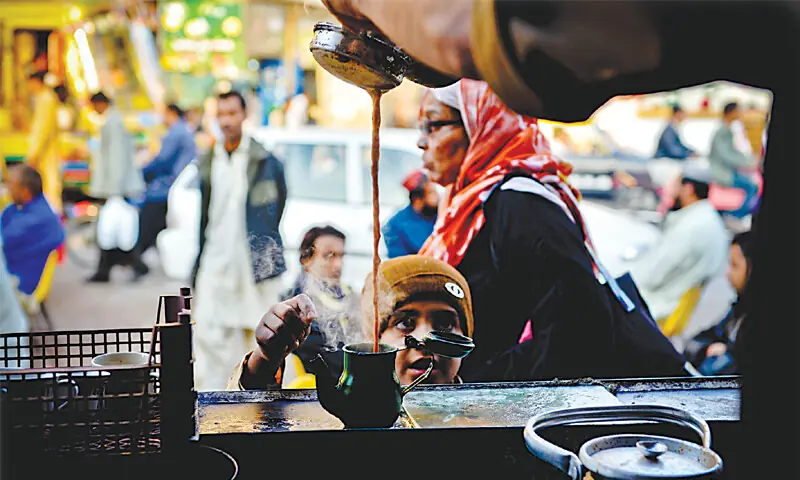
That’s the thing about this dhaba — it sits right at the edge of Boat Basin, where contradictions live side by side like old neighbours. Just a few feet away, there’s an upscale restaurant with valet parking and glass doors that seal in silence. Inside, menus are in English and the chai comes in porcelain cups. But here—on our side—plastic stools wobble, the table fans wheeze, and the chai is poured high and hot into chipped glasses that have seen generations.
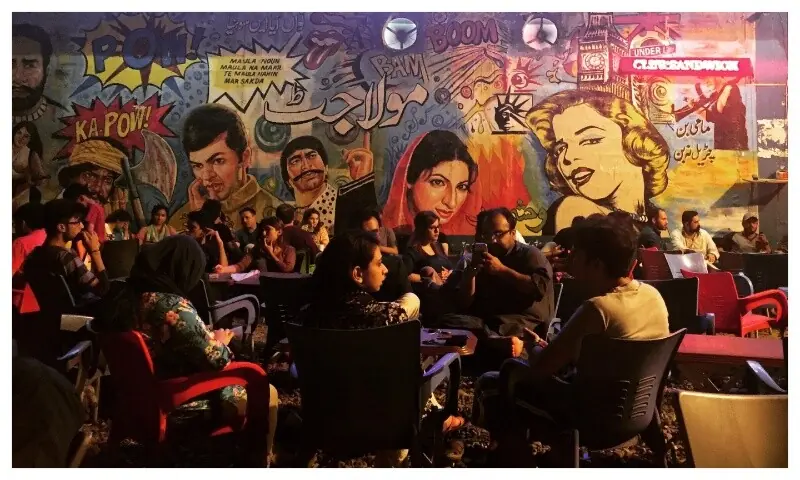
Because of that strange geography, everyone drifts through: CEOs loosening ties after late meetings, drivers parked outside in the heat, salon aunties in crisp Nia Mia lawn suits for an authentic “quick sip”, university kids splitting a paratha four ways, even confused foreigners trying to understand why this smells better than the five-star kitchen next door. Class doesn’t disappear here. But it softens. It simmers. Under the same roof of sky and smoke, everyone waits for chai from the same kettle. And for a moment, at least, the city breathes together.
The Zeenat Haroon Rashid Writing Prize for Women was set up in 2019 to promote and provide support for women who wish to pursue writing as a career.
The scrape of worn sandals on cement announces him before he even appears. Always at 4:07 pm, never a minute late. For some, time is money. For Professor Tufail, time is poetry. Precise. Weighted.
He’s all angles now — sharp elbows, hollow cheeks, a spine curved not by age, but by years of bending over books and blackboards. His kurta is perpetually creased at the collar, his glasses smudged at the edges, and his eyes — those eyes — float somewhere between now and 1968. He used to teach Urdu literature at a government college, when the walls still echoed with debates about Faiz and the dream of a softer, braver Pakistan. Now, he teaches no one.
He chooses the corner table every day, the one with the least sunlight. From there, he watches the world pass by, turning his cup of chai slowly, like it contains verses waiting to be read. I always serve him the same way: double karrak, no sugar. “Sweetness should come from the conversation,” he once told me with a smile that didn’t quite reach his eyes.
We talk sometimes. Sometimes he just sits in silence, listening to the familiar hum of the fan, the whistle of the kettle, the call to prayer floating through the Karachi dust. But when he does speak, it’s never casual. Each sentence is wrapped in metaphor, dipped in longing. His voice carries the patience of someone who once believed words could change the world.
One rainy evening, when the dhaba was near empty and even the pigeons had taken shelter, he looked at me and said, “Wahid, do you know what I miss the most?”
I shrugged. “Teaching?”
“No. Being heard.” He smiled faintly. “Back then, when I recited Faiz in class, the room would fall into a hush so thick, I could hear hearts beating.”
Every evening, this place becomes more than a chai hotel. It becomes a holding space for what people don’t say out loud. For broken men with loud laughs. For young women with fragile dreams. For workers too tired to scream. And for me, who somehow holds all these lives together with nothing more than tea and time.
He sipped his tea slowly, as though letting a line of poetry roll around in his mouth.
“I named my son Ameen. After Ameen Faheem. I thought the name would bless him with poetry, with grace. But he left. To Canada. Took a tech job. Married a woman who speaks in emails. Now when he calls, he asks about my health like it’s an obligation. He tells me to ‘stay hydrated’, never ‘stay inspired.’”

There was a pause. I didn’t interrupt.
“Last Eid, he sent me a tablet. A machine. Said I could read all the books I wanted. But how do I explain to him that I need pages? The smell of ink, the feel of margins where I can write my thoughts?”
He looked down at his cup.
“Did I love Faiz too loudly and my son too quietly?”
The question wasn’t meant for me. But it hung in the air like steam above a fresh pour.
I stepped forward, took his glasses, wiped them gently on my apron, and handed them back. “You love him still, Professor. That’s loud enough.”
He gave me a look — half gratitude, half grief. Then turned back to the window.
Since that day, I always serve him with a small piece of gurr [jaggery] on the side. He never asks for it, never eats it. But he sees it. And I think he knows what it means: some sweetness comes late. But it still comes.
Then there was the group of university friends — four of them, squeezed on to two benches like they belonged here more than anywhere else. Two girls, two boys, all final-university students, fresh with dreams and the electric energy of youth. They came in every Thursday afternoon, like it was a sacred ritual, lugging along a faded Ludo board and a bag of biscuits.
“Chacha Wahid, do your magic! Four chai, extra strong. And one with elaichi, Sana’s royalty today,” said Zain, the loudest of the lot, tossing his backpack towards the back. Sana rolled her eyes. “Chai with elaichi isn’t royalty — it’s class. Learn something, Zain.”
They laughed easily, the kind of laughter that softened the sharp edges of Karachi’s bustle. Their chai orders became a ritual: Zain wanted karrak and sweet, Sana preferred elaichi, Salik liked it with doodh pati strength, and Alia, ever undecided, would sip from everyone’s before committing to her own.
One afternoon, the laughter dimmed just slightly. Salik stared at his red token, unmoved for several turns. Finally, he said, “I got the acceptance letter. Germany. Master’s program.”
The dice paused mid-air. Silence settled between them.
Zain blinked. “You’re serious?” Salik gave a small nod, almost apologetic. “I didn’t want to jinx it.”
For a second, no one knew what to say. Alia glanced down at the board. Sana picked up her cup and set it back down.
“You better not forget us,” Sana finally said, her voice half a joke, half a dare. Salik smiled. “I couldn’t, even if I tried.”
“Just remember,” Zain said, wagging a finger dramatically, “your replacement has to laugh at my jokes.”
Alia laughed softly. “Impossible criteria.”
They played one more round. It was slower, quieter. They talked about travel, visas and thesis ideas. But also about which chai stall near Salik’s future university might even come close to Wahid Chacha’s. When the sun dipped and the dhaba filled with shadows and other voices, they packed up the board. Salik lingered a little longer, folding the game cloth slowly, as if each crease might store a memory.
“Next week?” he asked.
“Of course,” Zain replied. “Next week.”
But they all knew it might be different.
As they left, I watched them go — still young, still joking, but with something tender beneath their laughter. That soft ache of growing up, of outgrowing spaces you love, but returning anyway. For one more game. For one more cup.
Then there’s Fahad who arrives without a sound.
No loud greetings. No theatrical sighs. No scooting of benches or tapping of spoons. Just the soft hum of his motorbike dying at the edge of the sidewalk and the quiet shuffle of worn sneakers against concrete. He slips in like dusk — gradual, unnoticed, but certain.
He’s young — maybe twenty-two — but his back already bends like he’s carrying more than deliveries. The dull green of his rider uniform is always damp with Karachi’s moods — sometimes sweat, sometimes rain, sometimes both. A frayed backpack clings to him, heavy with someone else’s hunger. The only thing he ever carries for himself is stillness.
I noticed him first because of the way he drank chai.
Not rushed. Not distracted. But like he was drinking permission. Permission to pause. To exist. To be more than a green blur zigzagging through traffic. He sat on the far end of the bench, eyes on the cracks in the tiles, fingers wrapped around the warm glass like it was a lifeline.
He never ordered. I just started keeping a cup for him.
One day, during a sudden downpour, he arrived soaked to the bone. His fingers were trembling, his lips slightly blue. I handed him a cup of karrak chai with cardamom, the kind I reserve for days that need a little softness.
He took a long sip. Closed his eyes.
“They only notice us when we’re late,” he muttered, barely audible over the rain.
I didn’t say anything. Just waited.
“My friend — Raheel — he died last week. A car hit him near Baloch Colony. We were both supposed to be on that route, but I had a flat tyre. That’s the only reason I wasn’t with him.”
He looked at the cup. “His phone rang. His mother. Same ringtone as mine. I picked it up by mistake.”
He paused. “She thought it was him. She started scolding him for not calling. For not eating. For not sleeping enough.”
A shiver ran through his frame, and not just from the wet clothes.“I didn’t correct her. Not for five minutes. I let her talk. I answered in nods he would’ve given. Just for five minutes, I let her believe her son was alive.”
I wanted to say something. Anything. But all I managed was, “And then?”
“She started crying. Said she’d made his favourite daal. That he should come home. That she missed the sound of his bike outside the gate.”
He wiped his face — not sure if it was rain or tears.“I hung up. Then called her back. Told her everything.” His voice broke. “She didn’t cry the second time. She just… said thank you.” He didn’t speak after that. Just sat there, steam rising from his cup, mingling with the mist on his face.
I quietly refilled his glass. This time with extra cardamom and two spoons of sugar.
“Is this free?” he asked, hesitant.
“No,” I replied, “you’ve paid for it — with five minutes of being someone’s son.”
For a moment, he looked like he might cry. Instead, he nodded.
Fahad still comes by. Not every day. But often enough for me to notice. He never stays long. Just enough to finish his chai. But he always leaves behind the exact amount — even if it means counting coins.
Some people speak their grief. Others sip it slowly, between deliveries. And sometimes, the most invisible stories sit right in front of you — on a metal bench, wearing a rider’s helmet, holding a steaming cup of dignity.
And then, just yesterday, there was the couple. They entered like two sides of a coin flipped into the air — spinning, uncertain, but bound to land together.
I could tell the moment they stepped in — this was a rishta meeting. No aunties in sight, which was rare, but the signs were all there. The boy’s shirt was so well-pressed it probably hadn’t met a wrinkle in hours. His hair was gelled just enough to say, “I tried.” The girl had a sky-blue dupatta pinned so delicately around her head it felt like she was scared it might offend someone by slipping off. Their movements were rehearsed, polite, self-conscious. She looked around nervously, as if her reputation was hiding behind the tea glasses, ready to leap out and scold her.
They chose the bench near the corner window, under the faded fairy lights and the painted tile that says, “Chai peeyo, fikar bhulao [Drink tea and forget your worries].” Not too hidden — because that would be inappropriate — but not too exposed either.
I gave them a little time. No rush. When I finally approached, they both looked up like I’d caught them doing something scandalous. I asked, “Chai?” and the boy cleared his throat. “Yes, two. Medium sweet. Doodh patti?” he said, glancing at her for confirmation. She nodded, grateful for the small decision she didn’t have to make.
I made theirs with a hint of rosewater, just a few drops — perfect for people trying to say a hundred unsaid things. Back at their table, I could hear them speaking in the rhythm of rishta talk. Polite, indirect, full of sideways glances and questions loaded with family voices.
“So, what do you like to do in your free time?” he asked, voice gentle, unsure. She sipped slowly, buying time. “I read. I used to write. But mostly… I observe people.” She smiled. “I like chai places like this.”
He smiled back. “I like to cook. Not professionally. Just for stress.”
“Oh?” she raised an eyebrow. “What’s your signature dish?”
He looked sheepish. “My mom’s biryani. But I add cinnamon, she doesn’t know. Says it tastes ‘strangely nostalgic.’”
She laughed, then covered her mouth, surprised by the sound. The sound was real. Not polite. Not performative. He smiled wider. Something softened. A few beats passed in silence.
“My mother asked me to ask about your family,” he said. She nodded, “My father’s retired. My mother’s tired.” He chuckled. “That’s a better answer than I was expecting.” They both sipped. The rosewater in the tea seemed to open them just a little more.
“I don’t want to be someone’s project,” she said suddenly. He looked at her, surprised. “I mean — sometimes in marriage, women become… tasks. Things to fix, to manage, to mould.”
He nodded. “I don’t want to become my father.” She tilted her head. “What do you mean?”
“He barely speaks to my mother. Doesn’t ask her anything. They sit at dinner like strangers. I’m scared I’ll become that — mute, tired, indifferent.”
Their cups clinked as they both reached for the same sugar sachet. She let him take it. He poured only half.
They were leaning in now, literally and figuratively. Less formal. Less afraid.
“Tell me something honest,” she said. He thought for a moment. “I’m scared I’m too normal. Too average. That no one will ever feel lucky to love me.” She blinked, taken aback by his openness.
“Your turn,” he said.
She sighed. “I sometimes pretend to be more okay than I am. Even with my closest people. I’m scared if I show sadness too often, they’ll get tired of it.” He nodded as if he understood without needing to say it.
I brought their refills then. She thanked me with a smile that felt less hesitant now. He asked, “What’s the secret to a good cup?” I looked at him and then at her. She was watching me like my answer might apply to more than just tea.
“You can’t rush it,” I said. “If the leaves don’t boil long enough, you get flavoured milk. But if they burn, it turns bitter. You’ve got to watch it. Stir it gently. Add sweetness slowly. Chai, like people, takes time.”
She smiled. “Do you think the first try is ever perfect?”
I shook my head. “Beti, I didn’t make the best cup of chai on my first try. Not even close. Took years. Took mistakes. Sometimes even spilled a little.”
He looked at her, then back at me. “Worth the effort?”
“Always,” I said. “The best cups are never rushed. And never alone.”
They stayed a while longer. When they left, I saw them walking side by side — not holding hands, not quite sure yet — but with a rhythm that wasn’t rehearsed anymore. He opened the door for her. She stepped out with a real smile this time, her dupatta slightly off-centre, and she didn’t fix it. Two silhouettes stitched together by a maybe.
And sometimes, in this city of noise and nostalgia, a maybe is the most honest thing we have.
And then, there’s me. Chacha Wahid. I serve them all, yes, but I listen more than I speak. My stories live in the glances I exchange with my wife as she brings out fresh parathas. In the photos, I don’t show — the one of my daughter, the video of my grandson’s first steps. They’re with me always, tucked behind the counter, just like the mint leaves I keep for special guests.
Every evening, this place becomes more than a chai hotel. It becomes a holding space for what people don’t say out loud. For broken men with loud laughs. For young women with fragile dreams. For workers too tired to scream. And for me, who somehow holds all these lives together with nothing more than tea and time.
Outside, the Boat Basin traffic stutters, neon signs blink to life, and the city begins its nightly performance. But in here, the walls remember. They hold the murmur of unsaid things, the sound of spoons stirring courage into tea, the laughter that cuts through loneliness, and the pause before someone tells the truth for the first time.
And me — I wipe the counters, check the milk for the morning, and sit for a moment before closing.
This place wasn’t meant to be special. Just a spot for chai and shade. But, somewhere between the second cup and the stories people forget they’re telling, it became something else. Not a dhaba. A darwaza [door]. Between what people show and what they carry.
And as long as they keep coming — professors and poets, brides and bikers, artists and aunties — I’ll keep pouring.
One cup at a time.
The author is based in Karachi and works as a freelance marketing professional. She is also involved with Baydarii, a platform she co-founded to promote open conversations around women’s physical, mental and emotional health.
For more information on the ZHR Writing Prize for Women, please visit https://www.zhrwritingprize.com
Published in Dawn, EOS, November 23rd, 2025
Header illustration by Sarah Durrani