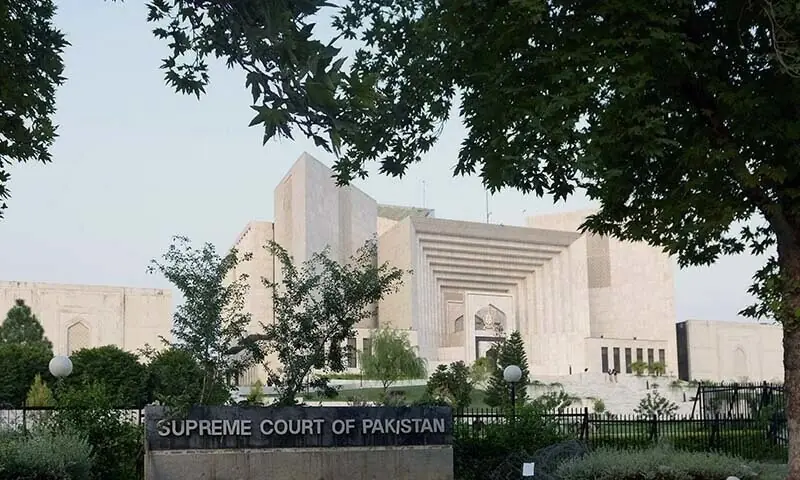
Situationer: A day of speculations in top court corridors
AS PARLIAMENT debated the historic 27th Constitutional Amendment on Monday, the corridors of the Supreme Court were charged with speculation and curiosity. From bar rooms to tearooms and even the canteen, lawyers and court officials found themselves gripped by the same set of burning questions:
Where will the proposed Federal Constitutional Court (FCC) be located? Who will lead it? And what will become of the mounting backlog of cases? Whether FCC will emerge as an independent constitutional authority and the Supreme Court will be transformed into a purely appellate body?
The 27th Amendment envisions a complete restructuring of the country’s legal framework.
Inside the Supreme Court, talk swirled around possible homes for the FCC once the amendment sails through both houses of parliament. Would the new court take over the premises of the Federal Shariat Court (FSC) across the road? Or perhaps find space inside the Supreme Court’s gleaming white facade?
Possible homes for Federal Constitutional Court among questions on everyone’s lips
The debate is particularly heated given the Supreme Court’s recent multimillion-rupee facelift. The building now boasts a modern facilitation centre for litigants and a refurbished main entrance equipped with state-of-the-art facilities — developments that raise questions about whether a new institution might soon inherit the revamped complex.
Dark horse?
Adding intrigue to the mix is speculation over who will head the FCC. Justice Aminuddin Khan, who currently leads the SC’s constitutional bench, is widely tipped to become its first chief justice. Yet, as one senior counsel remarked on condition of anonymity, “a dark horse candidate” could emerge to surprise many. “And if this happens,” he said, “FCC [as the existing SC’s constitutional bench] will continue to function inside the Supreme Court building.” After all, the FCC will become the “top court” in the constitutional hierarchy, he reasoned.
While many inside the legal fraternity see the FCC as a bold step forward, others question whether its creation addresses the pressing problem of the staggering backlog of nearly 60,000 cases pending before the Supreme Court.
Since the FCC’s jurisdiction will be confined to constitutional interpretation and advisory matters, some argue that shifting the Supreme Court’s premises — or even creating a separate court — may do little to ease the real burden on the system.
Interestingly, early drafts of the amendment had explored the idea of keeping the FCC within the current apex court building while relocating SC to the provincial branch registries as the supreme appellate forums to decide appeals coming out of the high courts.
This would have allowed appeals from the high courts to be heard closer to where they originate, reducing travel costs and easing the financial strain on litigants and lawyers alike. However, insiders claim that proposal was “abandoned”.
Any place across Pakistan?
The current draft of the 27th Amendment specifies under Article 175L that the FCC’s permanent seat will be in Islamabad, though it allows the court to convene elsewhere across the country with the approval of the President. Notably, it stops short of naming a specific building or location.
According to Article 175C, the first Chief Justice of the FCC will be appointed from among the sitting SC judges by the President on PM’s advice. And in consultation with the FCC CJ and on the premier’s advice, the President will also appoint the first batch of FCC judges. Article 175B provides that the court’s strength will be determined by Parliament, or until then, fixed by the President, “with equal representation from each province”.
Centre-provinces disputes
Under Article 175E, the FCC will have exclusive original jurisdiction in disputes between the federal and provincial governments. However, its powers will be limited to issuing declaratory judgments rather than enforcing decisions directly.
The 27th Amendment also proposes that all constitutional petitions, appeals, and review applications pending before the SC or its constitutional benches at the time the law takes effect will be automatically transferred to the FCC. The new court will inherit and decide all such cases. Moreover, the FCC will have the authority to call up any case from another court if it believes the matter involves a substantial constitutional question.
As Monday’s parliamentary debate raged on, the atmosphere at the Supreme Court reflected anticipation, uncertainty and reservations.
Published in Dawn, November 11th, 2025