GENDER AND THE FIGHT AGAINST ERASURE
The body is a human being’s first home and first identity. Now, imagine being born into a home that does not acknowledge your reality.
That is only a vague reflection of how the life of a transgender person begins. The term “transgender” has received much attention in recent years, yet it remains widely misunderstood.
Many conflicting definitions circulate around it. Some believe that only individuals born with ambiguous genitalia are truly transgender. Others connect the term with the traditional Khwaja Sira culture of the Subcontinent. Some even make harsh and unfounded claims that transgender persons are simply men or women cross-dressing to attract the opposite gender for physical relationships.
What is often overlooked is that behind every transgender person’s life experience lies a medical condition — that of gender dysphoria. It is a deeply misunderstood and rarely discussed condition, even among qualified medical practitioners. To understand it, imagine being forced to wear shoes that are too small for your feet. They hurt with every step, but you are told you must keep wearing them.
Now imagine that the pain is not just physical; you are judged, shamed and even abandoned by your family and friends for wanting to take them off. You are told that this discomfort is your duty, justified by culture, religion or tradition. Now take that feeling and apply it to your own body. Imagine that the thing causing you pain is not just a pair of shoes, but your own body not matching who you truly are. That is what a gender dysphoric person lives with every day.
In 2011, the Supreme Court of Pakistan took a significant step by recognising the rights and dignity of gender-diverse communities, offering long overdue visibility to those pushed to the margins. The judgment not only called for an end to invasive gender verification by medical boards, but also urged institutions such as the National Database and Registration Authority (Nadra) to abandon the dehumanising labels once suggested for transgender persons.
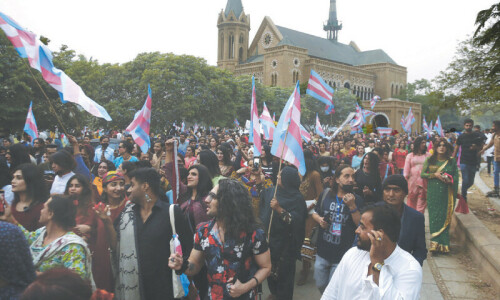
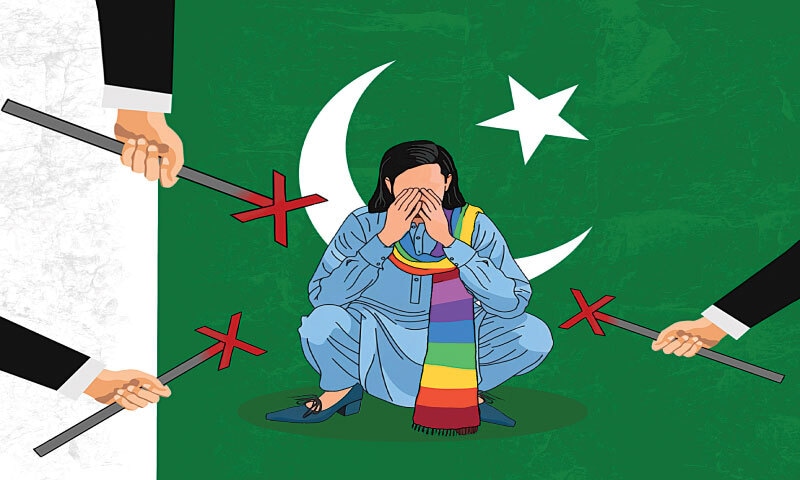
Pakistan’s transgender and Khwaja Sira communities are navigating a shifting legal landscape that alternates between recognition and rejection. An identity meant to affirm dignity has been reduced to a bureaucratic checkbox. Eos presents, with permission, an essay commissioned by the Human Rights of Commission of Pakistan (HRCP) that looks at the human cost of erasure, the cultural myths that sustain discrimination and the everyday resilience of gender minorities determined to be seen as they are…
As a result, Nadra eventually introduced a neutral ‘X’ marker through the Transgender Persons (Protection of Rights) Rules of 2020. However, this single-option marker stands in contradiction to the true spirit of the Transgender Persons (Protection of Rights) Act 2018, which upholds a person’s right to self-perceived identity, allowing them to be recognised as male, female or transgender.
For many, the ‘X’ marker feels alienating, as it erases specific identities and reinforces segregation rather than fostering inclusion. The early hope that followed these legal reforms was shaken by the 2023 Federal Shariat Court (FSC) ruling that struck down self-perceived identity as the basis for legal recognition.
By reinstating the requirement for medical and biological verification, the FSC ruling has placed transgender and Khwaja Sira individuals back under institutional scrutiny. This has not only created legal confusion for Nadra and other state bodies, but it has also reopened pathways for discrimination in education, employment and public life spaces.
FIGHTING FOR A PLACE
While the law continues to shift between progress and regression, the lived realities of transgender individuals unfold quietly in everyday moments, far from courtrooms and official directives.
In a quiet corner of a community office in Lahore, 30-year-old Khan adjusts the strap of his camera before heading to the gym. A passionate photographer and fitness enthusiast, Khan exudes the quiet confidence of a young man rooted in purpose. But beneath his steady demeanour lies a history few care to ask about — one shaped by being assigned female at birth and raised under the rigid control reserved for girls in patriarchal households.
“Transitioning was never just about changing how I looked,” he says. “It was about reclaiming who I always was, after years of being told not to speak loudly, not to sit a certain way, not to dream like a boy.” For many transgender men in Pakistan, such as Khan, life is a constant act of stitching visibility into a society that refuses to see them — a society that equates gender with genitalia and silence with safety.
While transgender men such as Khan struggle to be seen at all, Khwaja Sira persons, such as Faizi, are forced to fight even harder to be recognised on their own terms, especially when the system refuses to see beyond rigid gender binaries.
In the dusty district of Toba Tek Singh, where tradition often stands firmer than the law, Faizi sits at her desk in a crisp police uniform, fixing her dupatta with practised ease. Today, she is a victim support officer with the Punjab Police — a respected figure who offers support to survivors of abuse with the kind of empathy only lived pain can shape. But Faizi is more than her job title. She is a Khwaja Sira person who made legal history in Pakistan.
When her application for an Urdu lecturer post was rejected by the Punjab Public Service Commission (PPSC) in October 2020, on the grounds that she was neither male nor female, she did not retreat. She fought. Faizi took the matter to the Lahore High Court, filing a petition that challenged not just institutional discrimination but the broader erasure of third-gender persons from state systems.
On January 21 2021, the Lahore High Court stayed the entire lecturer recruitment process in response to her petition. Justice Faisal Zaman took notice. For the first time, in February 2021, the PPSC’s hiring processes were suspended as a human rights violation case unfolded in the courtroom. Lawyers argued on principles of dignity, equality and inclusion. Faizi stood her ground. And she won.
Since her victory, every PPSC job advertisement now includes a third gender category. It was a personal triumph as much as a milestone for the entire Khwaja Sira community, a segment of society so often celebrated in cultural folklore yet marginalised in civic life.
Today, Faizi represents the visible face of Pakistan’s third gender struggle. The Khwaja Sira community, more than any other gender minority group in the country, enjoys a relative degree of visibility and partial acceptance. Between 7,500-9,000 CNICs with the ‘X’ gender marker have been issued, primarily to Khwaja Sira individuals and a few transgender women.
But an ‘X’ on a card does not guarantee a livelihood. Despite the government’s repeated announcements to include Khwaja Siras in the public sector workforce, the vast majority still work within the development sector, especially in community-based organisations. Even these spaces, though more inclusive, are far from representative or stable.
THE KHWAJA SIRA EXPERIENCE
Khwaja Sira persons, such as transgender women, are mostly assigned male at birth, but later transition into a third gender identity. What sets them apart is their deep-rooted affiliation with a centuries-old subculture that predates colonial constructs of gender.
The Khwaja Sira tradition has its foundations in South Asia’s classical past, drawn from ancient Sanskrit texts and social roles that existed within royal courts and Sufi shrines. Unlike transgender women, who often identify within the binary gender, Khwaja Sira persons embrace a separate, traditional identity complete with its own rituals, guru-chela systems and codes of conduct.
But the visibility of this community has brought with it both opportunity and confusion. Pakistani society, which can barely accommodate non-binary ideas, continues to misunderstand who Khwaja Siras are.
Many believe they are born with intersex variations or ambiguous genitalia — a belief stemming more from myth than medical truth. Some Khwaja Sira elders perpetuate this narrative as a means of survival in a society that refuses to understand how someone assigned male at birth could reject masculinity. This misunderstanding bleeds into workplaces, where Khwaja Sira persons are mis-gendered, mocked, or quietly excluded — even by the media that celebrates their inclusion.
In reality, only a small fraction of Khwaja Sira persons work in formal organisations. The overwhelming majority are still bound to one of three professions — a system of labour shaped by appearance and societal prejudice.
If a Khwaja Sira person is not considered “aesthetically appealing”, she is likely to be seen begging at traffic signals or marketplaces. Those with striking features or refined dance skills often find employment at celebratory functions — especially in south Punjab, central Punjab and parts of Khyber Pakhtunkhwa — performing in secretive, high-paying gigs. The most conventionally attractive are often coerced into or voluntarily enter sex work, where they can earn in one night what government jobs pay in a month.
Despite efforts by the development sector and provincial governments to promote their inclusion, most Khwaja Sira individuals remain economically dependent on a system that pays more, asks fewer questions, and offers a twisted sense of dignity, even at the cost of safety.
Many serve as the silent backbone of their families, sending money for siblings’ schooling, parents’ medicine, or wedding dowries for sisters and, in a few cases, for daughters also, even if those families once rejected them. While they work, they are denied the right to love and partnership, as Pakistani law only permits marriage between a man and a woman, rendering third-gender persons outside the legal definition of companionship and care.
One of the most haunting yet overlooked socio-economic realities shaping Khawaja Sira lives is the concept of the Girya: a male romantic partner who, within Khwaja Sira culture, is often seen as a husband offering protection, financial support and a semblance of belonging. These relationships carry deep emotional weight and cultural significance. But outside this fragile Khwaja Sira circle, they are invisible. The state does not recognise this relation. There is no legal marriage, no formal commitment, only affection navigating through silence. And in that silence, danger thrives. Without recognition, there is no recourse.
Many men enter these relationships for sexual access, cloaked in promises of loyalty, only to abandon the Khwaja Sira partner, leaving behind emotional wreckage and renewed instability. Worse still, these Giryas — so-called protectors — often turn violent. Physical, emotional and financial abuse is common but no court acknowledges the crime because no law acknowledges the relationship. The state sees the Girya as a stranger. The Khwaja Sira sees him as family. And between those two truths lies a justice system that does not speak their language.
Faizi knows this betrayal intimately. Before she ever wore the crisp uniform of a police officer, she too lived in the shadow of such a love, where tenderness and terror blurred, and where the silence around her suffering was deafening. Her rise is not just a personal victory; it is a symbol of resistance from a community forced to live between symbolism and survival.
Faizi stands tall in the Punjab Police today — but how many others like her still wait, bruised by love, betrayed by silence, unseen by law and unrecognised by the nation that calls them its citizens?

THE STRUGGLE OF TRANSGENDERS
Khan shares the story of a fellow trans man — one whose journey lays bare the intersections of gender, family honour, and economic exclusion. Assigned female at birth and denied the chance to transition, this transgender man was forcibly married to a cis-gender man, subjected to years of marital rape, and bore two children before the marriage collapsed. Today, he lives with his children, having finally socially and medically transitioned. His children now call him “Abu”, fully accepting him as their father.
However, without a male CNIC reflecting his identity, he is unemployable in the formal sector. “He looks like a man, lives like a father but, in the eyes of the state, he is neither,” Khan explains. This bureaucratic erasure is compounded by social ignorance: workplace harassment, gendered ridicule, and relentless questions about bodies and “what is in your pants.”
Khan shared an experience of another fellow transgender man hired by a corporate company. Once his colleagues learned of his trans experience, he was no longer seen as himself — he became the “guy who was once a girl.”
While transgender men such as Khan’s friend are punished for asserting their identity, transgender women such as Wafa often survive by erasing theirs.
I met Wafa in her mother’s modest home in Islamabad, where she was visiting from the UAE. Over cups of tea and quiet pauses, she shared the story she rarely speaks aloud, the story behind the woman she has become, far from home. In the corridors of a sleek corporate building in the United Arab Emirates (UAE), Wafa sits behind a desk in the marketing department of a regional firm. With a degree in marketing and a talent for strategic campaigns, she is well-regarded by her colleagues, and known for her professionalism and creative edge.
She earns a stable income, supports her family in Pakistan, and manages her sibling’s education and parents’ medical expenses. But behind the polished presentations and confident smile lies a journey laced with sacrifice, isolation and one of the truths of being a transgender woman from Pakistan: to survive, one must hide who one really is — that’s the only survival tactic.
Assigned male at birth, Wafa has always identified as a woman. In the absence of community support, she relied entirely on her savings to undergo gender-affirming surgeries in Thailand. Every dirham she earned in the Gulf, she saved meticulously. “I wanted to come home as myself,” she says. “With dignity. With truth.”
Upon returning to Pakistan, she approached Nadra in 2023 to have her identity documents legally updated to reflect the woman she had always been. She was hopeful. After all, the Lahore High Court Rawalpindi bench had issued a historic ruling in 2011 allowing gender-affirming surgery and subsequent changes to identity documents to an applicant from Rawalpindi. Moreover, the Transgender Persons (Protection of Rights) Act, 2018 recognised a person’s right to self-identify. But what followed was an experience she describes as “more violent than surgery.”
Nadra referred her to Services Hospital Lahore for a medical examination. There, a urologist questioned her about her romantic life while examining her. But worse was still to come. The gynaecologist, who was also the head of department at the Services Institute of Medical Sciences, invited 40 medical students to examine Wafa’s surgically constructed genitalia, without her consent.
“I begged them to at least use gloves,” she recalled. “I just wanted some dignity.” Days later, she developed a vaginal infection. With her health deteriorating and her emotional well-being shattered, Wafa left the country once again — travelling back to the UAE, this time on the same male passport she had tried so hard to update.
Nadra had offered her an ‘X’ gender marker, but she refused. For transgender women such as Wafa, the ‘X’ category is not an option but an erasure. “If I take the ‘X’ marker,” she explains, “I can never return to the UAE. Gulf countries do not accept ‘X’ as a gender. I will not even be allowed to enter for Umrah or Hajj.” For many transgender persons and Khawaja Sira individuals, this exclusion is not just bureaucratic — it is spiritual. “Imagine wanting to pray in Mecca and being told your gender disqualifies you,” she says.

CHANGING SOCIETAL ATTITUDES
Wafa’s story reflects a critical shift in the transgender community in Pakistan. More and more transgender women are actively disassociating themselves from the traditional Khwaja Sira culture.
While some still take refuge in deras [homes owned by Khwaja Sira elders] and guru-led households for survival, many do not identify with the centuries-old customs and rituals. Their disassociation is not disrespect — it is about identity. Transgender women identify as women, not as a third gender. Their transition is often shaped by medical processes and gender-affirming treatment, and their struggle is to be recognised as female, not as “other.”
Despite similarities in lived discrimination, transgender women lack the community safety net that Khwaja Sira culture provides. Without a guru or a traditional support circle, many are left to face violence, homelessness and economic exclusion alone.
Wafa recalls that many transgender women apply for jobs under their legal male name, because changing it legally is nearly impossible without accepting the ‘X’ gender marker. But, at the workplace, they are ridiculed, questioned, or worse — sexually harassed. One woman interviewed during this research described being sexually propositioned during her job interview for a receptionist post, simply because her appearance did not match her official documents.
Family rejection is almost a certainty for transgender women in Pakistan. Many are pushed out of their homes the moment they begin to express who they truly are. With nowhere else to go, they often end up in Khwaja Sira deras, not out of choice but out of desperation. Some do not even identify with the traditional Khwaja Sira culture but are forced to adapt just to survive.
While working on this very piece, I met a transgender woman who had gone through full gender-affirming surgeries here in Pakistan. She was in love and wanted nothing more than to marry her partner and live a quiet life as a wife. She showed me her medical reports and kept asking for help to get her CNIC changed to female so she could marry legally. Her eyes were full of hope and fear at the same time. But there was nothing I could offer her. Nothing except to hold her hand as she cried, not because she doubted who she was, but because her country refused to see her the way she saw herself.
One of the most painful struggles transgender women face is mis-gendering. Wafa explains it best: “We work so hard to pass as women. We reshape our bodies, change our voices and live in fear of violence. But one wrong pronoun from a doctor, an officer, or even a friend, and it is like none of it ever mattered.” Mis-gendering is not a mistake — it is a rejection of truth. It reinforces the idea that gender is dictated by birth, not by identity, and invalidates the tremendous physical and emotional labour transgender women invest in becoming themselves.
What complicates the transgender woman’s struggle, which is already marred with complexities, is rejection by both the state and society. While Khwaja Sira persons are more culturally accepted — celebrated in media and recognised in rituals — transgender women remain misunderstood, seen by many as “Western imports” or as rejecting their biological role. But, in truth, they are simply asking to be seen for who they are. The law may offer them rights, but the practice of those rights in Nadra offices, hospitals or workplaces remains rooted in cruelty and ignorance.
Transgender women in Pakistan are fighting for inclusion and to be recognised as women. Until that simple truth is honoured, no policy, act or surgery will be enough to make them feel safe in their own country.
INCLUSIVE LAWS, EXCLUSIONARY SOCIETY
As he speaks, Khan’s voice shifts from exhaustion to quiet defiance. “I do not want an ‘X’ on my CNIC. I am not a third category. I am a man.” He laments the aftermath of the 2020 rules that hijacked the spirit of the Transgender Persons (Protection of Rights) Act, 2018, reducing the hard-won right of self-identification to a meaningless bureaucratic checkbox.
“No transgender man I know wants the ‘X’ marker. Why would we volunteer for a lifetime of stigma and scrutiny on every job form, at every airport, outside every Nadra office?” For Khan and many others, the fight is not just for recognition — it is for dignity, documentation, and the right to live without having to explain one’s existence at every turn. “People think we are opening a Pandora ’s Box,” Khan sighs. “But the truth is, we have been locked inside one our whole lives.”
These are not stories of the exotic or the extreme. They are the daily lived experiences of citizens who pay taxes, raise families, care for parents and seek dignity in Pakistan. They are photographers, marketers, survivors of abuse and seekers of love. Yet they face violence at police checkpoints, ridicule in waiting rooms, neglect in census forms and erasure from employment.
Pakistan may have progressive laws recognising the third gender on paper, but hearts, minds and systems have not caught up. Until schools teach respect, employers show compassion, and government officials practise empathy, gender minorities in this country will continue to survive, not live.
The burden does not rest solely on the transgender community — it rests squarely on the shoulders of our institutions, media, mosques, schools and each of us. The struggle for inclusion is about restoring what is rightfully theirs — their voice, their body, their future.
This piece was originally published as the report ‘‘X’ for exclusion? How Pakistan’s gender minorities are fighting against erasure’, by the Human Rights Commission of Pakistan (HRCP). It has been printed with permission
The author works at the HRCP
Published in Dawn, EOS, September 14th, 2025