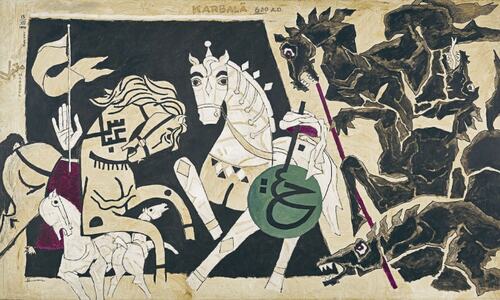
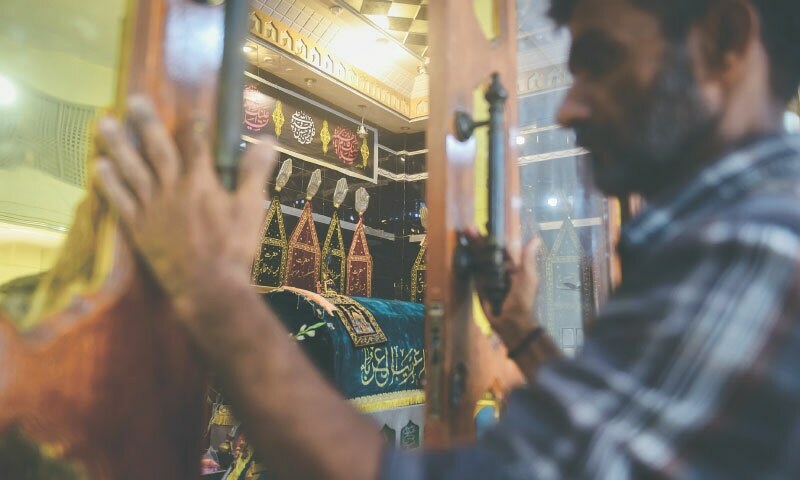
SOUNDSCAPES OF MUHARRAM
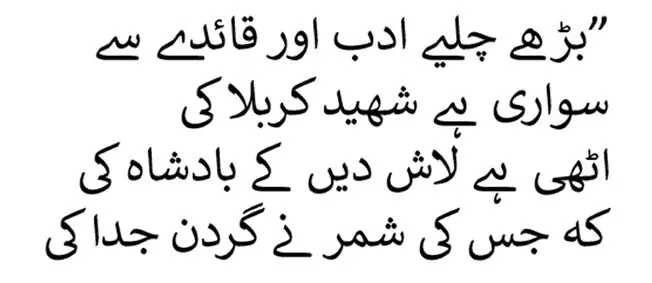
[Advance with utmost reverence and decorum,
For this is the procession of the Martyr of Karbala.
Lifted is the earthly remains of the King of
Faith, Whose [blessed neck] was severed by the blade of Shimr]
— The voice of the naqeeb [heralder]
in Muharram mourning processions
“Grief is the price we pay for love.”
— Queen Elizabeth II
From the dust of Pakistan’s independence in 1947 emerged a sonic revolution that would permanently rewrite Karachi’s spiritual DNA.
Rooted in classical Urdu, Arabic and Persian literary traditions, the noha — a profound elegiac lament commemorating the tragedy of Karbala and the martyrdom of Imam Husain (AS) — travelled across a fractured Subcontinent in the hearts of millions of families that migrated to Karachi. Over the last three-quarters of a century, this localised ritual of displacement morphed into a defining cultural powerhouse.
Driven by global shifts and technological eras, 12 trailblazing master orators of the noha [elegiac lament] arose, not merely as reciters, but as architectural anchors and boundary-breakers who fundamentally re-engineered the soundscape of devotion.
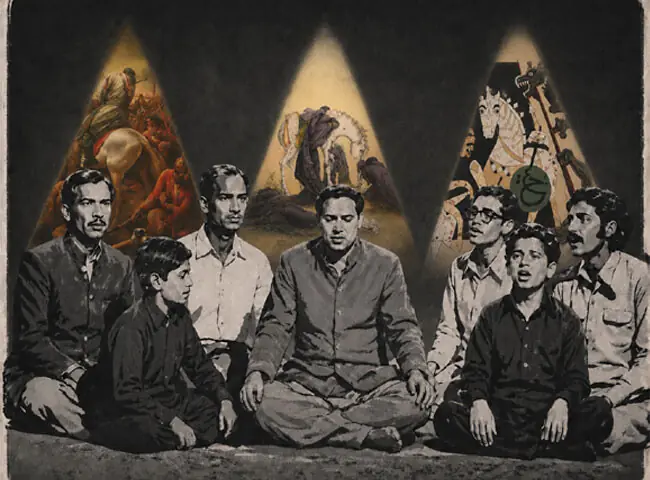
This is a tribute to those 12 legendary noha khwaans [noha reciters] who shaped Karachi’s Muharram.
Soul-stirring, heartbreaking, and melodically and poetically inventive, the noha occupies a central place in the Subcontinent’s Muharram mourning tradition. The masters of this form of elegiac lament found in Karachi a fertile ground to further increase the popularity of the noha in the post-Partition landscape…
THE LEGACY OF CHAJJAN SAHIB: SYNTHESIS AND SPIRITUAL RIGOUR
A monumental pillar of Pakistan’s cultural history, Chajjan Sahib (Ustad Sadiq Husain) was the foundational pioneer of organised Urdu noha khwaani [noha recitation] in Karachi. Born in Lucknow in 1905, his journey began at the age of 10, reciting during the historic Gomati River floods. After decades of devotion, he migrated to Karachi in 1950, transplanting his newly founded noha group, the Anjuman-i-Abidia Kazmia.
During Karachi’s inaugural Ashura (10th of Muharram) procession, his voice anchored the congregation, leading the mourning from Jahangir Park to the Husainia Iranian imambargah in Kharadar — establishing the enduring blueprint for the city’s spiritual landscape.
Even after his death in 1986, the enduring power of his artistic and spiritual legacy is preserved in several of his timeless and legendary compositions. His famous nohas, such as ‘Tumhare sajdon ko’, ‘Hasliyon walay merey ho chukay’, and the deeply evocative ‘Hum se mat poochho’, continue to serve as historic touchstones for devotees and cultural historians alike.
Chajjan Sahib’s recitation style was defined by a strict adherence to classical, old-school structures that prioritised immense literary weight, emotional devotion and extreme caution in delivery. Chajjan Sahib’s foundational work created a resilient framework that allowed subsequent generations of legends to bring innovation to the tradition.
IZZAT LAKHNAVI: THE SIGNIFIER OF MINIMALISM AND MAJESTY
Few figures command the reverence accorded to Agha Muhammad Izzat-uz-Zaman (1932–1981), universally celebrated as Izzat Lakhnavi. Born in Lucknow, India, he migrated to Pakistan in 1958, permanently transferring the pristine traditions of his homeland into the cultural fabric of post-Partition Karachi, where he established the Anjuman-i-Zafar-ul-Iman.
He would be clad in a traditional sherwani with a wristwatch on his right hand as he appeared on Pakistan Television Corporation (PTV) during the solemn days of Muharram — it defined his performance of Shahid Naqvi’s classic noha, ‘Ab aaye ho baba.’ Delivered with utmost seriousness, this iconic masterpiece remains Lakhnavi’s absolute magnum opus. This noha holds a monumental place in Pakistani media history, and is widely recognised as one of the very first nohas to be broadcast on air.
Lakhnavi’s other seminal noha is ‘Karbala aik aftab.’ Through a masterful command of vocal modulation, he utilised the ups-and-downs in pitch and pace to immerse the audience in the agonising pain endured by Imam Hussain’s loyal companions. His heart-wrenching recitation of the noha ‘Bano ne kaha’ captures the profound isolation of Imam Husain’s first wife Bibi Rubab as she calls out into the wilderness for her youngest child.
A master of elegiac minimalism, Lakhnavi’s pristine vocal purity and soul-touching voice helped him carve out an enduring legacy as a noha khwaan.
SYED AFAQ HUSSAIN RIZVI: THE STYLISTIC PIONEER
Whether it was blisteringly hot or bitingly cold on the streets outside Shah-i-Khurasan imambargah on Youm-i-Ashur, all weather-related agonies routinely dissipated the moment the voice of Syed Afaq Hussain Rizvi, the legendary Sahib-i-Bayaz [a master elegy reciter] of the Anjuman-i-Muhammadi Qadeem (an azadaari or mourning group), pierced the air.
His recitation of the iconic noha ‘Haye Karbala walon’, written by Najm Afandi, alleviated any physical exhaustion during Karachi’s historic Muharram procession.
He started noha khwaani during the early days of Pakistan and his passionate voice ruled the landscape of noha recitation for 50 years. He was the most sought out noha khwaan after Sachey Bhai (see below). His evocative recitations anchored the historic shab-bedari [night of mourning] processions, breathing life into compositions such as ‘Bey-watanon ka jo qafila aaya’, a classical lament that chronicles the heart-rending return of the surviving, displaced captives of Karbala back to their desolated homeland. His rendition of ‘Na lashkaray na sipaahay’, written by Sahir Faizabadi, highlights the agony and the loneliness of Imam Hussain at Karbala.
Rizvi shattered traditional stylistic boundaries and pioneered sophisticated vocal modulations and innovative rhythmic frameworks.
SACHEY BHAI: ACOUSTIC MAJESTY AND DEVOTION
Born in Azamgarh, India, in 1941 into the illustrious literary cradle of marsiya [elegy] poet and reciter Yawar Azmi, Syed Ali Muhammad Rizvi — immortally revered as Sachey Bhai — was destined to become the trendsetter of Karachi’s Muharram landscape.
In 1953, at just 12-years-old, he unleashed a voice of soaring pitch, emotional gravitas and profound mastery of rasai adab [elegiac literature]. His journey was deeply intertwined with the raw, acoustic textures of post-Partition Karachi. As documented in Prof Syed Imran Zafar Ali’s book Karachi Ki Azadari, it was the fierce cry of a local street-malang [derwish] chanting “Sahib-i-Zulfikar almaddad” [O’ possessor of the sword of Zulfikar, grant me aid] that sparked Sachey Bhai’s creative genius. He wove those very words into a verse and birthed his signature Anjuman-i-Zulfiqar-i-Haidery, thus carving a sanctuary for communal grief.
Through the searing heat of successive Ashura processions until the late 1980s, the sight of Sachey Bhai clad in a simple shalwar qameez became iconic. He commanded the sonic geography of Karachi, moving thousands to tears, both with the defiant ‘Ooncha rahay apna alam’ and ‘Museebat ki gharri’, or the classical, Arabic-infused masterworks ‘Ameer lashkar-i-Husain’ and ‘Taqqadam waladi’ — both penned by his revered mentor, Maulana Imdad Husain.
The art of noha khwaani remains inextricably bound to the monumental legacy of Sachey Bhai, who passed away in 2000 and who left behind the following prayer:
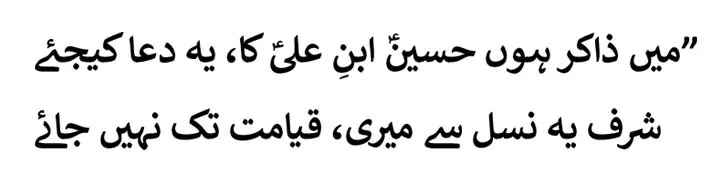
[I am a narrator of the tragedy of Husain Ibn Ali, pray for me, That this supreme honour never departs from my lineage, until the Day of Resurrection.]
JAFFAR HUSAIN: THE SILENCED VOICE THAT REFUSED TO STOP
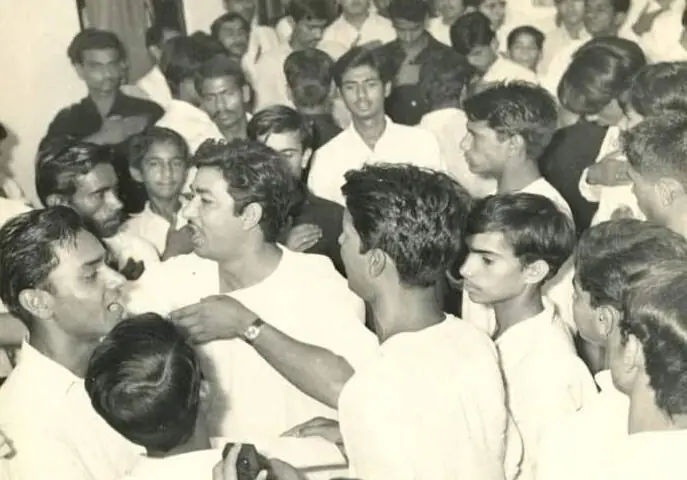
For veterans of the 1980s Ashura processions, the image remains indelible: a man clad in a pristine white kurta pajama, commanding the procession with his soulful recitations, his voice amplified by traditional mosque-style loudspeakers mounted on a simple, hand-driven cart.
The man was Ustad Jaffar Husain, affectionately known as Jaffar Dada. Leading the renowned Anjuman-i-Al Abbas, Jaffar Dada was widely recognised in Karachi as the third-largest crowd puller during the solemn Youm-i-Ashur processions, following closely in the footsteps of giants such as Sachey Bhai and Afaq Husain.
Jaffar Dada’s legacy is defined by his profound vocal delivery and three defining masterpieces. His recitation of ‘Ja ke keh do ke, darya pe hum aayein hain’ captures the unmatched courage of Imam Husain’s brother Hazrat Abbas with fierce, epic cadence. Conversely, ‘Shaheedon zindabad’, portrays the eternal victory of the martyrs of Karbala over tyranny and institutional oppression. His emotional depth peaks in ‘Ae Sakina, ab na baba aayein gey’, a heartbreaking lament that perfectly captures the profound grief of Imam Hussain’s youngest daughter.
His immense popularity and rising influence reportedly made him a target of professional jealousy, leading to a dark chapter, where he was allegedly poisoned. While the poison severely damaged and distorted his voice, it could not break his spiritual resolve. Defying the physical limitations of his damaged vocal cords, Jaffar Dada refused to stop reciting, continuing to read nohas with the same burning passion until his final days.
SYED NASIR JAHAN: THE VOICE OF NATIONAL HERITAGE
For decades, the airwaves of PTV and Radio Pakistan bore a signature resonance that became the definitive soundtrack of national religious broadcasting.
That voice belonged to Syed Nasir Jahan, a towering figure who elevated na’at khwaani [recitation of praise for the Prophet (PBUH)], salaam [tribute] and noha recitation into an institution of national heritage. His impact was so profound that, in his earlier days, his recitations on Radio Ceylon reportedly prompted people to purchase radio sets just to experience his unique style of recitation.
Blessed with a deeply soulful baritone, Jahan possessed an innate ability to express intense emotional depth with an unmatched sense of reverence that made him a permanent fixture of broadcasting during Muharram. His legendary rendering of ‘Ghabraye gi Zainab’ depicted the crushing loneliness of the Prophet Muhammad’s (PBUH) granddaughter in the ruined wilderness of Karbala.
‘Ae maarka-i-quwat-i-Islam ke jauhar’, a tribute to and the portrayal of the suffering of Imam Husain’s youngest son, Hazrat Ali Asghar, highlights Jahan’s mastery over melodic pace, weaving a rhythmic, melancholic rhythm.
Meanwhile, ‘La’chaar Hussaina’ is a classical lament that captures the profound isolation and absolute helplessness of Imam Hussain on the sands of Karbala. Jahan’s soulful voice formed a profound literary alliance with master poets such as Najm Afandi and Syed Aal-i-Raza, ensuring the theological purity and poetic metre of each text that he recited.
During the Muharram in 1990, adhering to a decades-long sacred tradition, as the dust settled on the grief-laden evening of Shaam-i-Ghariban [Night of the Bereaved], he recited his customary concluding salaam on PTV, sealing the night with the poignant verses:
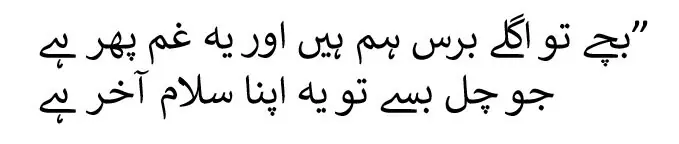
[If we survive, we shall return to this mourning next year, If we pass away, let this be our final Salaam]
Only weeks later, in December 1990, this towering icon of noha khwaani breathed his last, leaving the world of elegiac recitation for his permanent, eternal abode. What was meant to be a traditional recitation became his literal, immortal ‘Salaam-i-Aakhir’ [The Last Salaam], which continues to echo in the hearts of mourners to this day.
NAZIM HUSAIN: AN ANCHOR OF THE ELEGIAC TRADITION
Nazim Husain stood for over half-a-century as a monumental anchor of the tradition of noha recitation. His mastery is immortalised in his legendary recitation of ‘Shaam ka bazaar’, which portrays Imam Husain’s captive family’s march through Damascus.
Husain’s tempo makes the imagery of the exhausting drag of caravan chains seem visceral. His 1982 rendition of Mahshar Lakhnavi’s ‘Haye haye Ali Akbar’ captures the intense agony of Imam Husain’s wife Bibi Umme Laila weeping over the shattered youth of her 18-year-old son, Ali Akbar. His devastating delivery of ‘Aseer ho kay chali hoon salaam ae baba’ captures the heart-breaking farewell of Imam Husain’s daughter Bibi Sakina to her father as the caravan of the surviving holy women and children is forced to leave the burning plains of Karbala.
A staunch purist of poetic metre, Nazim Husain ensured that composition never compromised the sanctity of elegiac verse, steadfastly prioritising the weight of the subject and poetry over the rhythm itself.
SABIRA KAZMI: CHANTING THROUGH THE BURNING SANDS
Sabira Kazmi’s signature style is defined by an intimate, conversational pace that pictures a mother’s private lamentation.
Nowhere is this heartbreaking aesthetic more visible than in ‘Meray bachay ki aati hai mehndi.’ While recounting the tragedy of Imam Hasan’s son and Imam Husain’s nephew Hazrat Qasim — who was martyred in Karbala at the age of 13 — Kazmi balances a gentle, rhythmic lullaby tempo with a piercing sorrow, capturing the ultimate agony of a mother celebrating a wedding that transforms into a funeral.
Her vocal control shifts seamlessly into deep, communal despair in ‘Pukari laash pe’, capturing the agonising grief of the women of the Holy Prophet’s (PBUH) family over the unburied, shroud-less body of Imam Husain. This breathless, narrative-driven noha vividly describes the agonies of the holy women who stumbled on to the battlefield of Karbala.
‘Wawela sad wawela’ is a deeply moving and heartbreaking classical lament that wraps the soul in the raw, shattering grief of the Holy Prophet’s (PBUH) family, capturing their collective, agonising cry (wawela) over the martyrdom of Imam Husain and the profound sorrow borne by the surviving captives left behind.
Through these definitive renderings, Kazmi ensured that the historic legacy of female lamentation remained an indispensable pillar of Karachi’s religious fabric.
SYED ALI ZIA RIZVI: THE FORTRESS OF TRADITION
Syed Ali Zia Rizvi was a defining voice of Karachi’s Rizvia Society’s rich elegiac tradition. His popular noha ‘Kartay hain maatam haram Abbas ka’ stands as a monumental fortress of classical noha khwaani, as do his masterpieces ‘Aati hai gardoon se yeh paiham sada’ and ‘Asghar, haaye Asghar.’
Breaking from the era of a lead reciter supported by two back-up vocalists (bazoo), Rizvi pioneered solo noha khwaani, without any vocal assistance. Amid growing market pressures pushing peers toward commercialised grandeur, he remained celebrated for his signature simplicity. His classics include ‘Pamaal-i-sum-i-aspaan’ and ‘Abid kabhi tauq-i-zanjeer pe na roay.’
He utilised a piercing, mournful tenor that served almost as a foundational textbook for modern lamentation. As the founder of modern noha khwaani, Ali Zia Rizvi pioneered a school of recitation defined by a unique delivery style, deep vocal pathos (soz) and a vivid narrative portrayal of Karbala, all while strictly adhering to a disciplined, medium-sized Urdu poetic metre (behr).
SYED NASIR HUSAIN ZAIDI: UNMATCHED RANGE, UNDYING DEVOTION
Syed Nasir Husain Zaidi — affectionately referred to as Nasir Bhai — stood as the definitive anchor of the Anjuman Tanzeem-ul-Husaini.
Wielding a distinctive tenor that defied standard vocal constraints, Zaidi possessed an extraordinary acoustic range that could effortlessly command massive urban spaces, forever binding his congregations with the iconic noha ‘Abbas ka parcham hai, tanzeem Husaini hai.’
Born in Hyderabad, Sindh, in 1964, Zaidi migrated to Karachi in 1972, launching his sacred journey of recitation in 1976. Documented by Prof Imran Ali as the trusted right hand (bazoo) of the legendary Ali Zia Rizvi, Zaidi formally joined Tanzeem-ul-Husaini in 1981, etching his name into the city’s spiritual fabric.
Nowhere was his sonic power more legendary than under the sky at Mehfil-i-Shah-i-Khurasan. When he delivered the heart-wrenching verses of ‘Kisht-i-alaam mein Zainab ko bhala aaram kahaan’, his resonant voice would slice through the stillness. Zaidi’s dard-bhari [grief-laden] voice produced an immortal repertoire of devotion. His seminal works — including the heartbreaking ‘Na alam na chacha’ and the universally wept-over ‘Lo alamdaar, alamdaar chala’, defined an era of communal mourning.
After anchoring Karachi’s Muharram heartbeat for 45 years, this master of lament departed for his permanent abode in 2021, leaving behind a profound silence that still echoes through the streets of azadari.
NADEEM RAZA SARWAR: THE VOICE OF A GENERATION
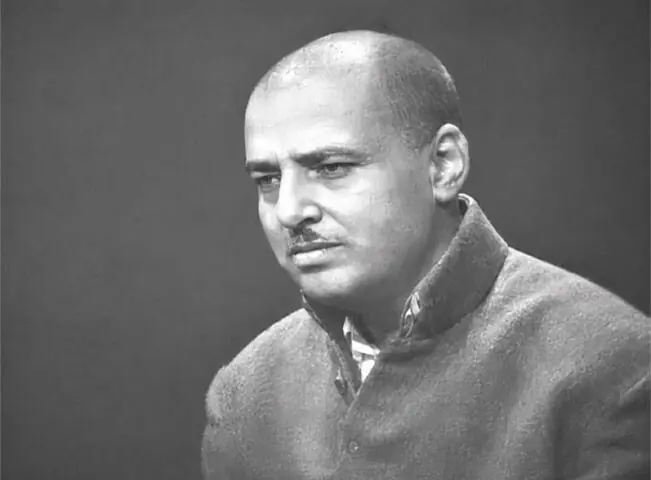
The unprecedented global stardom achieved by Nadeem Raza Sarwar of the Anjuman Gulzar-i-Haideri remains unmatched in the history of noha khwaani. It is no exaggeration to state that he has become the most luminous star in today’s noha khwaani firmament. From his very first volume of recordings, Sarwar announced a paradigm shift — moving away from traditional slow, measured chanting toward a faster, deeply evocative and narratively dramatic delivery.
In 1986, his masterpiece ‘Ae Shion jab peena pani’, which beautifully incorporated Arabic phrasing alongside Urdu, captured the imagination of the younger generation. By 1987, his popularity had soared to such heights that tracks such as ‘Tamam aalam mein aaj maatam’, ‘Achhi nahin yeh baat’ and, later, ‘Darya hai hamara’ were memorised verbatim by men, women and children alike, irrespective of sect.
By integrating Arabic and Persian into his nohas, Sarwar globalised the genre, making it accessible to international audiences. The 1980s and 1990s were the golden age of Karachi’s famous W-11 buses, which would blast Sarwar’s nohas across the city’s streets throughout the mourning season, transcending sectarian lines, as his voice resonated in every neighbourhood.
ALI SAFDAR RIZVI: THE VANGUARD OF RESISTANCE
The voice of Ali Safdar Rizvi of the Dasta-i-Imamia emerged as a powerful shift, fusing traditional lamentation with a fierce, definitive ideological consciousness.
Heavily inspired by the structural compositions and rhythmic cadences of the contemporary Iranian noha, Rizvi engineered a revolutionary school of recitation that captured the imagination of a younger generation of devotees. His signature style stands at the intersection of spiritual grief and socio-political awakening, transforming the historical tragedy of Karbala into an active, timeless resistance against oppression.
Rizvi’s vocal delivery is characterised by a high-energy, anthem-like gravitas that completely redefined congregational dynamics in the city’s central processions. His legacy is upheld by his monumental, battle-centric recitations, including the iconic identity anthem ‘Husain, Husain sha’ar-i-ma’, alongside the deeply evocative ‘Aishiqaan-i-Mehdi ko Karbala bulati hai’ and ‘Zainab pareshan ast’, solidifying his role as the vanguard of Pakistan’s contemporary elegiac movement.
A WORD ABOUT THE NOHA AND ITS WORDSMITHS
The rich literary tradition of noha khwaani has been meticulously shaped by distinct generations of extraordinary poets. Pakistan’s Muharram landscape was thoroughly enriched by a distinguished cadre of exceptional wordsmiths, including Gohar Jarchavi, Anees Paharsari, Syed Aal-i-Raza, Najm Afandi, Mujahid Lakhnavi and Urooj Bijnori.
The academic and structural depth of this poetic genre is further elevated by the contemporary brilliance of scholars such as Dr Hilal Naqvi. While classical figures such as Sahir Faizabadi, Maulana Imdad Husain and Yawar Azmi maintained a traditionalist approach to the pulpit, Dr Rehan Azmi carved out a distinct contemporary path, cementing a unique and unparalleled legacy that continues to bridge historical tragedy with modern poetic sensibilities.
Based on three immutable pillars — masaaib [the tragedy], fazaail [the virtues] and tableegh [the message] — the noha, through the agency of the noha khwaan, is not merely a passive piece of literature and instead serves as an active producer of place.
The walking bodies of the mourners physically trace an alternative map of the city. The route itself becomes a sacred geography, marked by traditional stopping points (gali [lane], choraha [square]) that are recognised year after year, building a permanent layer of religious and historical meaning over the grid of the city.
Moreover, seamlessly archived and globally amplified, the contemporary noha has broken free from localised boundaries, transforming into a high-powered, multimedia vehicle for identity affirmation. This ritualistic heraldry serves as the acoustic foundation for an urban transformation, where grief and pain cease to be a private affliction and becomes a structured, collective remapping of the city.
The writer wishes to acknowledge Syed Muhammad
Ali Kazmi, Shakil Jafri, Syed Ali Akbar Naqvi,
and Naqvi’s colleagues Asad Agha and
Qaiser Husain for their invaluable assistance
in gathering information for this article
The writer is a peripatetic urbanite and can be
reached at mansooraza@gmail.com
Published in Dawn, EOS, June 21st, 2026
The author is a PhD scholar, peripatetic, Karachi-based academic and board member of the Urban Resource Centre (URC), Karachi. He can be reached at mansooraza@gmail.com