WHAT’S THE US-ISRAELI ENDGAME IN IRAN?
“I do the wrong and first begin to brawl.
The secret mischiefs that I set abroach
I lay unto the grievous charge of others…
And thus I clothe my naked villainy
With odd old ends stol’n forth of Holy Writ,
And seem a saint when most I play the devil.”
— Richard III (Act 1, Scene 3) by William Shakespeare
THE HOOK
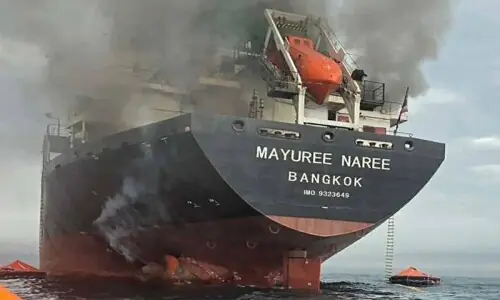
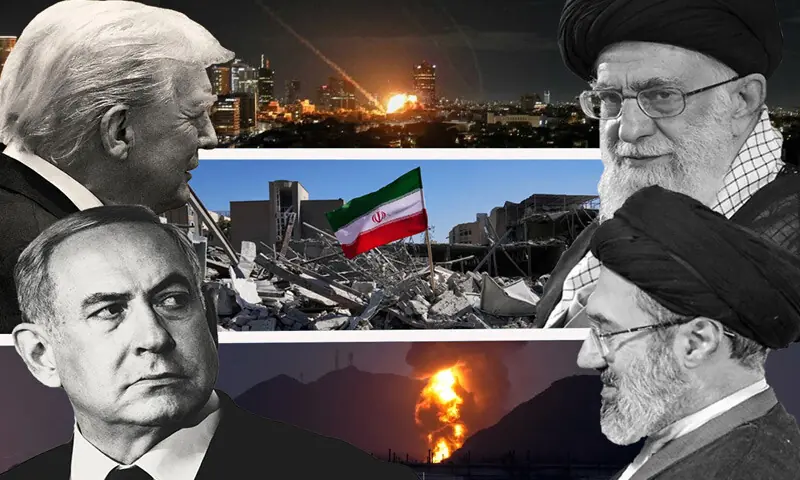
The US-Israeli war of aggression against Iran is the biggest story across the world. It is being reported by the minute and hour. Given the latency between writing this article and its publication, I cannot and do not intend to follow the news cycle.
Instead, the purpose here is to (a) dissect the conflict’s opening phase by examining its war aims; (b) briefly discuss its illegality, a central issue that has been pushed to the back-burner; (c) the dynamics of the US-Israeli alliance; (d) Iran’s strategic response and how it could be reshaping the region; (e) the efficacy of air power in light of classical strategic theory; and, finally, the likely scenarios, albeit given the fluidity and the complexity of the situation such a venture is akin to sticking one’s neck out.
Let’s begin with using the device of the inverted pyramid and state some facts.
FACT 1: This war is as sickeningly deceitful as the one Israel launched on June 13, 2025. Then as now, the United States was negotiating with Iran. Then as now, the war was imposed on Iran just days before the next round of talks was to take place. Then as now, to quote William Shakespeare again, the devil is citing Scripture for his purpose.
FACT 2: This flows from the above: negotiations were a ruse. In fact, as was broadly and consistently noted by multiple analysts, the talks were designed to fail. The fact that a war was being planned and deliberated has been established by multiple reports and analyses, notably by a detailed story in The New York Times dated March 3, 2026 and titled How Trump Decided to Go to War with Iran. Benjamin Netanyahu began lobbying for war in December last year, when he went to Mar-a-Lago. The central objective was to decapitate Iran’s civil and military leadership. Then, during a February 11, 2026 meeting at the White House, Netanyahu “discussed the prospects of war and even possible dates for an attack.”
From this point onwards, despite the ongoing negotiations, Trump began expressing his scepticism about talks and even determined, in answer to a question, that it “seems like [regime change] would be the best thing that could happen.”
FACT 3: The Gulf states and also Turkiye were trying to prevent the war but appear to have been supportive of the expansive agenda. War is problematic but it’s a good moment to force Tehran into conceding more than just nuclear-related demands. In other words, these Muslim states, traditionally wary of Iran, and some like the United Arab Emirates and Bahrain working in collusion with the Zionist entity, did not want a war but definitely wanted the US to defang Iran. They have got the war. In the end, the Zionist duo did not even bother to inform them of the timing of the attack.
FACT 4: Since Iran’s regime is being constantly referred to as a theocracy that must be uprooted, it’s important to flag the point about the Biblical references emanating from the US and Israel. The initial name of the operation, Shield of Judah, was Biblical, later rebranded by the US as Operation Epic Fury and Israel as Operation Rising Lion.
The US-Israeli war against Iran reveals a deeper strategic puzzle amid shifting American objectives, Israel’s consistent pursuit of regime collapse and an Iranian strategy built on horizontal escalation. As air power collides with geopolitical reality, the only certainty is that this conflict will permanently scar the Middle East. How did we get here and what happens next?
US Secretary of Defence Pete Hegseth, during a press briefing, referred to “Biblical wisdom”, and Netanyahu again invoked the massacre of Amalek, a persistent enemy of the Israelites described in the Hebrew Bible and Old Testament, to describe the war on Iran.
Then, on March 5, 2026, Christian leaders held an Oval Office prayer for Trump, featuring strong evangelical overtones, including laying hands on him, invoking Jesus’ name, and calling for wisdom and protection. The US ambassador to Israel, Mike Huckabee believes Jewish right to Palestine is rooted in a Biblical deed. Examples abound, going back to the founders of the Zionist entity who stole the Palestinian land.
We can now proceed to what this war is about and whether Trump’s and Netanyahu’s objectives are the same.
TRUMP’S WAR AIMS MIGHT BE SHIFTING, NETANYAHU’S ARE CONSISTENT
Much is being made of Trump’s shifting, even contradictory, war objectives. I won’t go into the details of his flip-flops because, by now, they have been identified and discussed to death. What is important, though, is to appreciate how Trump’s vast inner vacuousness, which informs his narcissism, has allowed Netanyahu to play him.
Democrat Senator Chris Von Hollen told the media that Netanyahu had been trying to drag the US into a war with Iran for the past four decades and has “finally found a [US] president stupid enough to do his bidding.”
My own assessment, given the evidence, is that Trump decided to replicate his Venezuela moment. This is borne out by his various statements, especially those related to regime change and his cretinously naive assertion after the assassination of Iran’s supreme leader that he (Trump) must have a role in choosing Iran’s next leader.
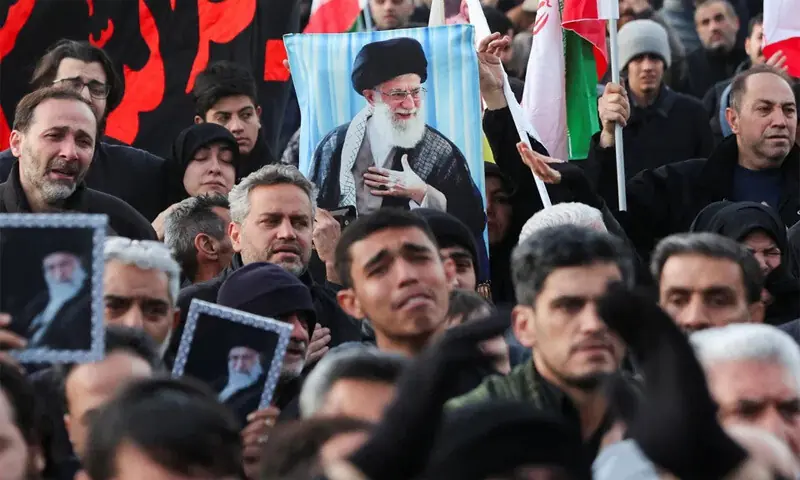
While the decapitation strikes were conducted by Israel, it is safe to assume that the US was privy to the decapitation strategy. Oozing hubris, Trump did not even pause to think why Ayatollah Ali Khamenei had decided to stay overground in his compound and not hide in a bunker — ie why was he prepared for martyrdom, given that it is now evident that Iran’s strategists were prepared for decapitation as Israel’s gambit.
Had Trump focused on this, he would have realised that Iran is not Venezuela. Now, as identified by an increasing number of analysts, civilian and military, in the US and elsewhere, Plan A having failed, Trump doesn’t have a Plan B.
The shifting timeline for the operation further underscores ambiguity. Trump has projected the conflict to last “four to five weeks” but has also conceded it could go on “as long as it takes.”
This equivocacy, as noted by Jon Alterman of the Washington DC-based Centre for Strategic and International Studies, suggests that the Trump administration may not be “committed to any particular outcome”, leaving the objectives open-ended. Doing so also means it becomes harder for Trump to declare victory down the road, unless he can spin it, which it seems to me is the only course open to him now.
And pray, what is Netanyahu’s objective? It is very clear: state collapse through regime collapse. Netanyahu’s rhetoric began in 1992 when he warned the Knesset that Iran was “three to five years” from a nuclear bomb, a prediction he repeated in his 1995 book. In 2002, he advocated for the invasion of Iraq before a US congressional committee, linking it to the Iranian threat. His warnings became iconic in 2012, when he brandished a cartoon bomb at the UN General Assembly, drawing a red line to illustrate his claim that Iran was close to developing a nuclear weapons capability.
Netanyahu has consistently clashed with US presidents over Iran, most notably publicly opposing Barack Obama’s 2015 nuclear deal. He viewed the agreement as insufficient and a threat to Israel’s security. He has also been consistent in framing the Iranian threat in stark, historical terms.
In his address justifying the 2025 strikes, he evoked the Holocaust, stating that “Nearly a century ago, facing the Nazis, a generation of leaders failed to act in time… Never again is now today.” This framing portrays any compromise as appeasement and the destruction of Iran as a moral imperative.
What is important to note, however, is the fact that while being about Iran, it is also about a bigger Zionist agenda: over the past two years, Netanyahu has repeatedly stated that Israel is “changing the face of the Middle East” and pursuing a “systematic plan” to alter the region’s strategic reality. Eliminating Iran’s nuclear programme and ensuring Israel’s unchallenged military superiority is a central feature of this vision that rests on the concept of Eretz Yisrael [Greater Israel]. And that vision did not begin with Netanyahu; it began with Zionism itself and its early leaders.
Put another way, the war is going perfectly for Israel. It has got US support and it believes it has the opportunity to sow chaos in Iran. Netanyahu’s only fear is that domestic pressure on Trump might trump his plan. That, by most evidence, has begun happening.
Given that, he would want the US to continue for as long as possible, giving Israel the space to repeatedly strike Iran and, ideally, to also have the time to provoke Kurdish and Baloch insurgencies in that country.
DOMESTIC AND INTERNATIONAL DIMENSIONS
Beyond the strategic confusion, the military action has drawn sharp condemnation for its apparent violation of both international and US domestic law.
The International Commission of Jurists (ICJ) and a group of UN human rights experts have both issued strong statements condemning the US and Israeli attacks. The core argument is simple. The use of force against a sovereign state is only lawful in two circumstances: in self-defence against an armed attack, or when authorised by the UN Security Council. Neither condition was met. The call for regime change is also a direct assault on the principle of political independence enshrined in the UN Charter.
The legal case is further strengthened by reports of significant civilian casualties, including the bombing of a girls’ school in Minab, which has reportedly killed over 160 schoolgirls. Iran has claimed that the US-Israeli strikes have targeted civilian infrastructure, including hospitals, energy infrastructure and desalination plants. Evidence gathered by independent sources supports Iran’s claims.
For its part, Israel says it is applying the Dahiya Doctrine, an Israeli military strategy of asymmetric warfare that advocates the use of massive, disproportionate force against an enemy, deliberately targeting civilian infrastructure to create long-term deterrence. It is eponymous with the Dahiya locality in southern Beirut, considered a Hezbollah stronghold and which has been repeatedly bombed by Israel.
The UN Secretary General and other states have also condemned Iran’s retaliatory strikes in the Gulf, though experts maintain that any action taken in self-defence, which is what Iran is doing, is justified on the condition that it is proportionate and necessary. We will come to this a little later.
On the domestic front, Trump’s decision to push the US into a war violated the constitutional provision — War Powers Resolution — which requires the president to notify Congress and, within 60 days, to seek authorisation for the use of military force or withdraw troops.
While Trump did formally notify Congress, he provided no timeline for the operation, essentially asking for a blank cheque. On March 5, 2026, the House of Representatives narrowly rejected a War Powers Resolution (219-212) that would have required congressional authorisation for further military action. The US Senate similarly defeated measures to rein in the president’s powers, along party lines. That might have given Trump the space for now but the split in his Maga [Make America Great Again] base is a cause for concern, as is the rising cost of war for the US and its allies.
IRAN’S COUNTER-STRATEGY: THE LOGIC OF HORIZONTAL ESCALATION
A central tenet of war is to not fight it on the enemy’s terms. Confronted by the vastly superior conventional militaries of Israel and the US, Iran has responded with a calculated strategy of horizontal escalation. This approach aims to broaden the conflict’s geographic and economic scope, turning the very strength of its adversaries into a potential liability.
To this end, it is (a) attacking US bases across the region; (b) targeting critical infrastructure and shipping in the Gulf; and (c) fraying the coalition.
Iran has launched missile and drone strikes at US military installations in Qatar (Al Udeid), Kuwait (Ali Al Salem), the UAE (Al Dhafra) and Bahrain (US Fifth Fleet HQ). The goal is to inflict casualties and demonstrate to the US and its allies that no US asset in the region is safe.
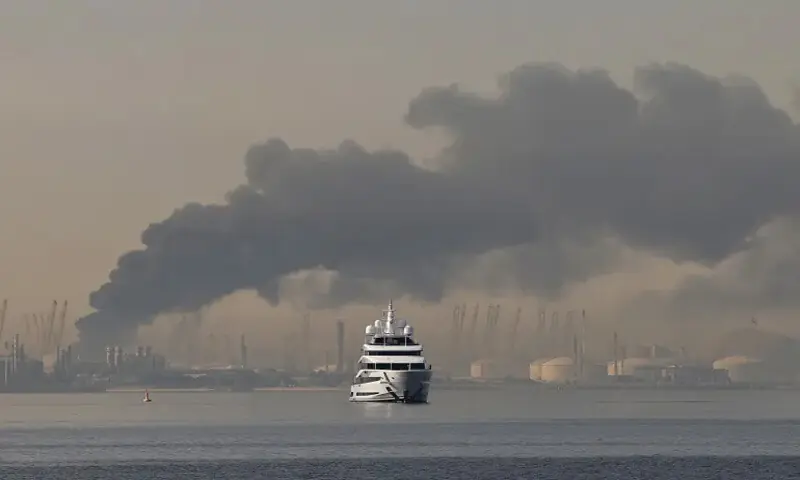
By threatening commercial shipping and energy facilities in the Gulf, Iran aims to spook global oil markets. Spiking crude oil prices and creating inflationary pressures — the government in Pakistan, for instance, has already decided to jack up prices — can turn the international community against the conflict, potentially prompting US allies to call for de-escalation.
The strategy involves salvos with a mix of legacy and new-generation missiles and slow- and low-flying direct attack munitions, to strain stocks of US and Israeli critical munitions (interceptors for ballistic/cruise missiles defences) and push world powers to demand the war cease before spiralling out of control.
Even small attacks on the territories of Gulf states undermines their carefully cultivated image of stability, imperative for investment and infrastructure development. Besides, by getting the US to focus more on defending its own and Israeli assets, it erodes their trust in the US security umbrella. Further, all the Gulf states, but most notably the UAE and Saudi Arabia, are aggressively attracting investment in digital technology and artificial intelligence, as well as tourism. That needs peace. Suddenly, there’s a great deficit of that.
Iran’s calculation is to pressure these governments into distancing themselves from the US campaign. The sweet irony is that the Gulf states had entered into bilateral Defence Cooperation Agreements with the US to offset any threat from Iran and to acquire the latest military equipment (systems and platforms). Iran’s strikes show that these bases, far from guaranteeing security, have helped drag these states into a war of aggression launched by the US and Israel.
Even the neoconservative Jewish Institute for National Security of America (Jinsa) has conceded in one of its recent reports that Iran has “prepared for precisely this kind of conflict, reflecting its ability to adapt between and amid exchanges of fire with the United States and Israel. It pre-dispersed authorities and locations of its launchers after Israel devastated its over-centralised command and control last June.”
Two sub-headings are important here before we proceed.
THE EFFICACY OF AIR POWER: A TEST OF THEORY
The current conflict provides a real-world laboratory for testing the theories of strategic thinkers like Mark Clodfelter, Colin Gray and Robert Pape. Their works serve as a powerful lens through which to assess the likely effectiveness of the US-Israeli air campaign. Professor Pape’s view is already known through his recent writings and interviews so I will focus on the other two.
Clodfelter, another American scholar, in his seminal work The Limits of Air Power, argued that the effectiveness of air power is entirely dependent on its ability to achieve specific political objectives within a given conflict’s unique context. He distinguished between positive objectives (what you want to achieve) and negative objectives (what you must avoid, like widening the war). The failure of Operation Rolling Thunder in Vietnam, he posited, was due to the vast gap between its immense positive goals (nation-building) and its many self-imposed restraints.
Applying this framework to the current war is revealing. The initial US-Israeli strikes were a stunning tactical success, decapitating key leadership and degrading Iran’s air defences. However, in the US case, the strategic confusion over war aims (identified above) is precisely the kind of politico-military disconnect Clodfelter warned against.
Is the positive objective a limited one (degrading missiles and strategic infrastructure) or an unlimited one (regime change)? If the US cannot clearly define what winning looks like, Clodfelter would argue that even the most impressive application of air power will ultimately prove strategically futile.
Gray, arguably the doyen of British strategists, consistently argued against the “fallacy of air power as an inherently strategic weapon.” His work emphasised that air power’s value is not inherent but is derived from the strategic effects it produces within a specific context.
In his monograph Understanding Airpower: Bonfire of the Fallacies, one of the three books he penned on the subject, he dismantled the notion that air power can be decisive on its own, independent of a coherent strategy. The idea that bombing alone can break an enemy’s will (a fallacy he identifies) is precisely what is being tested now.
Iran’s strategy of horizontal escalation is a direct counter to the idea of a quick, decisive air campaign. By broadening the war, Iran is forcing the US to confront the limits of air power, proving Gray’s point that the control of territory and people — a function of land power — is often the ultimate arbiter in conflict. The US and Israel can dominate the skies, but if they cannot stop Iran from firing missiles from mobile launchers or from using its allies, that demonstrates the relevance of Gray’s argument that “context rules.”
So, how is Iran countering this?
DISPERSAL AND DELEGATION: IRAN’S OPERATIONAL ADAPTATION
Facing an unrelenting air campaign, Iran’s military has had to adapt to survive. Initial reports, as also statements by Iran’s foreign minister, indicate that Tehran learnt critical lessons from previous encounters with Israel.
After the 12-day war in 2025, the Islamic Revolutionary Guard Corps (IRGC) recognised the vulnerability of its centralised command and control system. In preparation for this conflict, knowing that US and Israel will begin with decapitation strikes, it dispersed its offensive forces and delegated authority to the field commanders. It has also created succession redundancies.
This means a cat-and-mouse game in the skies over Iran. For their part, the US and Israel have shifted tactics, using slow surveillance aircraft to loiter over known ‘missile city’ complexes. According to reports in the US media, strikes are triggered only when activity is detected, targeting launchers as they emerge from their hardened bunkers.
For Iran, the central and crucial task is to ensure survival of its offensive capability: missiles and launchers as also attack drones. This is the ledge on which this war is perched now. The US (not Israel) wants to settle this quickly; Iran needs to drag it out. Israel is on a clock. Much as it wants this to continue, it also knows that once Trump wants it to be over, Israel will have no option but to stand down.
ROAD AHEAD: THREE LIKELY SCENARIOS
Predicting the future in such a volatile environment is fraught with risk, but by synthesising the analysis above, three primary scenarios emerge.
• Scenario 1: Protracted Attrition (current trajectory). In this scenario, the US and Israel continue their air campaign, steadily degrading Iran’s missile arsenal and leadership. Iran, in turn, continues with horizontal escalation, launching smaller but persistent drone and missile attacks on US bases and shipping, aiming to inflict a slow trickle of casualties and economic pain.
In this scenario, this becomes a war of endurance, testing the political will in Washington and Tel Aviv against the regime’s survival instinct in Tehran. The absence of a credible mediator makes this a dangerous but likely path.
• Scenario 2: Contained De-escalation (becoming more likely). International pressure, particularly from China, Russia, European powers and the beleaguered Gulf, could force a ceasefire. Both China and Russia, despite their rhetorical support for Iran, are pragmatic actors with a strong interest in stability. The US may calculate that it has sufficiently degraded Iran’s nuclear programme and achieved a level of deterrence, accepting a diplomatic off-ramp. This scenario would likely leave the Iranian regime battered but in place, and the region in a tense, cold-war state. It will also constitute a pause, not an end to hostilities.
• Scenario 3: Uncontrolled Regional Conflagration (unlikely at this stage but high-impact). This worst-case scenario could be triggered by a major Iranian success, such as the sinking of a US warship or the effective closure of the Strait of Hormuz. That could force a massive US escalation, including a possible ground invasion, which Trump has so far ruled out. That would send the region in a complete tailspin, wreaking devastation in Iran, causing refugee outflows and exacerbating a global energy crisis. It would fundamentally destabilise the entire Middle East and put an end to the investment model of the Gulf states.
EPILOGUE
Urdu has an idiom about the dhobi’s [washerman’s] dog. That about sums up the Gulf states.
In essence, the US-Israeli war on Iran has no profitable exit for the state actors within and outside the region and stands at a precarious crossroads. It is being fought against an adaptive Iran intent, at least for now, on standing its ground. Given the existential nature of the threat, there are no red lines for Iran.
The coming days will reveal whether the combined US-Israeli air power, guided by real-time intelligence, can achieve a coherent political end, or whether it will prove, yet again, that the limit of air power is ultimately the limit of the strategy that guides it. My own sense is that the US is looking for a way out.
What is clear is that the Gulf will not be the same again. The Gulf states have to decide which side of the conflict they want to stand on. Israel’s attack in Doha had caused a brief moment of introspection. But they lost that moment and have landed in a mess.
Gulf states are not united. Iran’s attacks are calculated in terms of which states to target and to what extent. It should be clear to the Gulf that, no matter what they do and how much they might invest in the US, Washington’s priority will always be Israel. And Israel’s priority will always be to create chaos in order to maintain and sustain its regional hegemony.
Evidence is emerging through social media posts and other commentary, however, that a realisation is setting in that the Gulf has made a Faustian bargain and the region requires a reset in a collective security framework that includes, not excludes, Iran. If that happens, this war might actually have caused some good in the long term.
The writer is a journalist interested in security and foreign policies. X: @ejazhaider
Published in Dawn, EOS, March 15th, 2026
The writer has an abiding interest in foreign and security policies and life’s ironies. He tweets @ejazhaider