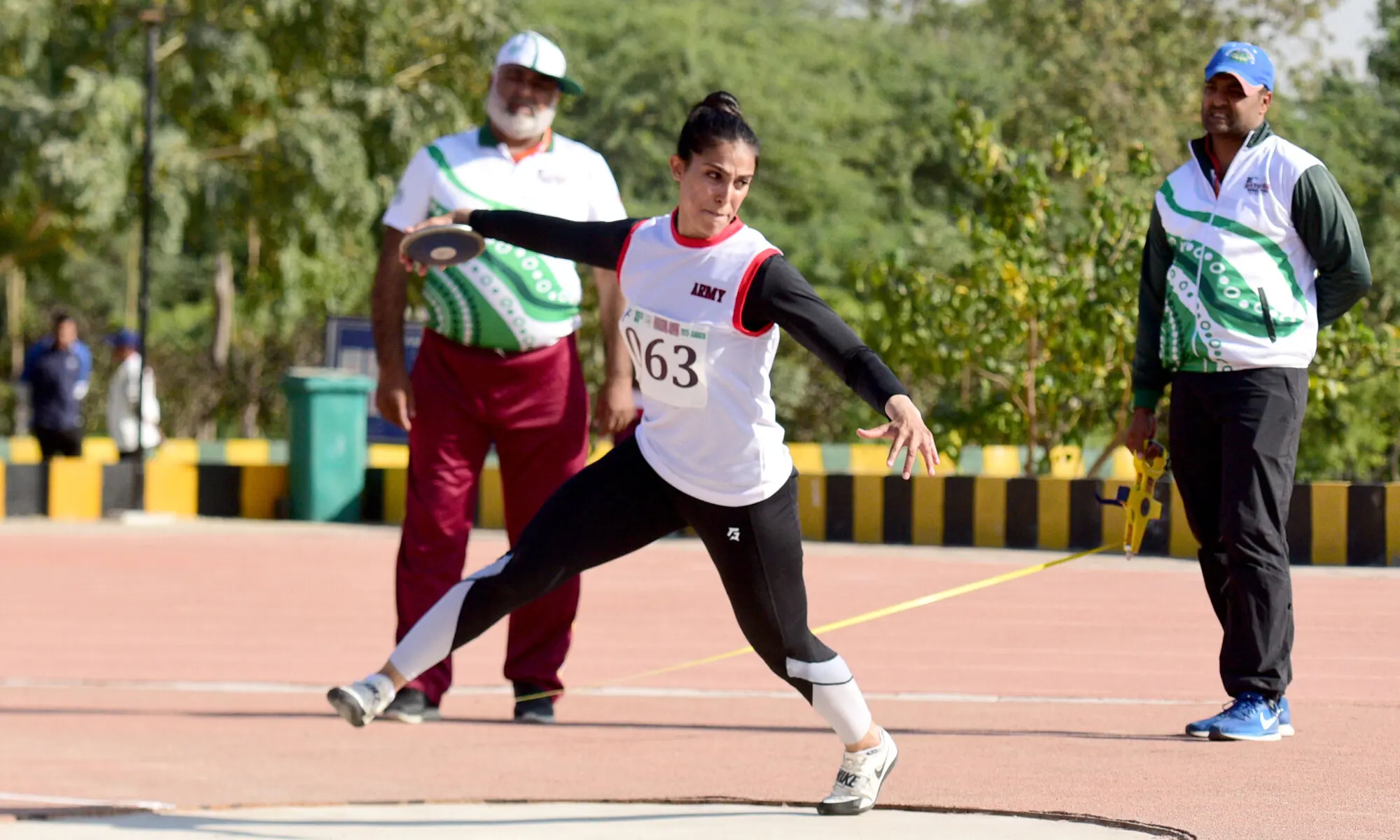
Faryal Farooq finally conquers a four-year goal with discus gold at National Games
For four years, Faryal Farooq carried the weight of an unbroken record.
Every training session, every competition, the mark stood just out of reach — a ghost she chased on dusty fields from her hometown in Azad Jammu and Kashmir to the national camp with the Pakistan Army.
On day two of the National Games athletics event, under a blazing December sun, that ghost finally met its match.
In the discus circle, the Army athlete had already taken four throws. None had come close.
The national record of 38.21 meters, set years earlier, seemed destined to remain untouched. Doubt, that familiar visitor, began to creep in. Another year, another near miss.
Then, before her sixth and final attempt, her coach Ashraf Ali walked over. He didn’t give a technical cue or a tactical reminder.
He leaned in and said, softly but firmly in Urdu, “Maan jao ga tmhain agar record tod diya” (I will be proud of you if you break the record).
“Those words lit a fire in me,” Faryal told Dawn later, her voice still charged with the moment.
She stepped back into the circle, the discus cool in her palm. The open field, humming with other events, seemed to fall quiet.
With a powerful spin and release, she launched it into the sky. All eyes tracked the discus as it flew, hung, and finally thudded into the sector — well beyond the previous best.
The technical officials confirmed it: 38.21 meters. A new national record.
The crowd erupted. For Faryal, it was a rush of pure ecstasy — the end of a long, lonely pursuit.
“After hearing my coach’s words, I put everything into the final throw,” she said, breathless. “We get few opportunities to compete throughout the year, so I train all year for one event and try to leave my heart out in the field.”
But in the glow of that golden moment, her words quickly turned to the reality so many Pakistani athletes face.
“There’s a lack of confidence in our athletes,” she confessed. “I am a champion, but I still feel this way.”
Her victory, she insisted, should be a beginning, not an endpoint. She appealed for more competitions — at least three a year — to help athletes overcome the fear that grips them on international stages.
“When we see the training standards and technique of athletes from other countries, we get demotivated. We can’t even perform at the level we are capable of.”
Her plea was also one of equity. She pointed to the nation’s javelin star, Arshad Nadeem, whose Olympic success highlighted what support can achieve.
“Arshad is our star, no doubt about that,” Faryal said. “So if facilities can be provided for him, then why not to us?”
Born in a town without proper grounds or spaces to train, Faryal’s journey has been one of borrowed facilities and department camps.
“The only way I can train properly is when I attend camps with my department,” she said. “If I had facilities in my local area, that would be great.”
On Tuesday, none of that mattered in the circle. For one soaring throw, Faryal was untouchable — a champion who rose above the bar she had set for herself four years earlier, and in doing so, raised her voice for every athlete still waiting for their chance to fly.


 0
0
Ahmed Ali is a Karachi-based sports reporter for Dawn with nearly four years of experience. He covers a diverse range of Olympic and non-Olympic sports. His work encompasses both live match reporting and in-depth features.