



 0
0

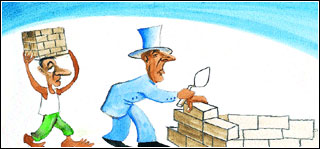 THE notion that Pakistan would make immense economic gains from the proposed rehabilitation and reconstruction work in the war-ravaged Afghanistan is not based on wishful thinking. But it could certainly turn into a nightmare for Pakistani economy if some of the ground realities that exist beyond the seeing eye are not factored into the formal proposals being put together for re-inventing Afghanistan’s economy.
For ages there has existed a clandestine free-trade zone between Afghanistan and Pakistan’s border provinces of NWFP and Balochistan. And this has clearly worked against Pakistan’s economic interests as high quality goods from cars to white goods including cosmetics and textiles made in the most hi-tech factories of the world would enter the formal markets of Pakistan functioning under legitimate tariff and non tariff barriers erected in the country’s economic self-interest via Afghanistan’s informal markets where the concept of tariff and non-tariff barriers had never existed. Even a formal customs arrangement has not been in existence in that country for almost now four decades.
There are three factors which should be kept in mind while looking at this problem. One is the 2,500 km-long porous border that separates Afghanistan and Pakistan; second the fact that divided families of Pushtoon tribes live straddling across this border and thirdly, the Afghan Transit Trade arrangement. Let us take the first factor. There is no way a country in Pakistan’s level of socio-economic development could effectively plug the physically non-existent Durand Line. Even the most developed country in the world, the US with its highly sensitive and state-of-the-art electronic gadgetry has not been able so far to plug completely its borders with Mexico.
Even fencing has failed to stop the human smuggling that continues despite the shoot-to-kill practice of border guards on the US side. A large number of troops from Pakistan army as well as police and border guards have been deployed rather massively today on Pak-Afghan borders in order to prevent the fleeing Taliban from entering Pakistan. But no one can claim that it would accomplish the desired task effectively. This is a high cost exercise and Pakistan on its own would never be in a position technically economically and/or strategically to make such heavy deployment on this border to stop smuggling during peace time.
Fencing of such a long border is also out of question. Fencing has never worked any where not even on the LoC. Even the Berlin Wall could not stop people moving to and fro from one Germany to the other. But then no one is talking of putting a Berlin Wall between Pakistan and Afghanistan. That is not the purpose of what is going on inside that country today. The world is trying to put together a country which would be friendly to all its six neighbours and do legitimate business with them. The second factor —that of the divided families straddling the Durand Line would itself work against the erection of such a wall or even fencing or even deployment of army troops round the clock and all along the border , no matter how inaccessible some parts of it are.
In fact, the very nature of this factor makes it impossible even for the enforcement of documented travel between the two countries across their borders. You can have check-post only at those points where it is possible for vehicular traffic to move. But such spots are only few and far between on the Durand Line. There are many passes linking the two countries which could either be traversed by mules and horses or on foot. Neither Pakistan nor Afghanistan can afford to locate immigration and passport offices or customs inspectors at all such spots.
And the third factor, that of the Afghan Transit Trade (ATT) also cannot be wished away by Pakistan. Under the UN Charter Pakistan with its sea outlets is obliged to provide transit trade facility to Afghanistan, a land-locked country. It is not known why Iran is not obliged to offer the same facility to Afghanistan. Anyway as long as the ATT exists, goods for Afghanistan would travel through Pakistan and be smuggled out on the way and where that is not possible come back quickly after entering the other side of the border. There are many spots inside the Afghan borders and even in Pakistan’s tribal areas where you can see huge ware-houses where the goods imported into Afghanistan through ATT are dumped to be smuggled back into Pakistan through the right routes and at the right time.
There is one way of stopping this. Erect the same tariff, non-tariff and quantitative barriers as in Pakistan on similar goods entering Afghanistan from any side of its borders with the six countries. This is a highly complicated matter and by the time the experts could work out the item-wise formula for enforcement it might perhaps take a decade and then because of the changing circumstances in both the countries these lists will have to be updated periodically in accordance with the changing economic policies of the two. But what would happen in the meanwhile. And this would become more problematic during the immediate reconstruction and rehabilitation work when material for these projects would cross over to Afghanistan and then come into Pakistani market where it would get a relatively better price in the smugglers’ market because of Pakistan’s absorptive capacity which, as of today, is thousand time better than that of Afghanistan. This is a recipe for sure economic disaster for Pakistan.
If Pakistan continues to remain a victim of Afghanistan-related smuggling then all the gains that we expect to make from the Afghan reconstruction work would quickly be neutralized and very soon the country would become one big dump of smugglers’ goods as it did become a dump of drugs and guns after the Afghan war of the 1980s. The only way to avert such an eventuality is to establish a formal free-trade zone between Afghanistan and Pakistan’s border provinces of NWFP and Balochistan. And to maximise the gains that would come our way following the launching of the reconstruction and rehabilitation work in Afghanistan, the official economic managers could also consider changing the costly and loss making industrial orientation of the Pakistani economy into a warehouse economy by letting the rupee float freely( with more than 4 billion dollars in the foreign exchange reserves we can do this today) and at the same time bring down all kinds of customs barriers against the import of raw materials and intermediaries to almost zero level.
And while doing this we could take into hand all the required physical infrastructure capacities like ports, airports, roads, bridges, power houses, irrigation water projects and other such facilities with the money now being made available to Pakistan for its services to the US-led coalition. This would make Pakistan the hub of trading activities from Casablanca to Uramchi and from beyond Burma to the Middle East. This way Pakistan could also become a ready and a more profitable trading route for the land-locked Central Asian countries.




























