0
0

ISLAMABAD, March 7: Opposition parties on Friday agreed to a government offer for talks to settle the row over the Legal Framework Order but pressed on with their protest in the National Assembly against the sweeping powers the document gives to President Pervez Musharraf.
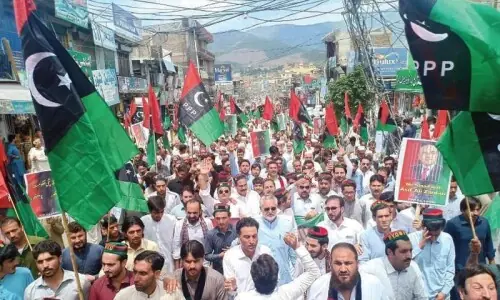
For its second successive sitting after a day’s peace-seeking recess, the 342-seat house failed to conduct any business because of an opposition furore marked by anti-LFO and anti-Musharraf slogans and was later adjourned until Monday afternoon.
The opposition parties said they would talk to government representatives outside the assembly but would not allow normal proceedings of the house until an agreement was reached to delete the disputed presidential decrees in the LFO from the constitution.
The parties — including People’s Party Parliamentarians, Muttahida Majlis-i-Amal, Pakistan Muslim League-N and their smaller allies — threatened a similar deadlock in the newly elected 100-seat Senate, where they said their more than 40 members would not take an oath under the LFO-amended constitution.
Pakistan Muslim League-Q and the opposition alliance blamed each other for the crisis which political sources said would be hard to resolve without President Musharraf agreeing to concessions at the cost of his own powers.
A sombre-looking PML-Q leader Chaudhry Shujaat Hussain, whose attempted speech in the assembly was drowned by opposition chants of “No LFO no” and “Go Musharraf go”, later told a news conference that his party, while negotiating with the opposition, would also talk to the general about clauses relating to presidential powers.
MMA parliamentary leader and Jamaat-i-Islami chief Qazi Hussain Ahmed said the dialogue with the government would be held outside the assembly while the opposition parties would carry on their “protest in the present form” inside the house.
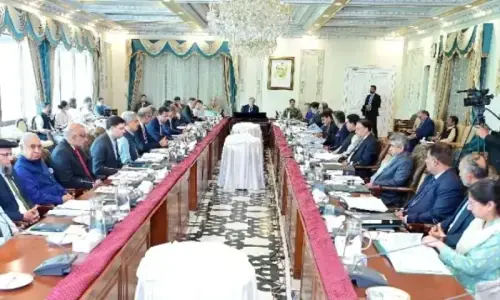
“We are ready to talk outside the assembly,” he told reporters. But he said no date had yet been set for talks, which the government offered on Thursday after a cabinet meeting presided over by Prime Minister Zafarullah Khan Jamali.
Before the session resumed on Friday morning after a day’s break, meant to cool tempers after Wednesday’s protests, PML-Q and opposition leaders met but failed to come to terms.
In a replay of what happened on Wednesday, opposition members began chanting “No, no” and rushed to the speaker’s rostrum immediately after a Qari finished the recitation from the holy Quran.
Speaker Chaudhry Amir Hussain’s repeated appeals to protesters to resume their seats and raise their points by turn had no effect and he finally gave the floor to Chaudhry Shujaat Hussain.
But the PML-Q leader’s remarks were inaudible amid desk- thumping by his own party members and louder opposition chants.
Oddly, the speaker asked the PML-Q leader to “speak or resume his seat” at one point and to “wind up” his speech at another.
What Mr Hussain later called a tamasha ended with the house being adjourned until 5pm on Monday.
The PML-Q leader said his party had already reached an understanding with the MMA, the PPP and other parties on 21 of the 29 articles of the LFO after general elections and would now talk to them about the remaining ones.
The opposition parties say they can agree to such amendments as reduction in the voting age to 18 from 21, increase of special women’s seats in parliament and provincial assemblies and powers of local bodies.
But they object to the powers it gives General Musharraf to remain president and army chief for five more years, head an overseeing military-civilian National Security Council, dissolve parliament, and sack prime ministers.
Other contentious LFO provisions include those giving the president the previously prime ministerial powers to appoint armed forces chiefs and provincial governors who, in turn, — with the president’s permission — will be empowered to dissolve the provincial assemblies and sack chief ministers.
The government says the LFO has become part of the constitution because of a May 2000 Supreme Court ruling that upheld General Musharraf’s seizure of power in the October 1999 coup and authorized him to amend the Constitution to help him carry out his promised reforms.
But the opposition parties question the justification of the court giving somebody powers that it itself does not have and accuse the president of crossing a limited court authority.
The opposition parties reiterated on Friday they would not accept any amendment to the constitution unless it was passed by both houses of parliament by the required two-third majority — which neither side of the present political has but can be mustered in the event of an agreement between them.
Qazi Hussain Ahmed said on Friday opposition members in the Senate would not take oath when the upper house met because the government had not come up with new copies of the constitution that includes the LFO.