0
0

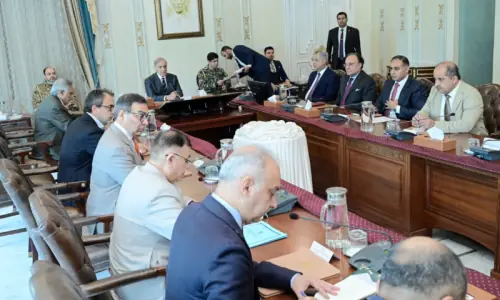
KARACHI, March 4: The police have failed to come up to the expectations of the masses and get their confidence, as people are not satisfied with the law and order situation, Sindh Chief Minister Ali Mohammad Mahar observed during a discussion on the subject in a cabinet meeting on Tuesday.
The meeting stressed the need for taking concrete actions, including dismissal from service instead of cosmetic measures of transfer and suspension, against officials found in dereliction of their duties.
Information Secretary Mehtab Akbar Rashdi briefed newsmen about the decisions taken by the cabinet, which met at the new Sindh secretariat with Mr Mahar in the chair.
In its about five-hour-long deliberations, the cabinet discussed law and order, police reforms, arrangements to ensure peace during Muharram, restructuring of irrigation system, wheat procurement policy, relief to people in the drought-affected districts as well as matters relating to medical college students and contract doctors.
The cabinet, which met formally for the first time after its induction on Jan 2, endorsed an agreement signed by the Sindh government with a Chinese firm — Shenhua — on Thar coal mining and power project. It also approved the policies initiated by former provincial finance minister Abdul
Hafeez Shaikh about reform programmes supported by an structural adjustment credit of Rs18 billion from the World Bank.
Giving a briefing on law and order situation, which was the second item on the agenda, the Inspector-General of Police, Syed Kamal Shah, recalled the circumstances and shortcomings of facilities which did not match those of the criminals.
The cabinet, short of satisfaction, endorsed the views of the police chief and called for accessibility of police officials to the masses through open kachehries, TV programmes
on the pattern of the weekly radio programmes, in which the IGP, etc., responded public queries.
The chief minister said that in the open kachehries, MPAs should participate and coordinate with the officials to provide on-the-spot redressal to the pubic grievances.
He asked the concerned officials to provide the facilities of ”Helpline-15” and the CPLC in other districts as well.
On the difference of Rs670 between the salaries of policemen in Punjab and Sindh, Mr Mahar asked the finance department to prepare a feasibility report on the subject for removing the difference, and also to prepare a report for setting up a DNA laboratory in Karachi, as at present samples were being sent to Punjab for conducting the test.
Referring to police reforms, the chief minister stressed the need for submitting proposals to the NRB to bring necessary amendments to the reforms, as other provinces had also taken the same step.
He directed the officials that in recruitment of police personnel, commitment, quality and merit should be ensured and that the concerned department should also make sure that smoke-emitting vehicles are banned in the province.
Home Minister Sardar Ahmad informed the cabinet that all necessary steps had been taken to ensure peace during Muharram. Mohalla and peace committees, Nazims and elected representatives’ cooperation had been sought and all other foolproof arrangements had been made in this regard, he added.
The adviser to the prime minister on privatisation, Abdul Hafeez Shaikh, attended the meeting on special invitation and briefed the cabinet on the reform programmes supported by the structural adjustment credit.
He said that the credit of Rs18 billion was being provided to the Sindh government by the World Bank as a soft loan with a zero per cent interest rate. He said that Rs6 billion would be disbursed each year under the credit programme, which was meant for improving health and education facilities. The cabinet endorsed the ongoing schemes.
It was informed that six districts — Tharparkar, Mirpurkhas, Sanghar, Dadu, Thatta and Ghotki — had been declared drought-hit areas where for the last two months 24 thousand families had been provided with wheat free of cost, while during the next four months they would get the commodity at a 50 per cent subsidise rate as the situation was not likely to improve soon.
The cabinet was informed that a bumper wheat crop was expected this year and the government planned to procure 0.5million tons of wheat in addition to over 0.2 million tons of wheat available in the godowns.
However, a suggestion whether to market it at a lower rate or export it was handed over to a committee, headed by agriculture minister, which would also safeguard the interests of the growers, so that they could get a Rs300 per maund procurement price.
Reviewing the performance of the merged department of irrigation with the agriculture department, the cabinet decided to restore the old status of the two departments, each headed by a grade-20 official.
The meeting was also briefed on revamping and restructuring of irrigation system, for which a sum of Rs10 billion had been sanctioned by President Gen Pervez Musharraf. As the fund was provided to the previous government, the cabinet decided to review the proposals submitted before the induction of the present government. Another committee was formed under minister of development and planning, which would submit its report in the next cabinet meeting.
Reviewing the issue of the SMC students, the cabinet formed a committee, headed by Arbab Ghulam Rahim with Dr Saeeda Malik and Irfanullah Marwat as its members. The committee was asked to submit its report in the next meeting.
Thar coal project: Chief Secretary K.B. Rind, who led a 10-member delegation to China, briefed the cabinet about the silent features of the agreement signed with the Shenhua Group Corporation of China.
The Chinese firm would get the right to excavate coal from 22kms and would pay annual rent of the mining areas at the rate of US $ 75 per square-kilometre and a royalty of one US $ per ton in addition to spending US $ 0.1 per ton to affect social reforms and development, he said.
The provincial government will build roads, which could sustain the load of machinery to be transported to the areas. The government would also provide electricity transmission lines at a cost of Rs5 billion.
The ownership of the power plant, which would be built on a BOT basis, would be transferred to Sindh in thirty years. Availability of water for human consumption and construction would be provided by the government free of cost during its construction, afterwards the government could charge commercial rates for the water supply.
The land would be leased for 30 years and the government would charge nominal rates for the state land.
The cabinet was also informed that Nestle company had shown interest in acquiring 20 acres of land along the National and Super highways on a 30-year lease to establish its plants.
The cabinet formed a committee to report about its feasibility in the next meeting.