0
0

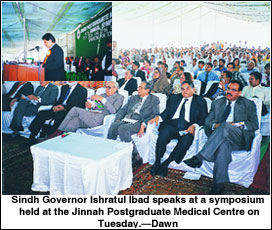 KARACHI, Feb 25: Sindh Governor Dr Ishratul Ibad, addressing the 40th Annual Symposium of the Jinnah Postgraduate Medical Centre, here on Tuesday underscored the need for improved micro-environment to help prevent many noncommunicable diseases in the country.
According to him, in the ultimate analysis any society is judged by its ability to provide universal health-care for its people, which does not merely entail the ability to treat diseases but also to prevent their onset by suitable preventive systems and measures.
“Many communicable diseases can be prevented by having appropriate sanitation systems and controlling disease-spreading materials, and by immunization programmes carried out on a large scale,” he observed.
The governor further said that adequate attention extended towards nutrition and dietary supplements could also control diseases, and balanced food intake and regular physical exercise could prevent several forms of heart ailments.
He appreciated of the services rendered by the JPMC over the years. Referring to the theme of the symposium— Medical Education-Dimensions for Tomorrow— he said that it particularly held relevance for medical requirements of the ailing people exposed to communicable and noncommunicable diseases.
Referring to the surge in the incidence of TB, AIDS and diarrhoea, the governor maintained that to combat them in an effective manner the medical community had to concentrate on finding simple, safe and inexpensive methods of diagnosis and treatment.
Expressing his concern about the increased commercialization in the health-care delivery system, he said it could be tolerated if insurance and social security coverage met the costs, or if private hospitals subsidize the weaker sections, without regard to caste, creed and colour, just as they met the needs of the rich.
He announced a donation of Rs1 million for upgrading the JPMC library. He also announced a donation of Rs50,000 for the Eye Care Centre.
On behalf of the Prime Minister, he announced a grant of Rs4 million for procurement of necessary equipments for the JPMC.
The JPMC director, Prof Kazi A Shakoor, speaking on the occasion, said the three-day annual event was aimed at providing an opportunity to medical experts to share their experiences with junior practitioners, while the latter were offered a platform to bring into light their research works during the recent years.
“I must mention with immense pleasure that, through the consistent support of local philanthropists the JPMC is in gradual process of upgrading its varied wards and departments,” he said.
Dr Aleem A Kadar offered the vote of thanks.— APP