



 0
0

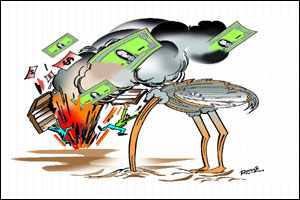 The recent disaster at the Sambrial Dry Port, near Sialkot, is another tragic addition to the national portfolio of crime and corruption, causing 17 deaths and injuries to 35. That is the wages of unbridled greed and profit, blatantly transcending basic, legal, human, social, and ethical considerations.
Two containers imported from China/Dubai via Karachi caused this devastating blast. The Speaker of National Assembly billed it as an exquisite tragedy and vowed to bring the culprits to book. The disaster has exposed a number of soft spots in the conduct of international trade, transport and logistics; most important of all, the security and safety emanating from the cargo within the box.
It is an indicator of the need, primacy and urgency of fool-proof conduct and observance of respective security measures along the logistic chain in international trade. This, in equal measure, stresses the need for observing vigilance and care by all the shareholders and stakeholders in international trade at both ends, i.e., the country of origin and the country of destination as well as the country of transit. The over-riding aim and mission in the international transport and logistics, is not only to provide time and cost-effective transportation and the allied services and facilities from the point of origin in the country of export to the point of destination in the importing country, but also to strive to eliminate any threat to the security and safety of the physical conditions and human beings involved in this movement of goods amongst nations, even though in practice it can at best be minimized.
While containerization marked the greatest revolutionary break-through in the transportation technology of 20th century, to facilitate fast, safe and cost-effective mass transportation of manufactured goods, it equally holds potential to be great source of threat to the safety and security. The maximum benefits of containerization only accrue when the movement of container is door-to-door, i.e., from the stockyard of the exporter to the warehouse of the importer, ensuring the integrity of stacking and packing of goods within the box along the entire transport chain from the country of export to the country of import. This calls for utmost care and observance of international conventions concerning security and legality of the goods in the container.
Container, conceived and designed to be a blessing for world trade, can prove to be a bane, if requisite care, caution and vigilance are not exercised. Soon after the events of 9/11, Economist, London, flashed a story on a startling event, across the Atlantic, at the South Italian port of Gioia Tauro, where a person allegedly belonging to Al-Qaeda, was found in a container, equipped in comfort for the duration of the intended sea-voyage of the container from Italy to the port of Halifax in Canada. He was stated to be carrying plans of airports, an aviation mechanic’s certificate and security passes. The alarming discovery exposed the tensions and contradictions between requirements of international security and those of international trade, and sent a shock wave for the intelligence establishment of the US.
The Sambrial tragedy is apparently ascribable to greed and quick-bucks mentality in the garb of trade. No wonder that in the US, in the aftermath of 9/11, the customs is scrambling to secure 14 million containers coming into the US ports against tampering. It is to this end that increasing use is being made of million-dollar X-Ray machines and smart software tools at the ports of entry in the US that can scan a container truck in seconds. However developing countries will have to find financial resources to undertake such arrangements. The decision by the government of Pakistan, as stated by the CBR on February 8, 2003, to install scanning machines at all ports for speedy checking of goods in all containers can be billed as the most positive and constructive as well as timely response to what occurred at Sambrial Dry Port. Apart from such state-of-the-art technological devices, developing countries are called upon to develop legal, institutional and professional measures and procedures that seek to entirely preempt the incidence of accidents as occurred at the Sambrial port. These measures and procedures have to be hard and harsh in implementation; cost of their being soft can be disasters of any proportion. International trade, especially in case of developing countries where it represents the very life-blood of the economy, can not permit to be held hostage by such disasters, caused either by terrorism, over-greed or inefficiency of operating systems of global logistics.
Considering the Sambrial tragedy as a wake-up call, Pakistan is called upon to have a critical look at the ways, procedures and legal framework surrounding the conduct of international trade and its movement between points of origin and destination. Trade and transport are inalienable fellow-travellers; strengths of the one reinforces the position of the other. The main-stream transport sector involved with the international trade is today subject to an integrated approach; to be progressive and forward-looking transport operator, you don’t deal with segmented transportation; the entire chain of transport for global trade is deemed to be an integrated system. With containerization dominating the skylines of sea ports, port is no more a terminal point; it has become a link in the chain — though probably the most vital one — of the international logistics. A sea port is more a point of co-operation and co-ordination with other modes of transport, i.e., railways, road, airlines/airports, as well as institutions and agencies assigned with the task of facilitation of trade into/out of the country, and less a competitor under segmented transport concept of the past.
Diversity and expansion of the global trade over the past decades, with pro-active role of containerization, have affected the international shipping, port industry and freight forwarding industry in equal measure. In the emerging scheme of things pertaining to the transportation of our international trade, the pivotal role has to be played by the freight forwarding industry, to match the international trade landscape to emerge in the wake of the applicability of the procedures and regulations of the WTO from 2005 onwards. It has yet to enter the phase of a viable and vibrant logistics industry as the forwarding industry in the advanced economies conducts itself.
This calls for re-organization of this sector, with necessary legislation by the government of Pakistan to match international practice in transportation summed up as multi-modalism. Acting as multi-modal transport operator (MTO) a freight forwarder acts as a principal, subcontracts all the services, except those provided by his organization, to other transport entities, has the responsibility and accountability for all modal transport, negotiations, payment and claims; offers one, all-inclusive, price for the whole of the services to be successfully undertaken throughout the door-to-door transport chain. Whatever happens, the client (shipper or consignee) will only pay the pre-established price. The MTO will assume responsibility for the performance of the whole operation for the agreed price and will support any price fluctuation and other expenses which might not have originally been envisaged. Door-to-door services are more sophisticated and comprehensive than segmented or modal-split transport operations, but far more simplified for the customers.
MTO puts the trader in a price-wise safe and operations-wise problem-free position so that international trade transactions can be conducted in a faster and more profitable way. The trader would prefer to be free from all possible problems against a price, if taken over by the MTO. It is here that term logistics enters the equation. Logistics has been defined in the United Nations professional literature as “the process of planning, implementing and controlling the efficient, cost-effective flow and storage of raw materials, in-process inventory, finished goods and related information from the point of origin to the point of consumption for the purpose of conforming to customers requirements”. The transport logistics is the integration of transport with other services — including stock management, packing and labelling of products, insurance and banking operations related to the movement of goods, border formalities in case of international transport — resulting in improved levels of service to customers. The MTO is expected to cater for the full range of logistics requirements of the trade, if the national trade and transport sectors have to be globally competitive.
The ground realities concerning freight forwarding industry of Pakistan, in general terms, hardly excite up-beat mood. Of course, the leading companies in this business can be compared to world-class companies in freight forwarding and logistics. They maintain worldwide network of correspondent logistics enterprises to provide fast and reliable service to their clients. It is such companies that observe the greatest concern — to save and maintain their business image — for security and the legality of the professional standing and credentials of the importers and exporters; employ professionals well-versed in the patterns and practices of global logistics industry. Then, there are, at the lowest rung of the ladder of the hierarchy, informal operators, who have according to the classification of UNCTAD — for developing countries — “neither appropriate structure nor legal existence. They have become numerous, do not pay licence fees or taxes, and they encroach on individual consignments market in which they manage to provide cheaper services than the established freight forwarders. Their activity is mostly limited to the customs clearance, where their personal contacts are valuable.” It is this group, in particular, that deserves greatest effort and attention to put the forwarding industry on the right track in the run-up to have a reliable, professionally sound and ethically unblemished transport sector. The FPCCI and the PIFFC (Pakistan International Freight Forwarders Council) as the subordinate body of the FPCCI, bear responsibility to clear the deck and streamline the organizational contours of this critical segment of national transport sector to serve as absolutely reliable and competitive channel between national productive sector and the international markets.
The government is required to enact the necessary legislation for introducing multi-modalism as the pattern for international trade transportation, setting as well the criteria for the companies to be accredited, requiring them to dispose of adequate financial capability and sufficient management experience at executive level, with valid forwarder’s liability insurance.
Further, the watchdog function related to the customs regime needs to be substantially up-scaled to minimize the “under-the-table understanding” with the parties with vested interests. The FPCCI would do a good turn to the economy and its moral image by cleansing itself of the black sheep that can go to any length for their personal benefits. Pakistan stands a bright chance for its transport sector to make increasing contribution to the GDP, provided a clean level field is made available to those who genuinely want to play a fair game.





























