



 0
0

 Pakistan has a perilously low proportion of forest area — a paltry 4 per cent,which is much below the recommended minimum of 25 per cent. Importance of forest wealth could be gauged from the fact that forest cover in Germany is 30 per cent, France 27 per cent and the UK 10 per cent.
At present the share of agriculture in GDP is about 25 per cent and the share of forestry in agriculture is 0.62 per cent and the share of forestry in GDP is only 0.15 per cent. Reportedly the United Nation Development Programme (UNDP) has arranged a funding line of 2.2 million euro to promote tropical forest in Pakistan during the next five years.
The funding facility extended by the European Commission would be utilized for the promotion of tropical forest through disbursement of small grant among to the private sector stakeholders involved in forestry , i.e. non-governmental organization, community based organization and other non-profit organization, association and network registered in Pakistan. Initially the programme would focus on mangrove along the coast line of Balochistan and Sindh and scrub of NWFP.
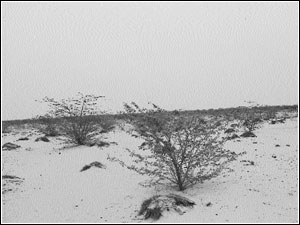
No doubt promotion of mangrove forestry along the coastline is vital for the protection of marine bio-diversity and its ecosystem, but one more area where promotion of afforestation is needed to achieve self-sufficiency in food and fibre and alleviate the poverty is that desert belt of Balochistan where sand bearing wind blows over the fruit orchards in Quetta valley, particularly. Afforestation in such areas, as a matter of fact, is needed to check the wind erosion of sand and soil particles which deposit on the canopy of orchards which in turn leads to resurgence of mitepest on twit orchards requiring several sprays of miticides for its control creating unnecessary burden on the economy of the fruit orchard owners.
Last year in April 2002, a Kenyan trade delegation while visiting apple growing areas in Quetta valley expressed their concern that because of excessive use of miticides and pesticides for pest control apples grown in the valley may not be able to secure export market in many foreign countries, including Kenya. It would be proper to mention here that besides Quetta valley, apple is also grown in Kurrum agency and Wana plane of South Waziristan in the NWFP. But fruit orchards in these valleys did not encounter mitepest problem. The simple reason being wind blown here did not bear sand and soil particles causing no desiccation on leaf surface, which is the factor of mite resurgence.
Truly speaking, afforestation or tree planting in the desert is a very difficult venture because of arid climate — the high temperature, low rainfall and high wind velocity. Accordingly, a tree for desert must be extremely hardy to endure such conditions. One such tree of arid and semi-arid region is “Prosopis”. In Pakistan some major species of Prosopis are Prosopis cineraria, P. juliflora, P. glandulosa, P. fareta, P. stephoniane. Prosopis cineraria locally known as “kandi” is an important tree of arid and semi-arid zones of Pakistan and India. Its green unripe pods are used as vegetable and in the preparation of curries and pickles. The dry pods, known as “khokha” in India, are used as an emergency food and help in preventing protein calorie malnutrition. The powdered flowers mixed with sugar are used by women to safeguard themselves against miscarriage during pregnancy, and the flowers are used as tonic for blood purifier in skin diseases. Roasted seeds are added to coffee. Bark, rich in tannin, is used for roofing in Columbia. Gum is used in confectionery and mending pottery. The wood is used for furniture and fuel.
According to Professor Shahid, head of the Botany Department, University of Karachi, Prosopis juliflora is an introduced species from Mexico. Reportedly, it is classified as a principal weed in Mexico, a common weed in the US (but does not naturally occur in the US, this report due to the long prevailing taxonomic confusion) and a weed in Australia, Dominican Republic, India, Iraq and Venezuela.
While visiting desert area of Sistan, Balochistan, and Kirman provinces of Iran, it was observed that for sand dune stabilization as well as to prevent sand bearing wind from dune formation on roads across desert belts, large scale tree planting with Prosopis has been undertaken by the forest department of Iran.
Suggestion: To stop wind erosion of soil and sand particles, which deposits on fruit orchids in Quetta valley, it is imperative that afforestation in the desert belt of Balochistan using Prosopis trees should also be initiated with the UNDP funding like that of mangrove forestry along the coastline of Sindh and Balochistan.




























