0
0

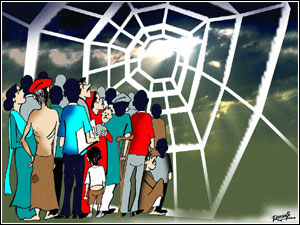 As always, economics and politics are coming together in the making of economic decisions. ‘Relief’ is the buzzword. Emphasis on ‘relief’ strongly implies that since the hardships are likely to continue, the government can at best provide some relief. For how long will the hardships continue is what the people would like to know? The answer is known to none. All they talk about is a trickle which, if too small or isolated, may even evaporate before reaching the needy.
So, while the small amount of relief is not likely to cover all those in need, the ones covered will also be covered only partially or fractionally. What is being passed on even as relief will hardly relieve the sufferings of those touched by it.The Rs-5-billion falahi scheme of the Prime Minister is supposed to target 2.5 million families (15 million individuals) which boils down to Rs2,000 per family per annum or Rs167 per family per month. People have been trying to figure out its benefit for the poorest of the poor.
The PM’s adviser on finance tries to explain its benefits in terms of the marginal utility of Rs167 per month for a poor family of six in an era when even beggar children expect nothing less than Rs2 in alms from an individual. So, the relief of Rs167 would provide for 83 naans(tandoori rotis) which a family of six would consume in roughly five to six days, given the healthier appetites of the poor. The number of days for which Rs167 will enable them to subsist if the roti is cooked at home will be somewhat higher but still the whole month will not be provided for.
While Rs5 billion may sound impressive on the surface, it will not help the poor approach subsistence which level is measured as a family’s food budget (not just rotis) for the month times three. What then is the marginal utility of Rs167 per month for a family of six? While its determination may provide a research area for the researchers getting a paper or two out, the trickle of relief will make little or no difference on the ground. And, while the ground reality will remain pretty much unchanged with the changes, if any, to be searched through a microscopic lens, it is the political marginal utility of Rs5 billion that is perhaps the essence of the decision.
Poverty is the fashionable goal that all now wish to promote even if it is the IMF that was supposed to be providing balance-of-payments support. As “poverty” or the P-word, if you will (after the T-word), became fashionable, even the IMF rechristened its programmes after this new password. So, even though the PRGF (Poverty Reduction and Growth Facility) aimed at market-reform and structural adjustment for macroeconomic stabilization first and foremost, old package was laced with the P-word for greater political popularity and palatability. Consequently, we even came to hear about pro-poor privatization when it is now common knowledge that privatization leads to unemployment, and thereby poverty in an economy which is not growing rapidly enough to absorb the off-loaded.
Even then privatization is another priority item on the present government’s agenda. Although the government is ostensibly concerned with poverty, it must also gain pace on privatization as required by external financiers. So, an attempt is being made to establish a convergence between the privatization and the poverty so as to play it safe politically on both the turfs of the general public as well as that of the IFIs.
As institutional strengthening is required whether or not dictated by the IFIs, we must heed available knowledge on the subject which too is based on real life experiences and is not merely theoretical or bookish as alleged mostly by those who wish nothing better than status quo for various reasons. These could range from protection of class interest to a lack of information on the subject or a lack of ability to be administratively or managerially innovative in the field. This is one of the reasons why we used rightsizing almost as a euphemism for downsizing. And, the Indians viewed rightsizing as relieving only the inefficient and the unproductive while gearing up to utilize the productive workforce.
Indian scholars present appropriate organizational turnaround strategies in developing countries that are not only least injurious but are effective in our environment. Also, they present a new gauge for evaluation of turnaround strategies, which is based on humane considerations. These are totally ignored in our country due to a host of reasons.
While faith in the Western prescriptions and some of the above reasons are some of them, our turnaround efforts are driven by economists instead of independent management experts. As for management, many subscribe to old schools that are outdated and obsolete and fail to show the desired results in this information age characterized by high mass awareness and uprising for individual rights, including avenues for self-expression at all hierarchical levels alike.
While none dispute the role of an active, socially conscious, and a managerially sound private sector; privatization too requires a moral edifice on which this superstructure can be safely erected which appears like a remote possibility at present as our social fabric remains pretty much ruptured. Mixed results of our very own privatization experience ought to have driven home the point by now that privatization is no panacea for poor management of the public sector. For, solution of poor management is good management whether the sector is public or private. It is said that good management is difficult in the public sector due to the government’s political interference. Is good management easy in the private sector if the owner manager or those with a majority stake keep interfering, out of their sense of insecurity, either authoritatively or paternalistically both of which are absolutely outdated styles of management?
Insecure managements, whether in public or private sectors, find it difficult to share in decision-making, which is why neither a cohesive bond through shared vision and values can develop nor can self-propelled organizations be thrown up with an identity of their own. While there may be outliers, by and large there is a need for a management revolution. This can, however, be effected through transformations within the psyche and constitution of the managers at the helm. As blind faith is reposed in the invisible hand doctrine, the economic experts fail to recall the assumption of self-interest that makes the invisible hand work.
So, just because the invisible hand works effectively in the West is no reason why it can work here if it is SELFISH interest that we excel in instead of self-interest which is fine to promote as long as it is not at the expense of others. So, poverty of confidence, independence, character, values, management practices, and thought feed into the poverty of institutions and their composition which together are likely to beget more of the material poverty whose amelioration we now also seek through privatization in parallel with a begging bowl that remains extended perpetually.
It is no wonder then that the external financiers come charging in when we reduce power tariffs in the name of relief. They also demand to know why Wapda and the KESC have not been privatized so far. We ought to have stood up and presented our organizational solutions but for the poverty of above factors, we have to adopt solutions that can only add to material poverty, the IMF’s claims to the contrary notwithstanding.
So, what may be popular with the people (tariff decrease) may not be politically expedient with the donor. An economy handcuffed to the donors has to worry about politics on two fronts — at home and in its interaction with the financiers. So, on the one hand, the elected government pushes privatization and, on the other hand, it fends for relief from the fallout of donor-driven policies. Therefore, those who think that the donors are only concerned with the macro picture and we should, therefore, focus first on macro and then on micro ought to see that the donors emphasize micro performance no less than they emphasize macro level stabilization. Macro- and micro-level are not sequential as can be seen by all.
The micro-level performance feeds into the macro-level indicators.The macro economy would be as robust and resilient as the micro level players would be. Otherwise, padded forex reserves mainly due to the fallout of a gory 9/11 incident and postponement of some of the debt burden are transient facelifts that will not hold on their own unless the constituent components of the macro economy gain in strength and vitality. So, while macro situation may need to be saved in the short run even if through temporary measures, it is the micro level that needs to be focused upon for a lasting impact on both levels of the economy. Unfortunately, the financial management of the country gets consumed doing the former with the latter either allowed to take its own natural course or made to take a course forced upon by the IFIs. As indigenous solutions are dismissed as “impractical”, the IFIs-driven solutions have yet to show practical results too in the form of providing substance and real teeth to the economy.
As the donors drop some assistance, they require a transformation that may or may not gel with our socio-cultural environment unless transformation in the latter is also aimed at in parallel and unless other sources and causes of material poverty are rooted out. Just because the root cause of material poverty remains untouched due to political expediency is no reason why those micro levels should remain untouched too where a difference can possibly be made.
To make this difference, however, there is a need to bring down the anti-development value system and to simultaneously promote pro-development attitudes, behaviour, and disposition through modern management practices. Otherwise, year after year we will remain hitched to not only the IFIs’ bandwagon but the multitude will have their destinies tied only to the coffers of the wealthy elite. And, we will be taking pride only in providing pittance to the poor and the pensioners viewing them as key welfare measures. These no longer are popular pro-poor measures for as long as the broad thrust of economic policy remains anti-poor and for as long as the lower segments cannot muster resources enough to take charge of their own destiny. It cumulatively adds up to the nation’s dependence as a whole on the resourceful of the world, the complacency of the country’s smug resourceful notwithstanding.