0
0

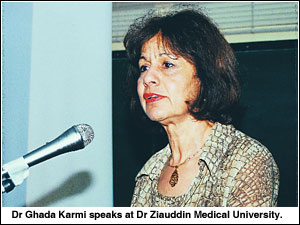 KARACHI, Jan 31: Muslim scholars went out to various parts of the world to learn about other countries. Books in different languages were imported from these regions. That was how the early Muslims methodically collated data, gathered information, and progressed, said a London-based Palestinian writer, activist and physician here on Friday.
Foreign-language texts were translated into Arabic. Libraries, observatories and madressahs were set up. That was how the Muslims disseminated the information and knowledge they gathered, the scholar, Dr Ghada Karmi, said during a talk at Dr Ziauddin Medical University.
Dr Karmi has come to Pakistan on a lecture tour sponsored by the Dawn Group of Newspapers and Dawn’s Books and Authors section. She will speak on “Palestine: in the shadow of war” in Karachi on Saturday, and will also give lectures in Lahore and Islamabad.
During her talk, which was entitled “Medicine in the Mediaeval Islamic World”, Dr Karmi referred to the Muslims’ “Age of Original Contribution” which lasted until 1300 AD, and said it was during this ‘golden period’ that scholars, like Ibn-i-Sina, Al-Razi and Al-Zahrawi produced critically acclaimed works.
During this period, several streets in Baghdad were lined with bookshops. What set it apart from later, bleaker periods was that acquisition and dissemination of knowledge was patronized directly by the caliph.
“What’s remarkable about this period is that there was an institutional understanding of the importance of knowledge, although individuals also played an important role,” she said.
The Muslims proceeded to have an important impact on Mediaeval Europe, said the well-known author whose book “In search of Fatima: A Palestinian Story” has created world-wide interest. “Much of their understanding of philosophy, for instance, can be attributed to works in Greek which had been translated into Arabic by Muslims.”
Dr Karmi — who had to flee Jerusalem with her family in 1948 — said many western scholars of the time simply didn’t feel the need to refer to the original Latin works, so good were the Arabic translations.
The western scholars, while reading the translations, became familiar with Islamic ideas, but didn’t give Muslim scholars the credit they deserved for their contribution. “In a book you may come across a paragraph or two about the Muslims’ contribution, but that’s about it.”
The creation of a new corpus of knowledge was the early Muslims’ biggest achievement, said Dr Karmi. “This was made possible by curiosity and a thirst for knowledge at the highest levels of society.”
She said Ibn-i-Abu Saeeda, an Arab academic of the time, had described exactly how he had been taught medicine. “He says the students used to make a round of the wards. During these rounds the difficult cases were discussed. “After the rounds, the teachers used to deliver lectures. What does this remind you of?”
Dr Karmi described in detail the humouralism theory which formed the basis of Islamic medicine. “This theory controlled contemporary thinking until the 18th century.
“What’s notable about this theory is that it’s a perfectly logical one.” She said that because of it several terms — like phlegmatic, melancholic, good-humoured — had come into being.
Dr Karmi, who did her doctorate from London University, said acquisition of contemporary knowledge was extremely important but the Muslim people should be fully aware of their legacy. “We should be proud of our heritage.”
She was of the view that the Muslims were up against certain powers which wanted to make them their subjects. “We are facing a big battle.” Muslims must make efforts at several cultural levels to come out on top in this battle against a very clever and difficult enemy.
Answering a question, Dr Karmi said the Muslim world had produced many scientists of repute. “However, we don’t have the systems that could consistently produce scientists of calibre.”
In a departure from medical and social issues, she also responded to some political questions.
Mr Hameed Haroon, who chaired the event, said Dr Karmi was the most believable, and thus, celebrated Palestinian author.
Dr Asim Hussain of the Ziauddin Medical University presented the vote of thanks. Dr Naeem Jafarey presented a memento to her. Dr Karmi read out a passage from her book “In search of Fatima: a Palestinian story”.
Earlier in the day, Dr Karmi visited the Sindh Institute of Urology and Transplantation for a talk on the health problems of migrants.
Having specialized in public health and the problems of migrants, refugees and asylum-seekers in Britain, where she helped set up the NHS ethnic health unit, Dr Karmi was well informed about the health status of migrant communities.
Addressing the faculty of SIUT, a public sector health facility which is the main transplantation centre in Pakistan providing free of charge services to patients, Dr Karmi identified some of the factors which affect the health of migrants.
The trauma of migration, the psycho-social conditions which call for a measure of adjustment and the environmental factors create pressures which can exacerbate pre-existing health problems of a community apart from creating new ones. The epidemiology of the home country is also reflected in the pattern of diseases of the migrants.
Apart from that, migrants acquire new diseases on account of the changes in lifestyle and the disorders prevalent in the host countries. Among South Asians in Britain, the cardiovascular diseases, diabetes and dental health problems have the highest incidence.
Dr Karmi pointed out that the rate of suicide among South Asian migrant women in Britain was much higher than women from other communities.
She said the key question which needs to be addressed in countries with large migrant communities is whether separate health services should be provided for migrants or the existing services should be adapted to the needs of the ethnic communities. This is an important issue relating to the management of the health system.
Even a seemingly minor issue of difficulties of communication on account of language barriers can make it difficult for a medical professional to take care of his patient.