0
0

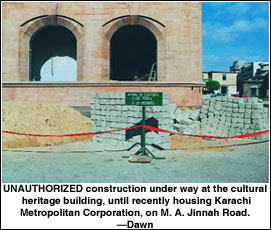 KARACHI, Jan 5: Repair and renovation work is being carried out in the head office of the now defunct Karachi Metropolitan Corporation without permission of relevant authorities, it is learnt. The building, located on M. A. Jinnah Road, is protected under the Sindh Cultural Heritage Protection Act.
Sources have indicated said that permissions for any repair or alteration in the heritage building have to be obtained from the Sindh Culture Department and Karachi Building Control authority (KBCA).
However, both the departments appeared unaware of the work being carried out at the building — one of the most prestigious, attractive and well-maintained monuments in the city.
A top official of the city government, supervising the work, when asked to comment, remarked: “No permission is required for such a ‘minor’ work.”
The sources, however, pointed out that many an old wooden doors had been removed and the openings closed with concrete construction to make room for a cafeteria in a portion of the building.
They recalled that the relevant rules and regulations were so strictly followed in the past that even the owner could not make any alteration to the structure in a building protected under the Act without the prior permission from the Advisory Committee on Cultural Heritage, which is headed by the provincial chief secretary. The Act prescribes heavy fines and long prison terms for the violators, they added.
Furthermore, they said, even after granting of permission, the work had to be carried out without changing the original architectural design, construction techniques and material of the building.
Responding to Dawn’s query, Syed Mahmood Ali, Building Controller of KBCA, Sadar Town, confirmed that the alteration work was under way at the KMC building but he termed the whole affair ‘a minor issue’ saying that termite-affected doors were being removed. He said that the raising of walls to close down the openings also did not require any permission from his department.
An official of the KBCA’s National Heritage Cell, when contacted, said that he was not aware of any permission or NOC having been given by the Advisory Committee on Cultural Heritage for the ongoing work. According to the procedure, he explained, any request for such an alteration had to be made to the Culture department which arranged for a survey. “The survey report eventually is sent to the advisory committee which submits it with the department. After a review of the application, the department and the committee take a decision,” he said. The official said that this procedure had not been adopted in the case of the ongoing work at the KMC building.
The sources in the Culture department also confirmed that any permission/NOC to carry out the work had neither been sought by the KMC nor granted by the advisory committee.
The Culture Secretary, Abdul Hameed Akhund, and the concerned section officer, Mr Arif, told Dawn that they were not in a position to comment on the grant or otherwise of such a permission since they had taken the charge of their respective posts only recently. They, however, added that they would be able to say any word after going through the records in a couple of days.
The District Coordination Officer, Shafiqur Rehman Paracha, who is the top official of the organization which has been handling the work at KMC building, told Dawn: “this is a minor work for which no permission is required.”
The Sindh Cultural Heritage Preservation Act section 18 (penalty) says: “Whereas any person including the owner destroys, removes, injured, alters, defaces a protected heritage ... shall be punishable with a fine which may extend to one lakh rupees, or with imprisonment which may extend to three years, or with both.”
The Section 6 and 6A of the Sindh Building Control Ordinance and its regulatory Section 21 prescribes that a prior permission has to be sought from the Karachi Building Control Authority before carrying out any addition, alteration, modification in any building. Violators are given heavy fines.
Designed by James S. C. Wynnes of Edinburgh, the KMC building is one of the most impressive Anglo-Mughal piece of architecture that was completed in 1931. The foundation stone of the building was laid in 1895.
The building’s front — facade and decorative mouldings etc. — has been constructed with the “Chhatar”, the pink sand stone from Jodhpur (Rajasthan, India), and locally available yellow Gizri sandstone was used internally and in the rear.
The three-storey U-shaped building’s each corner has large domes. Its centre looks like a tower with a clock on the top.