



 0
0

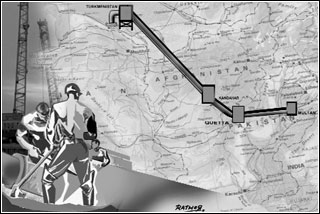 With the signing of the memorandum of understanding (MoU) between the governments of Pakistan, Turkmenistan and Afghanistan last month, the long held plan of importing gas from Turkmenistan through Afghanistan has lived up once again.
First phase of the proposed project would consist of a feasibility study, selection of a consultant estimation of costs, formation of a consortium and search for deep-pocketed financiers. The Asian Development Bank is likely to complete the feasibility study for the link by July this year.
The building of the trans-Afghanistan pipeline has been under discussion for some years but plans were held up due to decades of instability in Afghanistan. Even after signing of the MoU, the big question remains the same: who will come up with the $2.5 billion investment necessary for the completion of the project, and is return on the investment enough to make the proposition feasible?
The project was originally intended to be built by a consortium led by the US energy giant, the Unocal. In March 1995, a memorandum of understanding between the then governments of Pakistan, Afghanistan and Turkmenistan was also signed in this regard. But the consortium consisting of the Unocal Corporation (46.5 per cent), the Delta Oil Company Limited, Saudi Arabia,(15 per cent), the government of Turkmenistan (7 per cent), the Indonesia Petroleum, Inpex,Japan,(6.5 per cent), the Itochu Oil Exploration Co Ltd (Cieco, Japan, 6.5 per cent), Hyundai Engineering and Construction Co, Ltd, Korea, (5 per cent), and the Crescent Group, Pakistan, (3.5 per cent), withdrew from the project in 1998 after the US strikes against the training camps associated with Osama bin Laden in Afghanistan.
The 48-inch diameter proposed pipeline will extend 890 miles (1,425km) from the eastern Turkmenistan and follow the Herat-to-Kandahar Road through Afghanistan, cross the Pakistan border in the vicinity of Quetta, and terminate in Multan, Pakistan, where it will tie into an existing pipeline system. It will carry natural gas from the Dauletabad field at a rate of up to 2 billion cubic feet per day (20 billion cubic meter per year).
The Dauletabad Field is the third largest gas fields in the world. The field’s resources are adequate for project needs for 30 years or more. The government of Turkmenistan has guaranteed the delivery of 25 trillion cubic feet (709 billion cubic meters) of natural gas exclusively for this project.
The project enjoys strong support from the governments and leadership of the three countries as it offers numerous long and short-term benefits to the region. In addition to regional advantages, the pipeline offers specific benefits to the countries involved. Turkimenistan will reach new markets with its plentiful gas reserves, while Pakistan gains a reliable source of clean-burning fuel to drive its economic growth. Afghanistan will earn extensive economic benefits from the pipeline, both during construction and over the life of the project. A lucrative transit fee of tens of millions of dollars a year is likely to help speed the recovery of the war-ravaged state.
Pakistan is amongst the most gas dependent economies of the world. So far about 32 TCF of crude gas reserves of variable quality have been discovered of which over 11 TCF have already been produced and depleted.
Pakistan needs a high and sustained growth in energy supply. The per capita commercial energy consumption in our country is nearly half of the average energy consumption of the developing countries. Whereas, the global per capita commercial energy consumption is almost seven times higher to that of Pakistan.
The current gas requirement in the country’s power sector is estimated at around 1200 MCFD (million cubic feet per day). This included 300 MCFD for the Karachi Electric Supply Company (KESC) and 900 MCFD for Wapda system. The demand in power sector is estimated to go up by two to three times in next 10 years. Against this demand, the total gas supply estimates including from new discoveries have been estimated at around 1000 MCFD.
Pakistan’s demand for natural gas is expected to rise substantially in the next few years, with an increase of roughly 50 per cent by 2006, as it plans to make gas the “fuel of choice” for future electric power generation projects. This has necessitated a sharp rise in the production of natural gas, and also has generated interest for importing gas from the neighbouring countries.
As a matter of fact the feasibility of this pipeline project for economic technical and environmental aspect is very promising but for security reasons it is extremely doubtful. Amid the on-going political transition process in Afghanistan, the risks to the security of the pipeline cannot be discounted. In spite of Pakistan’s serious energy needs to enhance its industrial infrastructure, domestic politics in Afghanistan is complicating the picture.
Pakistan, Tukmenistan and Afghanistan are keen on strengthening the long-turn economic relationship, but any finality about the proposal for a gas pipeline between the three countries may take time — not because of want of interest by any one of them but on account of the problem posed by the unsecured political situation in Afghanistan.
The threatening situation in Afghanistan is the most significant problem which is likely to keep the investors away from this trilateral project. It would require a lot of change in Afghanistan to start the implementation of this project, especially as the current allied forces-backed government in Afghanistan does not control much outside the capital. Particularly in the areas from where the proposed pipeline is to pass. There are serious concerns about the Afghan stretch of the pipeline. There are questions concerning the potential impact that the feuding warlords could have in Afghanistan on the security of the proposed pipeline project. Pakistan must take into account the various contingencies, especially the risk of disruption in the event of hostilities, or of sabotage and damage even in the absence of an armed conflict in the region.
Keeping in view this threatening security issues in Afghanistan it is required that other available options for importing gas must also be explored instead of putting out huge industrial infrastructure at the mercy of such delicate situation.
The offer of Iran which has second largest gas reserves of the world after Russia, can only be a viable option for Pakistan. Some independent observers are also of the view that increases in domestic gas production, coupled with a slower growth in demand than projected by the Pakistani government is likely to render the gas pipeline projects economically unfeasible.





























