0
0

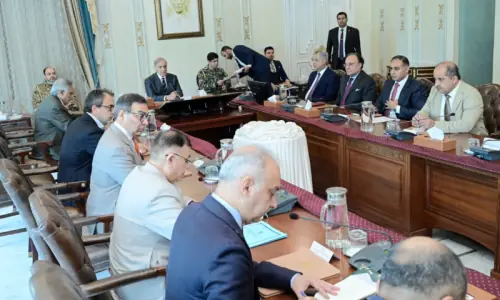
ISLAMABAD, June 6: The army’s top brass on Wednesday – quietly – congregated for the 150th Corps Commanders meeting. Neither was any media statement issued nor was any army official ready to say anything beyond that it was a routine affair. However, the timing and the international context were far from routine.
“The commanders were briefed about internal and external security situation of the country. Moreover, they took stock of the operational preparedness of the troops,” an army officer said.
According to a source, the most important issue before the generals was how to overcome the stalemate in talks with the US on new terms of engagement and, more importantly, the resumption of Nato’s ground supply routes suspended after the Nov 26 Salala attack.
For now the chances of an immediate restoration of the routes are not very promising, particularly given that a meeting of the Defence Committee of the Cabinet, the highest policy coordination forum on national security issues, which had been planned for June 11 has been quietly called off. The meeting was to review progress in the bilateral negotiations with the US and give go-ahead for new agreement on routes.
Pakistan’s renewal of insistence on a US apology, which had once been relegated on its set of priorities ahead of the Chicago summit, is likely to further complicate the dialogue.
Apparent hardening of the position in Islamabad comes after the CIA increased the frequency of drone attacks on militant targets in tribal areas, even though one of the recent strikes is said to have taken out Al Qaeda number 2 Abu Yahya Al-Libbi.
The toughening of stance also appears to be in response to the sharp US reaction on conviction of Dr Shakeel Afridi, the physician who helped CIA hunt down Osama bin Laden, for his collaboration with banned a militant group, Lashkar-i-Islami.
Parliament had in April given its nod for resumption of non-lethal Nato supplies, but the government has been struggling to conclude a new transit agreement. The negotiations on reopening ground routes have involved officials from the Foreign Office, finance ministry and the military. However, it is said that the army is calling the shots.
A deal on the routes hasn’t come through because of differences ranging from the fee to be paid by the military coalition to other technical issues.
But sources privy to the developments at the talks say both sides have “covered some ground”.Nato has signed agreements with three Central Asian states for exit of its equipment during drawdown in Afghanistan, but Nato and US officials have said that it shouldn’t be implied that they had given up on discussions with Pakistani authorities on the routes.
US assistant defence secretary Peter Lavoy is due in Islamabad this week to help break the logjam over the financial aspect of the deal.
SIACHEN: The commanders’ meeting reportedly also discussed the coming dialogue with India on Siachen and Sir Creek. Defence secretaries of India and Pakistan will meet in Islamabad on June 11-12 to discuss the Siachen dispute.
The Gayari tragedy, in which 139 Pakistani soldiers lost their lives after their headquarters got buried under a massive avalanche, has highlighted the futility of war at the world’s highest battleground.
There is little hope of progress at the talks because of India’s continued obduracy. Gen Kayani, who presided over the corps commanders’ meeting, had sometime ago said that India had hardened its position on Siachen.
The Indian army has dismissed Gen Kayani’s proposal for demilitarisation and Defence Minister A.K. Antony told parliament that no one should expect any “dramatic results” from talks.
The generals, after the corps commanders’ conference, attended the funeral of Lt Col Tanvir-ul-Hassan, who headed the battalion in Gayari.
The dialogue on Siachen will be followed by talks on Sir Creek on July 17-18.