



 0
0

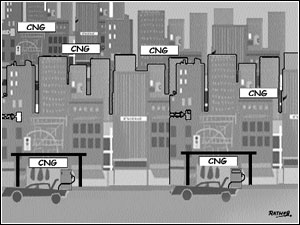 On 4, November 02, the Sindh Housing and Town Planning Department amended the Karachi Building and Town Planning Regulations 2002. Amongst the various outcomes of the amendment, the conversion of residential plots into CNG stations was allowed after the payment of a prescribed fee.
This action of the authorities was in line with the approach of gaining maximum commercial benefits without giving the slightest regard to long-term sustenance of neighbourhoods and urban environment.
Few months ago, a great deal of criticism was levied by public spirited professionals, citizens and some NGOs on the decision to regularize illegally built structures in the old town areas of the city. Obviously such regularization was aimed at generating some financial gains not at all commensurate with the extent of hazards posed to the public life and property. The administration finds it convenient to amend, bend, repeal or re-draft pieces of regulations and rules as it deems fit to its own self serving interests.
In the absence of a valid city plan, such actions continue unchecked and even unaccounted for. Needless to say that urban land-use management and control, infrastructural planning, development and management, resource generation alternatives, planning for social, cultural and environmental needs of the city can only be coordinated through a city master plan. Review of the past shall provide a useful background to urban planning process in the city.
Several plans have been prepared for Karachi since independence. The Greater Karachi Plan (GKP) was prepared by MRV Associates of Sweden in 1951-52. This plan established the growth corridors of the city and proposed an exclusive detached district in the northern part of the city to be developed as the new capital. Fast mobility links were also proposed between the capital complex and the old town. The housing issue was to be resolved through the development of multi storeyed flats between the old and the new cities. The plan could not meet is targets due to many reasons. The data base upon which the plan was founded was grossly inadequate. Besides the capital was shifted from Karachi to Islamabad thus making the new Karachi district a redundant idea. However, the city expanded more or less along the same corridors as identified in the plan.
The Greater Karachi Resettlement Plan (GKRP) by Doxiadis Associates - completed around 1958 - earmarked Korangi and North Karachi as the resettlement sites. Provision of employment opportunities through industrial and commercial development was envisioned parallel to the process of resettlement. The plan could not achieve its targets as it lacked a strategy for land-use management. Besides the role of participant authorities was not outlined. Also industrial and commercial development was very slow.
With the technical and financial assistance of United Nations Development of KDA began the preparation of the Karachi Development Plan (KDP) in 1969-70. The plan period covered a span of 12 years from 1973 to 1985. A comprehensive data generation was conducted for the plan which provided valuable statistical backup to the exercise. The plan, after careful analysis of the past trends, formulated specific targets at the sectoral and area level. Projection of the population, demand for housing and other facilities land-use allocations, corridors of growth, development of employment opportunities were some of the salient aspects outlined in the plan.
Though the KDP 1973-85 was able to achieve certain components of its stipulations, it was not able to meet its targets in the general sense. Ambitiously, the plan originated from well-intentioned objectives such as emphasis on adequate employment, basic infrastructure, food supplies, safe potable water, environment sanitation, flood protection and basic institutional changes. However due to an entirely limited capacity of the planning authority to persuade, communicate and enforce the stipulations of the plan, the objectives could not be met.
The plan largely believed that the state can deliver the goods but did not elaborate upon the instruments and mechanisms. For example, in one of its sectoral components, it emphasized upon housing provision to the shelterless. But the actual development shows that it was informal sector that was providing shelter through its own mechanism across the dismal failures / impeded public sector housing projects. The plan made references to fiscal and organizational changes but did not indicate them specifically. It addressed various comprehensive and / or sector programmes without outlining the basic role of participant actors.
The KDP (1986-2000) aimed at developing a new urban growth management tool based on quantitative analysis and computer analysis. Creation of mechanisms for continuous updating and diffusion of development plans prepared by concerned departments and training of the operative staff and senior officials in the new methodologies. The plan was a high budget exercise costing Rs430 million. It was not able to achieve its specified targets due to various reasons. One, it remained a non-entity, like the previous plans, due to absence of official notification. Two, the planners did not include the feedback of the various stakeholders who possessed a direct bearing on the city development.
Three, performance of mathematical models was dubious due to the non-availability of reliable data. And four, there was no institutional arrangement present to guide the overall implementation of the plan. Review of the previous urban planning processes raises several concerns. It has remained a common practice in planning to start afresh. Each time the previous plan was merely consulted for a passing reference.
Evaluations were never conducted to review the performance of any plan made in the past. All the plans for Karachi had been made under the auspices of the KDA (now defunct) which did not possess any legal or administrative control on the nineteen or so other land development agencies in the city. Thus the capacity of KDA to execute the plans was grossly constrained. The planning process was reduced to a mere residual type exercise which was only conducted under the directions of the donors or the UN agencies.
It never enjoyed the political mandate of any regime who traditionally wanted to keep their options open for any adhoc adjustment in the metropolitan functioning. The steering committee that was set in the Karachi Development Plan (KDP) 2000 and chaired by the Chief Minister of Sindh never met for once in the entire past to legally adopt the plan. The planning process, which was always organized in the most traditional pattern, was faulty and inadequate. The basis of the assumptions was drawn from sample surveys in the absence of comprehensive views on realities.
This led to under/over estimations. Physical data was obsolete and never upgraded. Even today the city does not have a comprehensive mapping base that is otherwise required for all kinds of planning and development exercises. Data gathered by the defence institutions is not in the public access. The property ownership records or the alignment of jurisdictions are simply inappropriate and obsolete. In the KDP-2000, the KDA suggested various options for investments or the concerned institutions that were entirely autonomous in their conduct. Thus it is impossible for the planning agency to execute the various components according to the outlined framework.
It is interesting to note that those groups who actually decide about the fate of the city were not invited to the policy or plan making tables neither during the KDP 1973-85 nor KDP 2000. Transporters, shopkeepers, estate agents, brokers, land sub-dividers, dealers, religious and political groups, professionals, builders and businessmen remained aloof throughout the process. Nor were the groups of localities from general public invited to contribute their ideas in the planning process.
In the past and present setup, the metropolitan level institutions have always remained an outreach of the provincial and federal government. The control of the municipal affairs directly rests with the provincial and federal bureaucracy. In the absence of an autonomous local government, it is difficult to imagine any urban planning to function.
One of the most vital assets that is governed through an effective urban planning process is land. In Karachi, land management and allocations have been inaccurately done throughout. According to land-use survey of 1986 - which was done in follow up of the KDP-2000, vacant urban land was 60.5 percent of the total value. This included 4.8 percent developed land, 17.1 percent land approved for a specific format of development and 38.6 percent other categories excluding agricultural land, flood plans or water bodies.
This shows that the concerned authorities resorted to indiscriminate allotment of land irrespective of the index of utilization or real need. Such land which eventually got transferred to private owners without immediate utility, became a barrier for a rational city development since in reduced the options of appropriate decision making. Growth corridors were termed as saturated as the land assets were continuously sold away in dubious deals. It also indicates rising pressure of various interest groups having stakes in acquiring, encroaching or changing the land uses.
As a consequence of this aimless land supply, 380,018 plots lied vacant. According to KDAs estimates, they have a total capacity of absorbing 5.1 million people - half the size of current population. Successive regimes have conveniently ignored urban planning for self serving reasons. One, a valid urban plan or planning guidelines establishes the rules and regulations of land disbursement or adjustment, it leaves almost no room for arbitrary allocation of land, a practice rampantly undertaken by provincial and local administrations. Two, a duly notified urban plan lays down the conditions of land utilization and corresponding developmental pattern.
Parameters such as density, infrastructural provisions and selling and purchasing gets regulated. It therefore curbs arbitrary decision. three, a master plan draws its conclusions from research studies on the concerned subjects. It is most likely to give realistic predictions in related matters. And four, a valid master plan tends to control squatters and land grabbing due to the defined status of land assets. chances of corruption also reduce sizably. Thus regimes which favoured malpractices in these directions have become rampant, discouraged entirely the notification of any kind of master plan.
It is obviously clear that in the absence of a strong planning agency that also exercises developmental control functions, planning process cannot develop. Some attempts have been made in the past to this effect. The KDA-2000 have suggested the creation of a Karachi Division Physical Planning Agency (KDPPA). The creation of this agency remained in cold storage for several years. In 1999, the then Governor of Sindh constituted a committee to help create a planning agency for Karachi. This committee, which comprised urban planners, academics, researchers and city administrators, voluntarily worked for several months on the subject before presenting its report. However its recommendations were never considered.
After the enforcement of Sindh Local Government Ordinance 2001, new planning structure was notified in December 2001. At the city level, a City Agency for Master Planning (CAMP) was suggested as an umbrella setup to ensure the enforcement of city master plan. The same pattern was to be repeated at the town level. In follow up of this notification no action was initiated.
It must be clearly understood that for generating any planning process leading to a viable city plan, two pre-requisites have to be fulfilled. An urban and regional planning law needs to be promulgated to define the objectives, direction, jurisdiction and overall control mechanisms pertinent to planning and development. Without a valid legislation, planning will not be able to achieve its desired results. In addition, an administrative empowered planning agency needs to be created with sufficient autonomy of conducting its affairs without bureaucratic and political interference. This agency must draw its own working agenda in consultation with the concerned stakeholders. After developing consensus, working methodologies and other details must be worked out. Without proper institutions, required out put cannot be generated.





























