



 0
0

 THE government in recent years has shown some positive signs of formulating a long-term industrial policy, which brings hope for industrial revival in the country.
However these efforts on the part of policy-makers would go in vain if these are not backed by the strong commitment shown by various stakeholders.
Automobile sector in general and car-assembling in particular is a glaring example where stakeholders are not working in unison.The automobile industry which has been in operation for more than a quarter of a century now has not been able to solve its problems due to what the players in industry called ‘inconsistency’ of the government policies and the general public call attribute it to auto assemblers’ greed of extracting as much profit as possible. The result is that the industry has failed to wrest even 50 per cent of the share of the car market.
Different governments introduced different policies at different times but the last straw on consumer’s back—- the imposition of ban on import of used cars—- was introduced in February 1994 on the insistence of local assemblers that such imports were killing the local industry. On their part, they assured the authorities that there would be no irrational increase in prices and they will facilitate the establishment of downstream industry by attaining high degree of deletion.
The car industry gradually attained the status of the most protected industry in the country as the government, besides banning import of used cars, retained the high rate of duty on import of new cars. This provides domestic car manufacturers immense monopolistic power which they use to exploit the consumers.
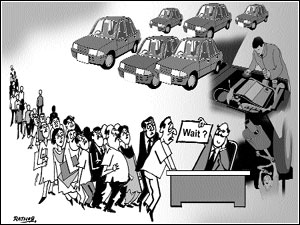
Car manufacturers have not yet implemented the agreement reached with the government in which the car industry had assured that the waiting period for delivery of a new car would be minimized up to 15 days by June 2002 but upto September the same was as high as seven months for Toyota Corolla. Another factor which consumers complain about is the presence of so-called brokers in the offices of authorized dealers of famous brand cars. These brokers ensure the consumer of delivery within 15 days after payment of “premium” which is up to Rs, 200,000 for new corolla models and less for other brands. A chunk of this ispassed on to the car manufacturers through authorized dealers. This is a unique example in today’s world when market economy is the buzz word across the globe.
Since 1994, car manufacturers never missed an occasion to immediately increase prices of their products at the slightest depreciation of the Pak rupee and always found a helping hand in the ministry of industries which always acknowledged the claim of car manufacturers that as 80 percent of their cost is based on imported CKD (completely knocked down) kit and the increase in prices is inevitable due to depreciation of the Rupee against dollar. Over the years, the auto prices have registered increases far above the rising rupee-dollar parity.
The post- 9/11 events has changed the situation and the rupee has appreciated by hefty 12 percent and on the same pretext, the car prices should have come down by at least 10 percent but the car manufacturers with the help of the ministry of industries created artificial shortage in the market to avoid any pressure from the consumers for price decrease.
The car industry has always kept utilization of production capacity below 40 percent to keep the prices up. The leasing companies and banks have boosted demand for new cars for sometime but car manufacturers are exploiting this extra demand by keeping supply far below the demand. The existence of five time’s bigger market of used cars than new cars implies that prospective car buyers are exploited. Automobiles in general and car industry in particular is the most protected industry in the country and the industry is taking advantage of this protection.Despite demand the car industry has always deliberately kept more than 50 percent of the capacity idle to keep the prices up.
In the current budget (2002-03), the government has reduced customs duties on imported cars to expose the industrty to competition competition. However, the reality is that highest reduction has been for cars that are above 1800 cc, which means luxury cars. The import duty on such cars has been reduced from 250 per cent to 200 per cent. The local industry does not manufacture cars of the aforesaid capacity, except a few models comprising diesel engines.The finance minister’s “signals” to car manufacturers did not bring the right response. Effective protection rate (EPR) for car industry is still very high by all standards.
It is interesting that the government was assured of help in grooming downstream vendor industry which manufacture and supply the local car assemblers with auto parts such as pistons, engine valves, gaskets, camshafts, shock-absorbers, struts, steering mechanism, cylinder head, wheel hubs, brake drums, wheels, bumpers, instruments and instrument panels, gears of all types, radiators, cylinder liners, blinkers, lights, doors and door locks as well as auto air conditioners. The car assemblers committed to attain 100 percent deletion by the end of 2000 but we are now in the year 2002 and we are no where near the target.
The government has provided extensive protection to the car industry under an agreement reached in 1995, under which the car manufacturers were to help grooming of downstream vending industry and take care of consumer’s interest. The car barons have never taken care of this agreement. The deletion level or indigenization has reached the target extent only in case of petty parts like battery, tyres, tubes, radio, floor covering and peripheral items for Toyota and Honda, and for Suzuki Mehran, 150 total deleted parts/ components only 15 are worth more than Rs500 a piece. Pakistan has spent $32 million worth of foreign exchange on import of auto parts. The Original Equipment Manufacturers (OEMs) contribute less than 50 percent of the parts. The vendor industry manufacture parts for old cars only. There are number of complaints regarding poor quality of auto parts used in local assembled new cars of various brands.
A rational tariff policy, indigenisation through vendor development and standards/quality control measures is the need of the hour. The development of automotive sector to meet the future national demand is only possible through strict control and monitoring by the government. After 2005, in accordance with the WTO ruling, there will be no duty on consumer items.




























