



 0
0

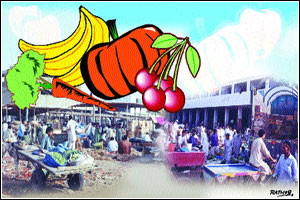 On 02 November 2002, the Governor of Sindh instructed the concerned authorities to allocate 20 acres of land to the growers in the new Karachi Fruit and Vegetable Market (‘sabzi mandi’).
While this action may have been in response to a long-standing demand of a category of stakeholders, it establishes the scarcity of space originally allocated for the market. The performance of the mandi and its overall state of affairs require a review as there are several concerns raised by the associated interest groups.
After years lost around in impasse, the Karachi Sahzi Mandi was finally shifted to its present venue along Super Highway about two years ago. The previous site on University Road had become extremely chaotic - virtually incapable to house the related activities any further. Traffic congestion in and outside the premises; mounting encroachments on the street side and along the vacant land strips; rising dumps of solid waste; absence of proper parking spaces for loading vehicles and private cars; total break down in the services and utilities; lack of possibility of expansion in any direction; absence of labour housing/shelter facilities for the workers; distant location of banks/financial institutions and a rising load on urban infrastructure were some of the major problems faced by the stakeholders of ‘sahzi mandi’ at its old location. However, the review of the new site does not depict any better situation.
The new ‘sahzi mandi’ has helplessly allowed itself to become a dilapidated site soon after its inauguration. The previous site was spread onto 110 acres of land, which at the time of its allocation in 1960s were found to be adequate. It is astonishing to find that after almost 40 years in which Karachi has expanded several folds in population, space and economic activities, the size of the new site is again around 110 acres. This establishes the fact that the Mandi was designed with a space constraint right from the start of its operation.
Controversy surrounded the whole affair of allotment of stalls and storage spaces. According to the Sabzi Mandi Welfare Association (SWA) , the preference of allotment was given to such applicants who were favoured by the controlling government authorities and law enforcement agencies. At the beginning of the project, 1764 shops and stalls were proposed by the market committee. A formula of allotment was worked out. 45 per cent shops were to be allotted to shop keepers of the old ‘sahzi mandi’, 25 per cent to landlords/growers and 30 per cent to new allottees.
In order to accommodate the political favourites, the number of shops was increased three folds while the size was considerably reduced. In some rows, the size of the shop was as small as 48 sq.ft. - similar to a paun cabin! Many unresolved cases of allotment add to the grievances of the genuine traders in fruits and vegetables who had been elbowed out to make room for fresh entrants. A case was filed by the SWA against the government of Sindh and the City District Government in 2000 - before the provincial Ombudsman.
After hearing the grievances and reviewing the overall situation - also seeking comments from professionals, the Ombudsman constituted a standing committee to oversee the overall working of the project for one year. This committee which was to be headed by the Chief Secretary and included important functionaries, was to get the existing layout plan updated and approved by the KDA wing of the City Government with the assistance of a town planner. After the approval of the said plan, the committee was to proceed with the pending allotment cases, applications and disputes.
All pending dues were also to be recovered from them. The ombudsman also ordered cancellation of the highly dubious allotments done in duplicate/triplicate which were in several hundreds. It was also stressed that the conditions of utilities and services essentially required for the functioning of the mandi shall be satisfactory before the shifting would take place. Steps were to be taken to enhance the parking for which sufficient space was not provided. In short, the learned ombudsman provided a number of decision making prerogatives to the standing committee to facilitate timely actions for the improvement of the situation.
Standing committee has been amorphous despite very clear instructions from the office of the ombudsman. It has neither met nor taken any action despite the mounting grievances among the stakeholders. The building and site layouts were never prepared. Despite this unpreparedness, the traders were made to shift to the new premises. Extremely low ceiling heights of the shops/stalls have rendered the entire construction exercise futile. The traders conduct their business in the open space outside their acquired shops.
The mandi converted into an instantaneous slum soon after its inception. Sanitation system has broken down as apparent from the site situation. Although thousands of folks use this space every day, only 60 toilets have been constructed. At no stage did the consultant or the executing agency obtained viewpoint of the community/stakeholders for assessing their daily needs. Being left out by the authorities, the stakeholders took several initiatives on their own to address several basic issues.
Through applications released to various fore, the users demanded for options in the design of the premises. The shopkeeper association stressed that the shops should be made of equal size, preferably with breadth not less than 12 It and length of 25 ft. They also suggested many modifications in the existing layout and automation system to organize vehicular flow.
Whole sellers demanded shops of the same kind since their nature of operations require similar space. It was further aspired by the traders to obtain properly built open platforms for those who have been involved in the business but lack the financial capacity to own a separate shop/stall. The shop keepers also demanded their participation in the overall decision making process related to planning, design, allotment and management of the premises. It is disappointing to note that the administration has not been able to provide the necessary assistance to the shopkeepers and other stakeholders. Review of the prevailing situation at the new site of the mandi presents a scene of haywire operations.
Business activities have spilled out of the confines of shops and stalls. This causes great deal of congestion and physical hurdle in the movement of pedestrian and vehicular movement. Retail business concentrates around the entry points to the mandi which causes impedance of movement for vehicles and pedestrians. The heavy vehicles move around in the entire premises without any restraint. They stop along main corridors causing mobility halts for hours. There is a severe shortage of water. Shopkeepers have to purchase water from the water tankers. Poor road conditions inside the mandi are a common sight. Damage in sewerage system causes a great deal of problems of cleanliness within the premises. Solid waste is scattered all around causing unhygienic condition.
No space control is found in the premises where encroachments and extension spaces have started coming up. Another key issue is labour housing and community. The mandi is located in the outskirt of the city where very few modes of public transport ply. Most of the labourers come from Landhi / Korangi and nearby eastern settlements. They end up spending Rs. 40-50 on daily commuting which is about one-third of their daily earnings. Options of labour housing are not provided which is a denial of an existing need. It has given rise to peripheral squatters that shall grow over the period of time.
It is a matter of grave concern that a new site has become a victim of blight not dissimilar to its old location. The gravity of the situation requires certain steps to be taken immediately to make the mandi function properly. The institutional setup prescribed by the honourable ombudsman must be made operational without delay. The proposed standing committee may begin consultations on the core issues and evolve a working committee wherein all the concerned operational groups need to be represented.
This committee should be empowered to undertake all the routine management affairs of the enterprise. A land use analysis must be conducted to study the prevailing conditions, identify the short comings and evolve workable solution to the satisfaction of all stakeholders. The study must include the peripheral locations which shall affect the overall performance of the mandi. It may also be noted that planning and design remedials are a pre-requisite to smooth functioning of the mandi. To resolve the disputes related to the allotment, the orders of the Ombudsman should be strictly followed. It must be remembered that institutional apathy can gravely undermine the potential of this vital enterprise that provides one of the most essential commodity to the citizens of Karachi.




























