0
0

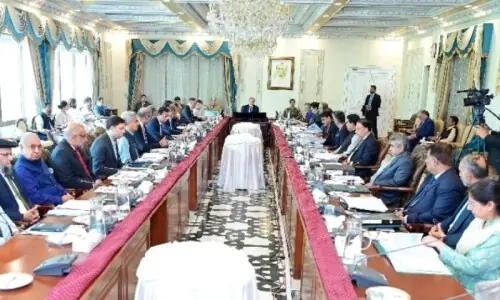
KARACHI, Nov 1: Speakers at a meeting here on Friday demanded that a master plan for the city be prepared after having consultations with all the stakeholders, and then it be strictly implemented.
They were speaking at the meeting where a panel discussion on “Managing Karachi’s Land use: The Way Ahead,” organized jointly by the Shehri — the Citizens for a Better Environment, and a German NGO, the Friedrich Naumann Foundation.
The speakers said unless an umbrella master plan document that provided for the city’s management, development and growth was not prepared, notified and strictly enforced, it would be extremely difficult to reverse the deterioration in the physical and natural environment of the city.
They also demanded that comprehensive laws be formulated and that the discretionary powers of government functionaries be abolished, as mostly these discretionary powers were misused to favour a few individuals.
They also demanded that information regarding government land and its use be made public so that when some land was put to wrong use, the area residents could easily know about it and raise their voice against the violation.
Barrister Qazi Faez Isa of the Shehri called for restoration of the Karachi Building Control Authority’s Oversee Committee which comprised technocrats and concerned citizens and monitored the working of the KBCA.
He also called for repeal of the Sindh Regulation and Control (Use of Plots and Construction of Buildings) Ordinance, under which all buildings constructed illegally could be regularized.
A former director-general of the Karachi Development Authority, Brig Zaheer Kadri (retd), referred to the allegations levelled against the KDA/KBCA, and said organizations would be as corrupt as the people running it were corrupt or otherwise. He said during his tenure he had sacked at least three controller of buildings.
He said a few months back the former chief controller of buildings (CCOB) had refused to oblige a builder despite phone calls from one of the most powerful men in the country who wanted to oblige his golf-playing buddy. He said he had asked the governing body members to extend support to the CCOB, but unfortunately they did not do so.
Arif Hassan said master plan be made keeping in view the ground realities and after reaching at a consensus among all the stakeholders.
Nooruddin Ahmed of the Pakistan Engineering Council said honest government officers were mostly under pressure from the rulers to carry out illegal orders, so after some time many of these honest people also began accepting bribes, because they felt that they were doing illegal work anyway so why should not they make some money out of it also.
Farooq Zaman of the Association of Builders and Developers said the government charged the land use change fees, but it did not spend these on the area from where these were generated. This adversely affected infrastructure resulting in hardships to the people. He said if the fees charged were used to upgrade and expand infrastructure in the same area there would be no problems.
Prof Nauman said land was considered a saleable commodity, not a social or community asset. He said Karachi used to be one of the cleanest cities in Asia before partition, but afterwards because of a rapid increase in population the infrastructure could not keep pace with it.
Tariq Rasool of the Pakistan Council of Architects and Town Planners (PCATP) said allegations of illegalities had been brought against more than 20 architects, but inquiries conducted by the PCATP revealed that only four or five of them were guilty.
Ahmed Parekh said if public representatives were given powers, they could solve most of the problems.
Khatib Ahmed, Ronald deSouza and others also spoke at the programme conducted by Mehreen Khan.