0
0

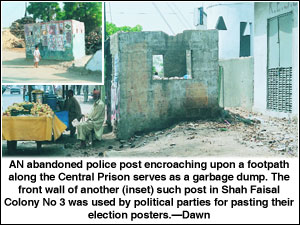 KARACHI, Oct 20: A large number of redundant police kiosks in the city pose a potential security risk to the general public instead of providing them a sense of security.
In the past, there have been several instances in which terrorists used these kiosks to carry out subversive activities.
Bomb explosions have taken place in a number of such unmanned police kiosks in different parts of the city, inflicting injuries on many people.
In the mid-90s, terrorists planted an explosive device in an abandoned police kiosk near the Sindh Assembly building.
Several passersby were injured in the explosion, which destroyed the kiosk as well and partially damaged the compound wall of a private property. Following the explosion, the picket was removed.
The setting up of new police check-posts in the aftermath of every major terrorist incident has become a common practice by the police, rendering the entire exercise merely a superficial measure.
In the wake of recent terrorist attacks on churches in Punjab, which claimed several lives, new kiosks were established outside major places of worship in the city, especially in Saddar town.
Such superficial security measures are being adopted outside the gates of Holy Trinity, St. Patrick and several other churches located in the area.
Following recent killings at the Idara Amn-o-Insaf in which seven persons were shot dead by unknown gunmen, security was further beefed up around different churches in the city.
Retrospectively speaking construction of such police check- posts has failed to curb any terrorist attack.
Some months ago, two police officials performing their duty at a police kiosk, constructed in front of Moti Mahal hall in Gulshan-i-Iqbal, were attacked with sophisticated weapons by armed motorcyclists.
As a matter of observation, even at manned police check-posts, often policemen are seen chatting with each other to kill the time.
Sources said in the Moti Mahal incident, the policemen on duty were busy chatting and were not alert when they came under attack. While the unmanned posts are a potential threat of being used in a subversive activity, these also prove to be a safe haven for drug addicts. A significant number of such kiosks are visible in the Saddar town.
However, police do not let any opportunity go, and they “tax” the down-trodden addicts for using the picket facility.
In the absence of public lavatories in the city, these abandoned kiosks are also catering to the needs of the general public who use them in their moment of need.
At various places, redundant police pickets have been converted into garbage dumps where sanitary workers and people dispose of rubbish. The sanitary workers even use them for garbage burning.
Moreover, construction of unspecific number of police kiosks on pavements obstructs pedestrians movement.
Even a centrally-located police kiosk on the pavement of Shaheen Complex blocks free pedestrian movement, as passersby have to get down the pavement while passing through the area; and being one of the busiest artery, there is a constant threat of accidents as traffic flow also gets disturbed owing to movement of pedestrians on the road.
The police, by setting up kiosks at busy junctions or thoroughfares, start snap checking of motorcycles and cars, causing disruptions in the smooth traffic flow.
A new kiosk was set up near the Fountain Chowk which was painted with a commercial advertisement by a private company, and policemen stop mainly motorcyclists at that spot to check their documents. They also stop cars in the rush hours, the traffic gets jammed due to their lust for ‘income generation’.
On main Sharea Faisal, the traffic police, along with military police, naval police and regular police force, have erected barriers for the past some months narrowing down the width of the road and they remain present there round-the-clock.
As they signal a car to stop, its driver usually stops his/her car owing to fear of police and army, ultimately becoming a risk factor in accidents.
Recently, the police signalled a car to stop, which took a sharp turn and stopped near the kiosk. A truck belonging to the armed forces, which was behind that car, pulled up scratching brakes to save the car ahead of it. However, another car, following the truck ploughed into it as its driver didn’t know what had happened ahead, and he was following the truck at a high speed, a usual practice by motorists on this portion of the road.
Such sorts of disruptions and minor accidents have become a routine near different police kiosks due to non-pragmatic approach of the police officials, posted at such sensitive points. Such sorts of measures do not yield any positive results, but compound the miseries of the people.
During extreme security alerts, the check-posts are seldom seen manned.
According to a list of police check-posts at roundabout, green-belts and central islands, submitted by the police to the Sindh Ombudsman a year ago, there are a total of 131 police and 14 rangers kiosks in the city, and their number is continuously increasing.
There are 34 pickets in Central, 36 in South, 29 in East, 23 West and 9 in Malir.
However, following the enforcement of the new police set-up, the number of police check-posts has increased manifold, said a senior police officer. Respective police of the 18 towns went ahead and constructed new police check-posts, he said.
According to a spokesman for the police, there are 217 police kiosks in the city whose number is weekly updated.
On average, 225 to 230 police kiosks are in use, depending on the law and order situation in the city.
According to a town wise break-up, Baldia Town has seven police check-posts, Bin Qasim 5, Clifton 12, Gulshan-i-Iqbal 58, Gulberg 6, Gadap 9, Jamshed 6, Keamari 21, Korangi 9, Landhi 8, Liaquatabad 20, Lyari 9, New Karachi 5, North Nazimabad 6, Orangi 4, Saddar 24, Site 4 and Shah Faisal 4, the spokesman added.