



 0
0

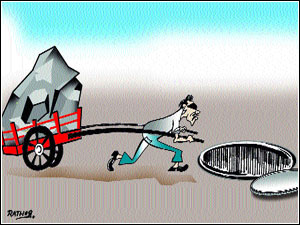 The Asian Development Bank (ADB) has decided to provide $2.4 billion for a period of two years (2003-05) to fight poverty. What is the basis for their optimism to have shown such generosity after years of reluctance to consider even smaller loans? Pakistan already owes $4.8 billion or 23.3 per cent of its total loans to the ADB.
According to the ADB annual report 2001, Pakistan’s development expenditure was a record low at 2.9 per cent of GDP. A recent report by the International Crisis Group presents a very poor state of affairs. Pakistan has become unstable with its economy in a state of stagnation, corruption rampant, rule of law missing, ethnic tensions on the rise and security having become elusive. If Pakistan is not doing enough for poverty alleviation what could infusion of dollars do?
In 1992-93, development expenditure was 36.4 per cent, or a little more than 1/3rd of the current expenditure.It declined to only 18 per cent in 2000-01. Falling development expenditure has synchronized with recessionary trends in the economy and has aggravated the problem of poverty. Rising poverty is, therefore, not an accident. The government in its effort to reduce the deficit, with lending agencies breathing down its neck, has adopted the soft approach of cutting the development expenditure without regard to its impact to the poor and the vulnerable.
The Pakistan Poverty Alleviation Fund (PPAF), funded by the World Bank, is currently in operation and is also intended to reduce poverty. Social Action Programme (SAP) was meant to serve the same objective. It has been admitted to have failed.The PRGF’s failure has been deferred for similar admission. The government is reported (Dawn 25.9.02) to have suppressed a report on poverty, which was based on a survey by the Federal Bureau of Statistics to conceal the extent of phenomena. A clarification only seems to confirm the suspicions. What then is the cacophony of self-congratulatory messages about? How does one explain the world praise for our economic performance? The fact of the matter is that nothing has changed except our pragmatism in relation to the only surviving super power, post 9/11.
To see that our fundamentals are all wrong one has only to turn to the UNDP publication, The Human Development Report 2002, which represents a worldwide survey of 173 countries with respect to development indicators. These countries have been divided in terms of human development into three categories: high, medium and low. On the basis of 30 criteria, out of 173 countries Pakistan ranks 138th on top of the last category. India is 14 places above at 124 under medium human development countries.
The Human Development Index (HDI) value for Pakistan is 0.499 (0.577 for India). It is the highest for Norway at 0.942. On the HDI trends, Pakistan has progressed from 0.345 in 1975 to 0.499 in 2000, whereas over the same period India has inched up from 0.407 to 0.577.
On polity, Pakistan has been performing very poorly indeed, on account of absence of democratic governance even 55 years after independence. It has as yet not ratified the International Convention on Civil and Political Rights (ICCPR). ‘On voice and accountability’, which has elements like free and fair elections, freedom of press, civil liberties, political rights, military in politics etc, its scores (-)1.43 against +0.66 for India (on a scale -2.5 to 2.5). While the world is getting more democratic, we are sliding backwards. We have as yet not signed the ICCPR (1966),The International Convention on Economic, Social and Cultural Rights (1966) and worst of all the Convention against Torture and other Cruelties, Inhuman and Degrading Treatment or Punishment (1984).
On the ‘Subjective Indicators of Governance’ (SIG) Pakistan scores (-) 6 on polity, (-10 is the least democratic country and +10 the most democratic) India scores +9. On ‘objective indicators of governance’ too, its performance has been equally desultory. There are 11 elements to the SIG and on each one of them Pakistan has been assessed to have performed poorly.
On corruption among public officials, corruption as an obstacle to business, frequency of irregular payments to officials and judges and perception in corruption in civil service, Pakistan scores (-) 0.79 (on a scale -2.5 to 2.5). On Corruption Perception’s Index (CPI) her score is 2.3 (0 - 10 scale). On law and order it scores 3 against 4 for India and on rule of law (-) 0.74 against India’s 0.23.
Under ‘progress towards millennium development goals’, Pakistan is on track in respect of two criteria out of 7 only in so far as halving the proportion of people suffering from hunger or of people having access to improved water sources are concerned. Information on removing gender disparity or ensuring compulsory primary education for all children has not been provided. It is far behind on goals regarding reduction of infant mortality rates by two-thirds of the existing.
In infant mortality, Pakistan’s record is despicable at 85 live births per thousand against India’s 69. ‘Under-five mortality’ of children, Pakistan, which had lower mortality rate of 181 in 1970 progressed only to 110, whereas India with 202 per thousand has shown remarkable improvement in reaching 96 in 2000. However, in terms of ‘under-weight children under 5’, Pakistan performs better than India.
Life expectancy for Pakistan in the year 2000 is 60 years (63.3 for India), adult literacy rate 43.2 (57.2 in India). Life expectancy for males is 60.2 years and for females 59.8 years. India’s was higher at 62.8 and 63.8 per cent respectively. Life expectancy has improved almost in tandem with India’s between 1970-75 to 1995-2000; India had a life expectancy of 50.3 years in 1975, whereas Pakistan 49.
On Purchase Price Parity (PPP) index, GDP per capita was $ 1928 ($2358 for India). India’s GDP of$ 457 billion was almost 8 times that of Pakistan’s $61.6 on PPP basis. India was ahead with $ 2395.4 billion against Pakistan’s $266.2. Plain per capita GNP, (un-adjusted for PPP) according to Asian Development Outlook 2003, (an ADB publication), Pakistan’s $ 470 was higher than India at $460.
On Human and Income Poverty (HIP) among the developing countries, Pakistan ranks 68th against India’s 55th. Both countries rank equal under population ‘not using improved water sources’. That means Pakistanis are less undernourished than Indians. India is mired in stark poverty with 44.2 per cent of its population earning less than a dollar a day whereas Pakistan’s share is 31 per cent. The poorest country among the developing countries is Niger. Even for population below income poverty line Pakistan has performed marginally better. Population earning $2 a day is 86.2 per cent for India against Pakistan’s 84.6 per cent.
Cigarette consumption in Pakistan is 5 times higher than in India with 620 cigarettes per adult per annum against 119 for India. This in itself poses a long-term threat to the health of Pakistan’s population, and impose greater burden on our derelict health services. Telephone per thousand people for India was 32 against 22 for Pakistan. Similarly in matter of mobile phones India was twice as good as Pakistan with 4 per one thousand people possessing them. Even in electricity, per capita consumption was lower at 321/kwt hrs for Pakistan against India’s 379. Remember that at one time we went through the motions of selling electricity to India being surplus in production?
By 2015 according to demographic trends Pakistan will have a high 2.5 per cent annual population growth. India’s growth of 1.3 per cent will be below the replacement level of 2.1 per cent. Will there be enough standing space in Pakistan? And what horrendous consequences will follow in respect of environment, law and order and poverty? Portents are far too horrendous to contemplate. The sinkhole is getting bigger and sucks in the entire dole. In the absence of change in fundamentals, particularly governance, any effort at improvement will be fruitless and the money wasted with the ‘silent majority’ saddled with more debts.





























