



 0
0

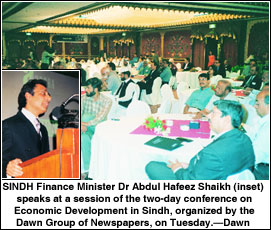 KARACHI, Oct 1: The Nazim of the City District Government Karachi, Naimatullah Khan, said on Tuesday people want to invest in Karachi but there are forces, both internal and external, which do not want that and create conditions that impede progress.
He was speaking at the first working session of a two-day seminar on “Economic Development in Sindh,” organized by the Dawn Group of newspapers.
Referring to the problems being faced by the Karachiites, Mr Khan said as the megacity needed everything there was a need for public-private partnership in which the government should act as a facilitator.
Water was a big problem of the city, therefore the city government was planning to set up desalination plants. He disclosed that six Japanese firms were holding talks to set up such plants in the city.
Mr Khan said the country was passing through a critical phase due to inconsistency in policy, and because of which the common man suffered. More than 35 per cent of the population lived below the poverty line, he added.
Karachi, where 14 million people lived, also suffered due to galloping inflation and population growth. Hardly 50 per cent of the city was planned and more than 53 percent of the population lived in kutchi abadis. He attributed this to a crisisof management as people either did not want to work, or could not work, or could not find work.
Mr Khan however emphasized that the answer to the problems of the city was not borrowing from the IMF or the World Bank, but the solution lay in encouraging public-private partnership.
He said the city government had already signed 18 MoUs and work on detailed feasibility for magnetic levitation railways, to be built with Swiss and German assistance, would be ready by December this year.
Mr Khan said a Saudi firm had shown interest in developing an amusement park in Clifton. He also referred to plans for recycling of sewerage water.
He also referred to various road projects in the city and said the Shah Faisal Colony flyover would be completed six months ahead of schedule. Work on the FTC flyover was in hand, and work on a flyover on Shahrah-i-Quaideen would begin in the next three months. He also referred to projects planned at Guru Mandir.
Mr Khan said in order to generate funds for the city government he had proposed the levy of port-user cess and road-user cess. Road-user cess had now been included in the provincial budget, but the other proposal was not approved by the cabinet.
When his attention was drawn to the rising incidence of hepatitis and TB caused by consumption of contaminated water and insanitation in the city, the city Nazim conceded that lack of solid waste management, garbage-lifting and proper sewerage system were among the causes of these and other diseases. He said efforts were being made to tackle these problem on a long-term basis.
In the context of noise and other pollution, he said soon silencers of rickshaws would be changed.
Nafisa Shah, the Nazim of Khairpur, gave another perspective by focusing on the two extremes that dominate the social fabric of Sindh.
“Violence, ethnic and of other varieties, kidnapping, extortion and other forms of terror represent that government has fragmented and broken down,” she said.
She was of the view that democracy was never given a chance due to frequent military interventions. “There seems to be transition to democracy, though there seems to be no transition,” she said.
Being a Nazim she felt that despite the devolution of power Pakistan is an “oppressively” centralized state as the federal government controls the purse- strings. Even the salary of a sanitary worker is dependent on transfers from the federal government, she said.
She believed that there was a crisis of governance and claimed that the district governments had no tax leverage. She was critical of the fact that the finance award was being decided without the participation of the local governments.
The director-general of the Sindh Katchi Abadi Authority, Tasneem Siddiqui, said 70 per cent of funds allocated for infrastructural development were misappropriated.
He said 300,000 plots of land were lying vacant in Sindh. In Karachi alone there was a need for 50,000 additional plots every year.
He said due to lop- sided planning only 20 per cent of the 53,739 apartments in Surjani Town were occupied. In Shah Lateef Town only one per cent of the 50,000 apartments were occupied, and in Malir Housing Scheme all the 32,000 units were lying vacant.
He said the poor had been excluded from planning for housing despite the fact that housing for the poor was not only shelter but the basic requirement for all economic activity.
He also gave an overview of his experience with Katchi Abadi projects.
Dr Qazi Masood, Associate Professor at the Institute of Business Administration, focused on social inequalities which, he said, were a cause of discontent. He gave figures of the disparities between richest and poorest both in urban and rural areas.
Giving deprivation index, he said in Sindh eight districts were highly deprived, six were in between and only two developed.
Questions were asked as to why the districts which had sizable multi- national investment were still rated among the poorest of the province.
Aly Ercelawn of PILER was of the view that most of the problems were due to following the prescriptions of the World Bank, the IMF or the Asian Development Bank. He was critical of the mega projects and said the foreign-funded projects actually served the interest of foreign donors and were not primarily based on the needs of the people.
In the afternoon session, participants expressed views on donors’ views, agriculture and irrigation in Sindh.





























