0
0

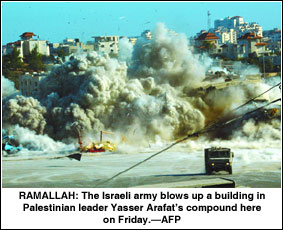 RAMALLAH, Sept 20: The Israeli army laid siege to Palestinian leader Yasser Arafat’s headquarters on Friday, razing everything around it, following a suicide bombing that killed six people in Tel Aviv on Thursday.
A policeman in Arafat’s office building was shot dead by a sniper, and three other Palestinians, including a woman and a teenager, were killed during Israeli raids in the Gaza Strip.
The army, using tanks and bulldozers, took over the Ramallah compound on Thursday night after an emergency cabinet meeting decided to isolate Arafat, whom Prime Minister Ariel Sharon’s government blames for every anti-Israeli attack.
The cabinet demanded the surrender of some 20 Palestinians wanted for alleged involvement in attacks and said to be holed up with the Palestinian leader in his offices.
Two of Arafat’s bodyguards were injured in exchanges of fire in the early stages of the raid and 23 Palestinians were taken prisoner by troops, Palestinian security sources said.
The army then proceeded with bulldozers and excavators to demolish systematically all the buildings left in the compound since a siege last spring.
Several explosions, including one very large blast, were heard, sending huge clouds of smoke and dust into the air.
Within hours all the compound buildings, which housed several Palestinian security bases and the interior ministry, a garage for Arafat’s cars, a jail and dormitories, had been torn down, leaving Arafat’s personal quarters the only building still standing.
The Israeli government acted after a suicide bomber blew himself up on a bus in Tel Aviv, killing five people as well as himself and injuring some 60, 10 of them seriously.
A Scottish teenager who was critically injured in the blast died of his wounds on Friday, hospital sources said.
The attack, the second in 24 hours following a six-week lull in the wake of Israel’s reoccupation of the West Bank, was claimed by the armed wing of the Hamas, which vowed that more would follow.
Israel besieged Arafat’s headquarters for five weeks after another deadlier suicide bombing triggered an invasion of the West Bank in March. It was only lifted after US and British mediators negotiated the imprisonment, under international guard, of six Palestinians who had been holed up inside the compound.
Those being sought this time include West Bank intelligence chief Tawfiq Tirawi and the commander of Arafat’s Force 17 bodyguard, Mahmud Damra.
Before the Israeli army installed a system blocking all calls to and from the Muqataa, Arafat briefed his Arab counterparts on the situation, but this siege did not draw the barrage of international criticism which met the March 29 invasion.
In a very mild rebuke, Washington urged Israel to “bear in mind” the impact of its siege, but nevertheless spoke of Israel’s “right to defend itself and to deal with security”.—AFP