



 0
0

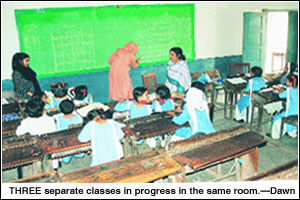 KARACHI, Sept 18: The Deep Chand T-Ojha (DCTO) in Baghdadi, Lyari, has within its boundary wall three two-storey buildings where 13 schools run — four primary schools for boys, four for girls and one secondary school for boys in the morning shift; and four primary schools for boys in the evening shift.
“Two more schools will soon be added: the City School will be shifted here from Pakistan Chowk and a new model school will be set up,” according to area (UC-4) Nazim, Mohammad Hanif Chattani. This will bring the total number of schools within one boundary wall to 15.
One primary school in DCTO - Islamia Nawabad - has a headmaster, but no teacher or schoolchildren. This school has also received the SMC (school management committee) fund of Rs48,000 which, according to the headmaster, Abdul Ghani, is “in the bank, along with some other funds”.
He adds: “I will not spend this money as there are no children in my school.”
The councillor of Lyari Town, Pir Abdul Baqi, explains why so many schools have been concentrated in one place.
“With the commercialization of certain areas in the city, the price of land, on which the government schools have been running on rent, has shot up. The landowners then offered to construct a new school elsewhere, the cost of which is far lower than the price of the land.”
This policy of shifting schools from one area to another provoked much criticism from the headmasters of primary schools in the DCTO and from the Nazimeen of UC 4 and 3.
“There are some 300 children in City School, Pakistan Chowk. If this school is shifted to the DCTO, the students will suffer and they will have to seek admission elsewhere. While in Baghdadi, only a few children will attend the newly set up school as there are already 13 schools in the same premises.
What purpose will all this serve?” Asks Habib Hasan, the Nazim of UC-3. He also added that there were 27 government schools in UC 4, but not one government school in his area - UC 3 - with a population of 60,000.
The 13 schools of DCTO face several problems. According to Ghulam Murtaza, the in-charge of the lone Government Boys Secondary School on the ground, the 430 boys in his school have no toilet. Instead, they use the bathrooms of the nearby mosque. The teachers in the school also face a similar problem and they have to visit nearby homes of relatives, if any, friends or people they have been introduced to in the neighbourhood”.
Earlier, he said, some 30 or so women teachers of the girl primary schools in the premises faced this problem. However, now, with the SMC funds the three existing broken toilets have been rebuilt.
The Government Musa Lane Gujrati School, where the medium of instruction is Urdu, has 128 students, five classes are held, but the school has only two rooms. Classes 1 and 11 are held in the same room and the teachers share the blackboard. “When I instruct my class, the other teacher gives written work,” said the class 11 teacher. Similarly, class 111 and class 1V are held in the same room, while the students of class V sit in the corridor. Despite this, the school has “good education” with a pass percentage of 70 to 80.
Former headmistress Halima Ismail of the Urdu Girls Primary School (in DCTO) complained that the government demolished the adjacent rooms belonging to the Sakina Bai Fadoo School about 14 years ago. She voluntarily gave two rooms of her school to the Sakina Bai school so that it could be run by holding two classes in one room.
The authorities had promised to set up new rooms for Sakina Bai school. However, after completion, they are now being handed over to the two schools, which will be shifted here shortly. Ms Ismail added that a number of schools receiving the Rs48,000 SMC funds have not spent all the money honestly. However, she claimed that she spent the SMC fund, among other things, on establishment of a tank for drinking water. “For 19 years there was no arrangement for drinking water for the children.”
One schoolteacher said that monitoring of the 13 schools was not easy and this permitted some schools to resort to cheating. “If you check the registers of some schools you will find several names of children being repeated.”
There is no sweeper for the 13 schools. “Only five sweepers have been allotted to the Lyari Town, so it is difficult for them to come here,” points out Nazim Hanif Chattani.
He was also troubled by the lack of a central management in the 13 schools. “With just one electricity meter, and one electricity bill, who will pay? If there was a central management, this could be sorted out. Now some schools refuse to pay their share and this arrangement is encouraging the use of kundas.”
Headmaster Amar Katwi of a primary school at DCTO said the basic problem was that the EDO (education) did not come from the local community and this phenomenon encouraged corruption and highhandedness in monitoring of the schools. He added: “Senior primary teachers should be appointed as supervisors of primary schools, who will understand the problems. They should not appoint junior teachers of the secondary schools as supervisors.” He also lamented the low incentives given to primary teachers who, even after several years of service, are given Grade 11 or 12.





























