0
0

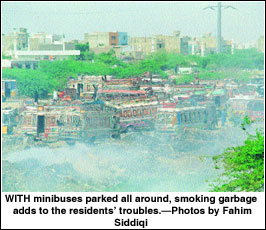 KARACHI, Oct 8: Qayyumabad, a residential area next to Defence Housing Authority, has been invaded by all types of vehicles, and their operators. The most conspicuous of them are minibuses, their drivers and conductors.
The presence of these vehicles has not only made entry and exit for the locality’s people unbearably difficult, but has also given birth to vices that were strange to the locality before the arrival of these vehicles. Drug abuse and prostitution are now rampant.
The minibuses are apparently stationed there with the permission of the authorities. At least seven routes terminate there, including XB, N, N-4, W-21 and Marwat Coach. They may be handy for the commuters wishing to get public transport at their doorsteps. But they are too many in proportion to the population. And the residents are paying a high price for the convenience.
The yellow devils spill into the narrow lanes, block the pathways and rob the residents of privacy and peace.
Besides, the businesses related to vehicles have crept into the lanes of the locality. The usual din made by the denters. The banging of iron by ironsmiths and welders’ jarring sound. All this make life miserable for the people.
The operators’ free time is more troublesome for the residents. They loiter around, smoking stuffed cigarettes, playing loud music in the vehicles, making obscene gestures and cracking dirty jokes.
The transport operators have made life miserable for the residents. Women venturing out of their homes without accompanied by males feel embarrassed when they encounter the ogling outsiders.
The eating-houses set up on roadsides facilitate the transport operators in their ugly business.
“Children used to play cricket and other games where these vehicles are now parked,” says a resident.
A councillor, Haji Wazir Khan, says prostitution and drug abuse are on the rise in the colony, and young men are being ruined by these vices.
“Our next generation is destined to grow as drug addicts,” the councillor says.
The contractor of the “addas,” as the terminuses are called, allegedly gets Rs100 from each of the scores of vehicles. For it, he ensures that these vehicles are not disturbed by police on the roads.
In addition to these minibuses and coaches, there are long-route airconditioned buses parked there because their owners live there. Oil tankers and trucks are also seen parked on roads and in lanes in a haphazard way.
The locality is not deficient in the usual problems, either. The open places around the locality are used for releasing sewage. Sometimes big pools of sewage, with buffaloes and dogs enjoying a swim, are also seen. The sewage also floods the main Korangi road and has already ruined parts of it.
People have to lay sewerage lines on their own as the existing lines cannot take the load. The population, which was 5,000-6,000, when the sewerage lines were first laid, has grown up to an estimated 100,000. However, the number of registered voters of the settlement are 10,000 only. The population is settled on an officially stated 164-acre area.
The only park in the colony is filled with sewage and weeds. Its restoration seems very difficult as the park land needs a lot of filling to bring it up to the road level.
The roads inside the colony are in a very bad shape. The lanes are not metalled.
The Naib Nazim of the UC-2 (probably the biggest in the city both in terms of population and area), Waqar Husain Shah, says he, with the Nazim, had rectified some of the problems. He admits that drug abuse and sale of narcotics are rampant, but says since the vice has been there for long and has taken deep roots, it will take time to root it out.
“As and when an incident comes to our notice, we try to settle it. Yesterday a man came in and told us that his son was not only an addict but also a peddler of heroin. We forwarded his application to the SHO of Zaman Town advising him to arrest the narcotics peddler.”
About the presence of vehicles, he says the elected representatives had had a meeting with the owners of the “addas” to tell them to ensure that the transport operators did not enter the settlement, not block the roads and not play loud music, etc.
“A police patrol has been arranged to monitor the activities of these transport operators,” said the Naib Nazim.
A part of Sector C is without water. The lanes from 8 to 13 receive no water. Either they have to buy brackish water tankers or have to seek help from people in the neighbouring lanes.
“There is no arrangement for anything,” said Sher Afzal, a retired armyman. “We have not received water for a whole year. Sometimes water mixed with sewage does come, but the best use we can make of it is for washing.”
A dumper filled with garbage was seen going out of the settlement. “Look at it. We have arranged lifting of garbage from the settlement,” said the Naib Nazim, pointing to the dumper.
Along the road near the embankment, garbage is being dumped and burnt. The constantly smouldering garbage, with smoke billowing from it, is another affliction for the residents.