0
0

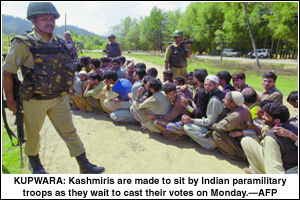 NEW DELHI, Sept 16: Occupied Kashmir went to the polls on Monday in the first phase of a four-stage elections to the held state’s assembly.
While polling was higher in Poonch and Rajouri districts of Jammu region, it was markedly lower in the Valley’s Kupwara and Baramulla districts, India’s election commission said.
The lowest turnout was recorded in Sopar, where only three to five per cent voting took place.
A Punjab police jawan was killed when militants opened fire at a polling station in a school in Sar village of Poonch district.
An 18-year-old boy was killed in a rocket attack at a polling booth in Kupwara district.
Around a dozen people were injured in militant attacks on booths during the polls that ended at 4pm (4.30pm PST).
Suspected militants also made a bid to disrupt the polls by planting improvised explosive devices at several booths, but most of them were defused before any damage could occur.
Indian Prime Minister Atal Behari Vajpayee, who had on Sunday expressed fears that Pakistan would subvert the controversial polls, changed his tune on Monday, describing the polling as free and fair and reasonably good.
There were reports of alleged militant attacks and at least one policeman was killed.
An Indian army spokesman was quoted as describing incidents of firing between Indian and Pakistani troops along the LoC. Another spokesman said Pakistani troops resorted to shelling at Indian positions.
No such indication from the prime minister, who was until two days ago livid with President Pervez Musharraf over the latter’s speech at the United Nations in which the issues of Kashmir and Gujarat were raised to a new level.
“The election was free and fair with a reasonably good turnout,” Vajpayee was quoted by the Press trust of India in Zurich, where he arrived on his way back from a visit to New York.
Vajpayee spoke over the phone with Kashmir Governor G.K. Saxena and inquired about the election.
“Undeterred by militants’ threats and the boycott call given by the All-Parties Hurriyat Conference, an estimated 44 per cent of the electorate in 23 constituencies voted in the first phase of the Jammu and Kashmir assembly election on Monday,” PTI said.
MIXED TRENDS: Polling in the first phase of elections today threw up conflicting trends.
Several news channels, covering the polls for the 23 assembly constituencies that were in the race on Monday, gave a mixed picture of turnout.
Star News said Gurez and Sopore — two constituencies that went to the polls in the first phase — illustrated the deep divide. One had a 60 per cent voter turnout and the other 2.5.
Gurez, nestled in the mountains on the extreme north of the Kashmir Valley, turned out to be the assembly constituency registering an extremely high voter turnout in the first phase of polling, but this has not really been a big surprise.
In the 1996 elections also, Gurez had seen a 70 per cent turnout.
On the other side of the divide is Sopore — the bastion of the Jamaat-i-Islami and the Hurriyat Conference _ which saw a negligible voter turnout.
“We are sitting here since morning. We thought people will come but very few have turned up. Now we are getting bored,” said an election official.
But the underlying factor in Sopore remains fear, Star News said. Militants had distributed pamphlets in this area before polling, warning people against voting.
“We know we should vote but we can’t. You know the reason,” said several residents, who admitted that it was fear of the gun-wielding militants which forced them to boycott polls.
Sopore is the stronghold of Jamaat leader Syed Shah Geelani, who is currently lodged in a jail at Ranchi.
In Kupwara, voting began under the watchful and noisy gaze of army helicopters overhead. Kupwara district has attracted the most attention as every seat here is being contested by rebel candidates of Sajjad Lone’s People’s Conference.
Thousands of personnel from the army, paramilitary forces and police fanned out across the held state to provide security. Around 40,000 personnel from across India were also deploy-ed.
Sixteen diplomats, including from the United States, European Union and Canada, witnessed the polls. Electronic voting machines were used for the first time in the elections.
STRAY INCIDENTS: Stray incidents of violence were reported from Baramulla, Kupwara, Handwara and Rajouri towns.
Four people were injured in a blast in Shaleel village near Kupwara. The Lashkar-i-Jabbar has claimed responsibility for the attack.
“We are responsible for the blast outside the polling station as we do not believe in these elections”, said Sheikh Jabbar, a person identifying himself to be a spokesperson for the outfit.
In another incident, as early as 6am (6.30am PST), militants fired a rocket at a polling station in the Thana Mandi area of Rajouri. There were no casualties, Star News said.
Agencies add: A strike called by Mujahideen to protest the elections closed shops and businesses in Srinagar and other parts of the held state.
Voters were frisked before entering polling booths on a cold, late-autumn morning and many Kashmiris, frightened by the violence and disillusioned by Indian rule, said they would not vote.
Villagers accused Indian soldiers of storming into their homes and beating them to force a large turnout, an accusation that coloured the last election in 1996.
“They beat me with rifle butts when I refused to come out of my home (to vote),” Mukhtar Ahmad of Singhpora village, just outside Srinagar, said.
Some polls opened after the official time of 7am (7.30am PST) as election officials made last-minute preparations.
Counting for all four stages will be done together and results are expected on Oct 10.
The ruling National Conference party, also a member of the coalition government in Delhi, is likely to be returned in the absence of any strong opposition.
More than 2,000 people have died so far this year and more than 35,000 since the freedom movement began 13 years ago.
Those killed in pre-poll violence included the held state’s law minister, and authorities say they expect more attacks.
On Sunday, Mujahideen ambushed the tourism minister, killing two of her bodyguards. The minister herself was unhurt.
The entrenched violence has unsettled voters.
“There is no point,” said one man in a small village about 80kms from Srinagar. “The situation is getting worse. The (held state’s) government doesn’t do anything for us and they don’t protect us either. Every family has lost someone.”