0
0

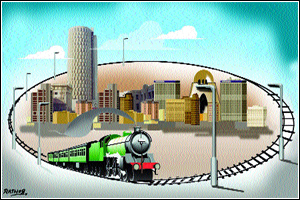 The decision at the summit level taken after a high profile discussion and deliberation in the President’s meeting at Sindh Governor’s House on September 4 has sealed the fate of the Karachi Circular Railway for good. Perhaps, no thought was given even to the problem of saving the fixed assets — earth work, track, bridges, station buildings, staff quarters, vacant land.
Will all this infrastructure be disposed of by the auction-prone Pakistan Railways, whose property these assets are, and who have already washed their hands clean and consigned the KCR as a dead weight and an oppressive burden?
If so, they are most likely to pawn off all these things in their current spree of selling Railway lands, residential colonies, clubs and recreation centres all over the country to convert red colour into green. Thus, the question of saving the ‘heritage’ of the extinct KCR as an eye-opener to the posterity like all those mausoleums, palaces and royal gardens looked after and maintained by the archeological outfit, wherever these reminders of the past glory and magnificence exist, does not arise. In any case, the City Nazim, being a vociferous and vocal opponent of the KCR’s revival and a protagonist of the German magno-train, will not protest the obliteration of this landmark in the city under his gubernatorial care.
Sentiments apart, the approach of the Engineering Consultants International (Private) Ltd., who produced, very pains-takingly no doubt, the ‘master plan’ of the KCR’s revival with an elaborately laid-out expansion plan was, as it appears, not worldly-wise. They, perhaps, missed entirely the most important point — the funding part of the project.
Had they dug deeper in the KDA’s archives, they would have certainly discovered that voluminous and bulky report of the Japanese consultants which was prepared by them in 1975 or 1976, which I called a ‘baby elephant’ while made to deal with it during my deputation in the Communications Ministry’s Rapid Transit Cell at Karachi. Nothing could be a more eye-catching presentation of the concept of transforming into a truly metropolitan railway, the existing ‘local railway’ which was conceived originally as a freight siding for use by the factories in SITE, connecting them with the rail ramification in the Port Trust area on one end and with the PR’s main line, on the other end at Landhi with direct entry and exit facility to and from Landhi railway station via the junction arrangement improvised at Drigh Colony.
Although no fault was found with the engineering feasibility of the Japanese experts’ revamping plan, it was rejected, out of hand, on the basis of economics — the billions of initial capital outlay, the millions required recurrently to operate and maintain the sophisticated system and the inevitability of the high level of fares to meet these costs, or, alternatively, the provision of a huge subsidy by the state — at metropolitan, provincial or federal level.
The latest ‘master plan’ of revival envisages an initial outlay of about Rs15 billion, only for upgrading the 48km semi-circle and equipping the system with new special type of rolling stock. The annual cost of operation and maintenance has not been printed for public consumption although such computation must be available on the consultants’ work sheets. The proposal to expand the system to cover almost all the built-up areas of the metropolis, estimated to cost an additional Rs7 billion loaded the dice decidedly against the project, as the grand total outlay touched the high limit of Rs30 billion by the time the project would be completed. The revival of only the semi-circle, at this stage should have been included in the present plan, to keep the cost at the minimum level. Future expansion may have been hinted at but not spelt out with estimated cost.
It has not been the dearth of bright ideas and imaginative plans which has stood in the way of reviving the KCR for the past several decades. Equally ambitious plans have already foundered on the same rock as now — refusal of the government of the day to provide the funds or even to share the capital cost with entrepreneurs, or to guarantee a minimum return to the investor on the capital outlay.
What made matters worse, this time round, was the City Father’s disinterestedness and complete detachment, who has been looking for the proverbial two in the bush (with small ‘b’) overlooking the one already in hand.
Coming to brass tacks, I can now suggest a plan which will cost a paltry sum and yet keep the KCR alive and paying its way. It will also give some satisfaction to the provincial government that the couple of billion rupees sunk in constructing fly-overs on University Road and Rashid Minhas Road has not gone waste the plan is:
(1) The single line semi-circle should be retained, as it is, starting from Drigh Road station, traversing the heart of the newly-developed Gulistan-e-Jauhar westward from Depot Hill station, then passing through Gulshan-e-Iqbal, Liaquatabad, north Nazimabad, SITE, Lyari, KPT and ending at the dead-end local train terminal just behind the commercial hub around Chundrigar Road.
(2) The rail link between this terminus and Drigh Road station via City and Cantt stations, being not available for use as the Railway’s main line operation keeps the ‘sectional capacity’ fully utilised, the KCR’s limits should fall between Drigh Road and Chundrigar Road only.
(3) Light weight 3-vehicle articulated diesel rail car set with one driving-cum-passenger unit on each end and a third purely passenger car in between should be procured for running on KCR. This composition will obviate reversing the driving-cum-passenger unit when running the rail car service in the opposite direction, from Chundrigar Road to Drigh Road.
(4) There should be no ‘line-clear’ system and signals and mechanical setting and locking of points and switches for each movement should be of no use, thus dispensing with the host of operating staff at each ‘block’ station. In all, six such rail car sets should be procured initially to run from Drigh Road to Chundrigar Road and vice versa at 15 minutes headway, treating the system as a heavy rail tramway.
(5) Walkie-talkie sets be provided to the driving staff on each rail-car to guide and caution the rail-cars immediately behind.
(6) All points, or switches, at the existing ‘block’ stations should be manually set, clamped and padlocked well ahead of the movement of railcars on ‘battery system’.
(7) The movement from Drigh Road to Chundrigar Road, with only six rail car sets in hand, will last hardly for two hours during the morning peak and, again, in the reverse direction for two hours in the evening peak, after ensuring, through staff visiting each ‘block’ station on a motor trolley, that the facing points have been duly reversed and set and padlocked for movement from the opposite direction. There will be no night running in view of operational safety. Tickets should be issued by travelling conductors, as in buses and trams. This will save cost on ticket issue at the forwarding station and ticket collection at the destination and will also ensure the minimum level of ticketless travel.
Maintenance of track and bridges should be only for light weight medium speed movements in day time, which would be much less than that on Railway’s main line at per kilometre rake.
This is no joke. It is a serious proposal. Let others lay down the detailed procedure and do the cash flow exercise.
Assuredly, this is the least expensive plan that can be effective in no time. After this system catches on, more rail car sets can be procured and the morning and afternoon “batteries” be longer than two hours each.