0
0

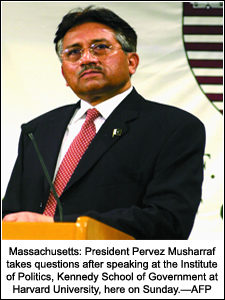 CAMBRIDGE (MASS), Sept 9: President Gen Pervez Musharraf on Sunday slammed increasing anti-Muslim bias and warned that it can split the Muslim world and the West. He called for an alliance between the two worlds to combat terrorism who “do not at any stage turn into antagonists confronting each other.”
Referring to the debate in the West on the clash of civilizations between Islam and the West since Sept 11 attacks, Gen Musharraf told a Harvard University meeting: “There is concern among the Islamic nations over the emergence of widespread prejudice, in some cases xenophobia,” Musharraf said.
“It is time we begin dealing with the real Islam and the real West rather than caricatures of each other.”
He told the students and faculty members at the Kennedy School of Government that the world needed a better understanding of Islam and the roots of terrorism, saying hate “must be stamped out with the same zeal with which the fights against terrorism are being pursued”.
“We must diagnose the malaise and treat the root causes of terrorism. What is it that conjures up such storms in the mind? What motivates a suicide bomber that his instinct for survival is overcome by a death wish?”
WAR FEAR: In the speech which was also devoted to the possibility of a war between India and Pakistan over Kashmir, Gen Musharraf said the United States with friendly ties with India and Pakistan “was in a unique position to facilitate the resolution of this (Kashmir) core dispute between Pakistan and India .”
Musharraf told the audience that Pakistan had offered India “No-war Pact”, a deal to rid the region of weapons of mass destruction, reduce forces which it has shunned. He said: “India needs to be persuaded that coercion is not a viable instrument in our regional environment.”
Responding to a question, he said: “Pakistan had never threatened India with a nuclear attack.
He asserted that the elections stipulated in the occupied Jammu and Kashmir are “no substitute for the plebiscite promised to the Kashmiris by the UN Security Council and the international community.” However, he added: “Pakistan remains ready to discuss all issues,” but asserted that without meaningful progress towards resolution of Kashmir issue relations between the two nations could not normalize. “Indo-Pakistan relations today are at their lowest ebb,” Gen Musharraf said.
He said Indian and Pakistani “forces confront each other eyeball-to-eyeball with most dangerous possibilities of the eruption of conflict by accident or design.”
During a question-answer session at a luncheon hosted by the editors of Christian Science Monitor,he said he would not involve his country in a war between the United States and Iraq. “Pakistan has its hands full,” Gen Musharraf said.
ARMY’S ROLE: Answering a question, Gen Musharraf justified the 29 amendments to the Constitution and the creation of the National Security Council (NSC), which, he said was essential to resolve disputes between Army Chief, President and Prime Minister from time to time.
Gen Musharraf asserted:”We don’t see military having any role in the executive and legislative functioning of Pakistan. We don’t see any role for the military in the governance of Pakistan. This all rests with the prime minister of Pakistan.” However, he said in the backdrop of the political history of Pakistan wherein prime ministers had removed president, dismissed the chief justice and removed the army chief, where the presidents had acted hastily in dismissing governments and the aggressive army chiefs taking over imposing martial law, it was essential to create the NSC.
Musharraf appealed to the audience to believe in his support for democracy despite his background as a career soldier. “I am extremely democratic. You have to believe me when I say that,” he said to a burst of laughter from the audience. “What we are trying to do is ... introduce real and sustainable democracy in Pakistan.”
He asked the Americans: “Don’t see Pakistan from a British view or American eyes, see Pakistan from Pakistani eyes. See what are the democratic and political structures of Pakistan. “We need to have checks and balances and the institutionalized NSC would have checks against any impulsive or misgovernance by anyone,” he stressed.