



 0
0

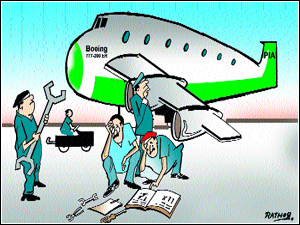 It is a miracle that the PIA, the national air carrier, after heavy losses since decades, has become a money earner. Three years back its future appeared murky and dark. But good planning and hard work has paid off.
Now full of confidence, the airline has decided to spend a billion dollars to buy latest aircraft. This surely will give a shine to its image world-wide. The airline’s management and the government deserve to be congratulated for turning the airline around. It is no more a white elephant. It is already a vibrant airline with a bright future. But the decision to buy the expensive US made Boeing 777-200 ER has caused doubts and misgivings. It may cast a long shadow on PIA’s rising expectations to become a front-line international air carrier. A wrong buy could make the airline a white elephant again.
Afflicted by uncontrolled unionism, political, bureaucratic and governmental interference, the airline’s days appeared to be numbered. It was politicized and bankrupted. Its MD was denied executive authority and initiative. With appointments without merit, discipline was unknown in the airline. Because of mismanagement, its employees were behaving like a bunch of cats. The national airline had started sinking from massive debts and losses. For four years, Mr Asif Zardari had virtual control on the PIA’s administration . His cronies on the board of directors pushed the airline into financial collapse. And the ‘Jiyalas’ inducted into the airlines by the thousands, caused virtual chaos. PIA suffered heavy losses but survived, primarily due to the dedication of the older employees.
PIA is not only breaking even but is becoming profitable. The new management embarked on surgical operations to rightsize the airline, review routes and destinations, balance revenue and expenditure and provide effective leadership to correct inefficiency and sagging morale. The results have been impressive. For the period ending June 30,2002, the airline earned a pre-tax profit of Rs552 million during the first half of the current year.
In fact, during the first quarter of the current year the PIA had earned a profit of Rs1.09 billion, but in the second quarter air traffic slump brought the profit down to Rs 552 million for the half yearly period. The cargo business has risen by 30 per cent over the first quarter. Financial restructuring and marketing strategy enabled the airline to keep abreast of all its financial obligations. The PIA was able to retire its short term loan of $ 54 million to the City Bank. Improved performance had a salutary effect on the airline’s share price, which rose from Rs 2.95 in January 2002, to Rs 9.70 in June. A total of 26.6 million PIA shares were traded during the half year ending June 30. This was impressive.
The PIA is emerging as an efficient airline, when air lines world over are collapsing. Its customers and travellers are full of praise, and its image has changed for the better. The planned purchase of latest American jet liners at an exorbitant cost of one billion dollars is a controversial decision which must be explained to the public. Confusion has been created by the news that the earlier decision to buy four advanced Airbus 340-300 passenger liners at a cost of $ 400 million had to be reversed under US pressure. PIA has now decided to buy US made Boeing 777-200ER aircraft which are far more expensive and demanding.
PIA’s board of directors at a meeting recently held in Islamabad decided to “purchase four Airbus 340-300 passenger aircraft at a cost of $ 400 million. The Defence Secretary, the Managing Director, and the Chairman of the Aircraft Acquisition Committee, Air Marshal Saleem Arshad were to address the press on August 25. The report stated that,” the decision in favour of the Airbus 340-300 was taken after a long debate. The PIA engineers branch had voted in favour of the Airbus 340-300. They argued that with four engines the Airbus 340-300 was a safer jet liner, as compared to the US Boeing 777-200ER, which had only two engines. Besides, the engineering facilities in Karachi specialize for the maintenance and overhaul of Airbus aircraft. The Boeing 777’s will have to be sent of the United States for expensive maintenance, repairs and overhaul.
But a day later on Monday, August 26, it was announced that the airline would purchase Boeing 777-ER’s in place of Airbus 340-300, “to revive the past glory of the national flag carrier.” Clearly powerful American lobbies had prevailed. At a press conference Secretary Defence and the Chairman PIA Lt General (R) Hamid Nawaz Khan announced that the board of directors had decided to buy eight Boeing 777 aircraft. He said that there was no outside pressure from any side. The government had allocated $ 150 million equity for the new aircraft. Three Boeing 777-ER 200 aircraft will be bought in 2003, two in 2006 and three more by 2010. The Chairman of the Air Craft Acquisition Committee, Air Marshal Salim Arshad, who is Vice Chief of Air Staff PAF, MD Ahmed Saeed, Economic Member PIA Board Salman shah, Director Engineering PIA AVM (Retd) Niaz Hussain, GM Fleet Planning Shahnawaz Rehman, and Arif Majeed GM Budget, besides concerned MOD officials were involved in the decision making. The Chairman said that ,”majority of the Board members were in favour of the Boeing 777 purchase. “The Boeing 777 would meet PIA’s long haul requirements more efficiently” he stressed. Analysis of aircraft performance, cost effectiveness and flight safety considerations all belie such claims.
PIA has a fleet of about 37 aircraft. The air-worthy fleet comprises two Twin Otters, five (47 year old) F-27 Fokkers, five Airbus A-310 aircraft with CF engines, and eight Airbus A-300-B4’s also with CF engines. The airline’s Boeing fleet consists of three B 747 - 200. Two of these are the COMBI version, i.e freight carriers also with CF6 engines, while one B747-200 is fitted with Prat and Whitney JT-90 engine. It’s other five Boeing 747-300 purchased recently from Cathy Pacific Airlines are fitted with Rolls Royce RB-211 engines.
Reportedly one more Boeing 747-300 may also be acquired from Cathy Pacific. These aircraft are in good condition, and have been acquired at an affordable price. Mentioning of engines is important, because engine maintenance is key to aircraft reliability. The airline has first rate aircraft and engine maintenance and engineering facilities for the Airbus, and Boeing 747 jumbos. It has engineers and technicians of high expertise, but new aircraft with oversized engines like the Boeing 777 cannot be serviced and overhauled in PIA engineering facilities. Besides spares for totally new systems will entail heavy expenses. This will hinder operations and will make maintenance and operations expensive. Boeing 777 engines are oversized, and their maintenance will be problematic and expensive,
According to the press reports, the” finance minister was forced into a position of decision making, because the board of directors was split whether to buy Airbus A 340-300 or Boeing 777-200ER. At the heart of the dispute was the price. PIA could get four Air Bus A340-300’s for the price of three Boeing 777-200 ER’s. But there are powerful lobbies behind the sale of both the types.
The American lobby appears to be more powerful, because expensive twin engine Boeing 777-200ER unsuitable for PIA routes, have been forced on to it. It is technology advanced liner with very large engines which cannot be handled at Karachi. The Airbus A-340-300 has four CF-6 engines.PIA already has the facilities and the expertise to service these, because they are common to the engines fitted on PIA’s existing Airbus fleet. For transporting the large CMF engines of the new Boeing 777’s, PIA will have to hire Russian Antonov cargo freighters or special Combi Boeing 747’s. to fly the unserviceable engines to the United States. This will entail heavy cost and waste of time, and will badly affect airline operations.
Besides, twin engine Boeing 777-200ER’s have to operate under ETOP’s limitations. While four-engine jet liners are free of ETOP’s restrictions.ETOP limitations require the twin engine passenger jets to fly on routes in the vicinity of airfields. Because engine failure i.e one engine operation of twin engine jet liner is an extreme emergency, requiring the pilot to land immediately, ETOP limitations stipulate specified and limited flight over the sea or over regions without suitable airports. For the Boeing 777-200ER’s engine reliability has to be repeatedly certified by various international agencies. The US Federal Aviation Agency could demand aircraft serviceability records from the PIA on regular basis. FAA could impose 90 minutes or 180 minutes ETOPs limitations. This should be a matter of worry and concern for twin engine jet aircraft operators.The PIA is already operating under ETOP limitations its five Airbus 310 aircraft. Purchase of Boeing 777-2000 ER’s inspite of limitations, ETOP restrictions, added infrastructure and heavy expenditure must be clarified. It is learnt that several US Senators and Congressmen have written letters to the minister of finance and minister of foreign affairs urging them to buy Boeing 777-200 ER’s.
In view of the airline’s high expertise with Airbus passenger liners, and their reliability and cost effectiveness, PIA’s first choice should have been the Airbus 340-300. But the US played a trump card by rescheduling $3 billion loan, with the promise to write-off another $1 billion. This is suspected to have been decisive. That the US offer came one day before the board of directors met in Islamabad for the final decision cannot be ignored. It is learnt that the French foreign minister who was in Islamabad recently, “pushed for the sale of Airbus A340-300”. But France did not reschedule any loans. Besides US has far greater clout than France.
Both the aircraft have been evaluated by PIA’s Aircraft Acquisition Committee, which earlier visited Airbus and Boeing headquarters in Paris and Seattle. It is in order to suggest that the new acquisition should have been on the basis of merit, economy, ease of maintenance, operational efficiency and safety. In the competitive airline business new aircraft while enhancing business provide tremendous image building. The airline needs it. But the sudden change and the unsatisfactory explanation for taking a big plunge, ostensibly under US pressure, must be clarified to remove doubts and rumours. It is hoped that instead of acting self-righteous the ministry of defence and the PIA management will clarify the questions and queries upsetting people’s minds.




























