0
0

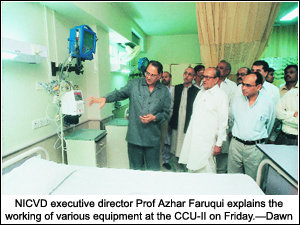 KARACHI, Sept 6: A renovated 12-bed coronary care unit — now equipped with state-of-the-art instruments — was inaugurated at the National Institute of Cardiovascular Diseases on Friday.
The expenses of the renovation were borne by a private philanthropist, Mian Abdullah, of the Sapphire group.
The NICVD executive director, Prof Azhar Faruqui, said that at least four beds in the CCU-II would be earmarked for patients undergoing angiography and angioplasty. He added that eight beds would be used by seriously ill cardiac patients.
Taking the philanthropist and his staff on a guided tour, Prof Faruqui explained that next to each bed in the CCU-II, there was a monitor and other devices which would show various pertinent parameters, such as blood pressure, electrocardiogram, temperature, pulse rate and rate of respiration of a patient at regular intervals. He added that the CCU-II also had an artificial breathing apparatus, as well as a shock reviving device.
“Besides, this CCU also boasts a ventilator which we previously used to procure from surgical units — if and when they were not in use,” — he elaborated.
Prof Faruqui observed that such advanced facilities were not available even in some of the private up-market hospitals.
Mr Abdullah said that in all public hospitals in Punjab, there was a private ward which enabled these medical institutions to obtain much-needed funds in a proper manner. He urged the Sindh government to take a leaf out of the Punjab government’s book, and allow public hospitals to run small private wards so that they could also generate funds.
After the inauguration ceremony, Prof Faruqui told Dawn that the occupancy rate in all the NICVD wards was about 150 per cent. “The NICVD has 370 beds, but at a time it provides bed facilities to about 500 cardiac patients. No fewer than 1,500 patients visit our out-patient department every day. At least 500 patients are attended to in our emergency wards and 100 patients are admitted to the NICVD daily.”
Faruqui explained that over the years, the workload had doubled at the NICVD. “In 1996, a quarter of a million cardiac patients were treated at the NICVD. Last year, this health institution offered medical facilities to about half a million patients.”
He deplored that the increase in budgetary allocation for the NICVD was not in proportion to the influx of patients. “The federal government gives an annual grant of Rs115 million to the NICVD which generates as much funds on its own through token charges from patients. Philanthropists and donors provide the NICVD with at least Rs40 million every year.”
He explained that patients paid 20 per cent of the charges, while the remaining amount was borne by the hospital. “However, those patients who deserve Zakat, as well as entitled government servants, are treated free of cost at the NICVD. Some 40 beds are allocated for private patients who pay for their treatment.”
Prof Faruqui said that at a private hospital, a patient paid some Rs2,000 for an exercise tolerance test. “At the NICVD, Rs250 is charged for an ETT. Similarly, angiography, which costs a patient Rs35,000 at a private hospital, is carried out at the NICVD for Rs9,000. It is free for Zakat-deserving patients.”