0
0

BEIRUT: The Iraqi authorities have reportedly drawn up contingency plans to blunt a US-led military campaign against the country and deter any anti-government uprising that it might trigger.
These include imposing sweeping curfews in areas where public opposition to the regime is strong, blowing up dams to hinder the advance of invading forces, and dispersing military units throughout Iraq, according to political observers.
Analysts believe that if the United States attacks Baghdad, it will spell the end of President Saddam Hussein’s regime. However, Iraqi officials are remarkably upbeat about its survival prospects.
The Iraqi president is well aware that “his own head” will be the principal target of any offensive, whether it takes the form of sustained air strikes aimed at triggering a popular uprising, special task force operations targeting him personally or a full- scale invasion.
It is, therefore, inevitable that Saddam will “throw everything he has” at the invading forces, and if he finds himself at an impasse he will resort to the ‘Samson option’ — if indeed he has the means to do so.
But Iraqi sources inside and others close to the government still speak self-assuredly of their capacity to repel an offensive and prevent it from achieving its aims.
Observers inside Iraq speak of three measures that the Iraqi leader is planning to take the moment Americans get into an offensive. The first is to impose a ‘total curfew’ in the predominantly Shia provinces of southern Iraq, where they fear an uprising like the one that followed the ejection of Iraqi forces from Kuwait in 1991.
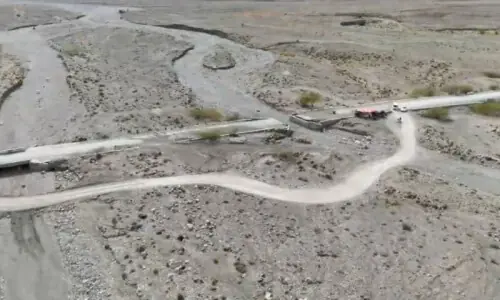
The second is to tear down dams built on the River Tigris and its tributaries in the three northern provinces of Arbil, Suleimaniya and Dohuk which constitute the autonomous Kurd districts. These areas are considered to be off limits for the central government and its forces since 1991. The resultant flooding would hinder an anticipated American advance, perhaps backed by Turkish troops and Iraqi Kurdis pehmergas from the north toward the oil-producing centers of Mosul and Kirkuk.
The third is for military forces to break up into smaller units and disperse throughout the country making them harder to target from the air and enabling them to wage an urban guerrilla warfare against the invading forces.
Hundreds of mobile short-range missiles launchers are also to be deployed aimed at the northern provinces from where anyn invasion is likely to be mounted.
Political observers say that Iraq’s military capabilities should not be underrated. They might be successful in mounting considerable resistance if the Americans do not succeed in triggering a rebellion or coup against the Iraqi president.
The Republican Guards and other elite units consist of around a quarter of a million men, and the regular army is about double that size. There are also millions of civilians who have been enlisted into the regime’s paramilitary groups, such as the so- called ‘Army of Jerusalem’, and most of them are trained in the use of small firearms.
It is also possible, military analysts say, that the Iraqi military has more sophisticated technology at its disposal than its adversaries might think of.
The recent downing of an unmanned US spy plane suggests that Baghdad might have managed to upgrade its air defence capability using home-grown resources, though that is far from certain given the difficulty it has had obtaining spare parts over the past decade.
The Americans are obviously taking all these possibilities into account, official sources admit. They clearly want to avoid getting involved in an urban guerrilla warfare and would like Saddam to be toppled by a coup or a popular revolt.
That is what some Iraqi opposition groups that Washington has been consulting with have been trying to encourage — notably the Iran-backed Supreme Assembly for the Islamic Revolution in Iraq (SAIRI).
As SAIRI leader Ayatollah Mohammed Baqar Al-Hakim put it recently: “The Iraqi people will seize power if the international community prevents Saddam from using weapons of mass destruction.”
There can be no doubt that the Iraqi leadership is in an ‘extremely difficult position’ internally and that it is widely resented by the population, observers point out. But the fears of the Sunni-minority about what the future could hold for them may prompt them to cooperate with the authorities and rally around the regime in defence of Iraq.
The majority of Kurds share Shia Muslims sentiments in overthrowing Saddam at any cost, but this does not necessarily mean that the Iraqi Kurds are in favour of war or would support an American-led attack. They have good reason to be apprehensive about the possible consequences, in the light of reports that Washington has assured Turkey that it will not allow an independent Kurdish state to emerge in northern Iraq, and suggestions that Ankara may intervene militarily to prevent that from happening and to take control of the area itself.