



 0
0

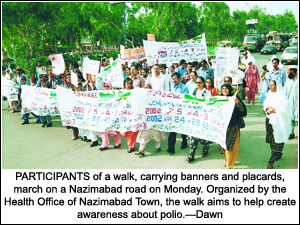 KARACHI, Sept 2: Pakistan striving to attain zero prevalence of acute flaccid paralysis (AFP) by the end of the year, will launch on Tuesday its thirty-first national immunization campaign in the backdrop of 35 confirmed cases of the disease.
Sindh Governor Mohammedmian Soomro inaugurating the campaign by administering polio drops to children here on Monday sought involvement and commitment on part of all segments of society, particularly the media, in the endeavour closely linked to sound future of the nation.
During the three-day exercise, approximately 25 million children, up to five years of age, including 8.4 million from the province of Sindh, would be vaccinated against the crippling disease.
The exercise has been a regular feature for the last few years and has made considerable difference as against 105 confirmed cases in 2001 the number has shrunk to 35 during the current year. This includes 14 cases in Sindh.
Since presence of a single case of polio virus is a threat for persistence of the disease, efforts are under way to ensure 100 per cent immunization of all the under-five children, attaining zero level prevalence and maintenance of the same for three years leading to the polio-free stage.
Reiterating the government’s commitment to help eliminate the virus responsible for the crippling disease, the governor said efforts were under way to ensure that the zero prevalence was maintained for three consecutive years.
“Concerted efforts have to be made as nothing could be attained in isolation,” Mr Soomro observed.
He also asked the concerned teams to set right their priorities and come forward with clear goals along with plausible strategy.
Earlier, Sindh health minister Ehsan Ahmed in his presentation said joint efforts on part of NGOS/CBOs, the UN agencies, donors and government departments helped immunization coverage rate to reach 80 per cent in the 1990s which was as low as two per cent in the early 1980s.
However, he regretted that the status could not be maintained due to a variety of reasons, including lack of required resources, leading to decline in routine coverage of the EPI.
“Consequently, in 1993 the country registered 1803 cases of polio which were 75 per cent of all polio cases in the EMRO region and 25 per cent of the world,” the minister said, adding that to counter the situation fixed central national immunization days were introduced in 1994, which too could not help a maximum coverage.
“There continues to be a need to create demand through sensitizing the masses about the severity of the situation and urgency to combat the same through timely and regular immunization,” the minister said, mentioning that NID strategy was also modified and house-to-house coverage was started in 1999.
The modification, he said, had made considerable difference and the number of polio cases was witnessed declining at a considerable pace. According to him, once the zero level was attained the country would be required to ensure effective surveillance system, keeping the track of the number of polio cases.
For this purpose, he said, along with the government health care system, all traditional health care providers, including hakims, homeopaths, general practitioners and religious leaders, were being involved.
The minister also called upon the media to extend necessary support to the government in creating public awareness along with a sense of urgency for polio eradication.
Dr Shamsunisa Ansari, director, Expanded Programme of Immunization (EPI-Sindh), attributed the 14 cases identified in the province in the current year to negligence on part of parents who despite being educated failed to realise the importance of immunization.
Regarding the outbreak in Ghotki, she said this was mainly due to virus transmitted from Balochistan.—APP





























