0
0

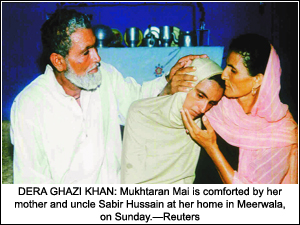 MEERWALA, Sept 1: Gang-rape victim Mukhtaran Mai said she was satisfied with Sunday’s court decision which saw six men responsible for the attack sentenced to death, but added she and her family were now living in fear of revenge.
Speaking to AFP at her desperately poor home village in a remote part of central Punjab province, she said the court’s verdict had further strengthened an already strong faith in God.
“I have been praying to Allah that he would grant me justice, so I feel elated. I feel my sacrifice has not been wasted,” she said.
“On that day when I was dragged in front of 250 people I cried for help. But the spectators remained silent and when I returned home that night I was a disgraced woman.
“Then my attackers said they would kill me and my family if we disclosed the attack and we were terrified, we thought there was no hope,” Mukhtaran said.
“We are so poor we could not even afford to flee to the city. For seven days we were virtually prisoners in our own home. Those were very distressful days.
“They are still threatening us and have told us that the court decision will lead to more bloodshed,” Mukhtaran said.
She said at first the family accepted their situation as the will of God and had resigned themselves to carry the burden of fear and humiliation for the rest of their lives.
But then, she said, journalists told her of the national outrage the incident had created. A contingent of police arrived to protect the family and slowly their courage began to rise, she added. “We are illiterate, but then we started to believe that perhaps we could get justice,” she said.
But when the trial at an anti-terrorist court (ATC) — special tribunals introduced five years ago to achieve quick justice for particularly horrible crimes — her spirits again began to sink.
“The lawyers asked very humiliating questions. At one stage during the trial I thought of leaving the court and I thought it was worse than what happened to me in Meerwala.
“But I faced it, thinking in my mind that the government, the police and the press people were telling the truth when they promised me that justice would be done,” Mukhtaran said.
“That hope kept me going and I was reassured by my lawyers that the humiliation would be just a temporary thing.
“I thought that if I got these people convicted, I would save my family from humiliation and that other women would perhaps not have to suffer the trauma that was inflicted on me.
“What I was subjected to should never happen to anybody.”
Mukhtaran, a 30-year-old divorcee, was raped for more than an hour on June 22 in a hut in the Punjab village near Meerwala, some 60km east of Dera Ghazi Khan, to atone for her 12-year-old brother’s alleged affair with a sister of one of the rapists.
He later claimed the alleged affair was concocted after he had been sodomised by three men from the powerful Mastoi clan.
Early Sunday morning the four rapists were sentenced to death by hanging. Two members of the tribal council (Panchayat), which sanctioned the assault, were also condemned to death. Defence prosecutors said they would appeal the convictions.
But Saturday’s expected verdict was delayed for nearly 18 hours and the tension of waiting took its toll.
“Yesterday as I waited I was praying, reading the Quran and asking Allah for justice. I waited till one o’clock in the morning. My elder brother had gone to the court, but he had not yet returned and we were really upset.
“I was so tired by then that I fell asleep. Then at 2.30am my father woke me up. I saw many policemen inside my home and they all were congratulating us,” Mukhtaran said.
“I felt elated and I immediately threw my hands towards the sky, and said ‘Thank You Allah. Justice is delivered’.”
Mukhtaran said the outcome had boosted her confidence, but that she still feared retribution, a question of honour in the often brutal traditional ways of Pakistan’s rural tribal culture.
“Of course, the fear is still there, but now we believe even more in Allah. He will protect us,” she said.—AFP