0
0

ISLAMABAD, Aug 29: The government has terminated over 26 per cent projects of the multidonor-funded $725 million (Rs31.4 billion) National Drainage Programme (NDP) with immediate effect.
This step was taken after a $184 million cut imposed by the World Bank-led consortium owing to slow use of fund.
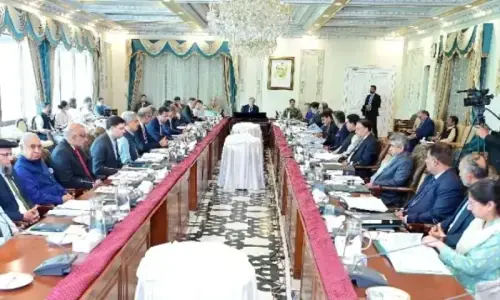
President Pervez Musharraf had decided about the termination of plans earlier this week on the recommendations of a special committee led by Agriculture Minister Khair Mohammad Junejo.
Out of 96 schemes on the NDP portfolio, 58 plans would be continued while 13 projects to be continued with modifications and 25 schemes had been deleted, a senior government official confirmed to Dawn .
The committee had been formed last year when the World Bank had curtailed its funding by $100 million, declaring the programme as ‘poor performing’. The GHQ also had raised serious objections over unnecessary consultancies and ill-planned investment portfolio (uplift plans), the official said.
He said the body had suggested drastic restructuring of the 6-year programme including cancellation of a major chunk out of 30 per cent allocation for consultancies. The president had approved it and put a complete ban on further studies, he added.
As a result of this restructuring, another $60 million funding would either be cancelled outrightly or diverted to some other water sector projects, documents provided to Dawn show.
Mr Musharraf had also approved reduction in the cost of project from Rs31.4 billion to Rs25 billion, which is 20 per cent less than approved PC-1 cost. The revised cost is 41 per cent, less than the projected cost of Rs42.51 billion. This would have occurred if the plan had not been restructured.
He had directed the officials concerned to complete the project within remaining two-and-a-half-year period out of the stipulated time. He had also directed that at least 88 per cent of the revised allocation should now be used for activities under the investment component.
The special committee led by the federal agricultural minister, comprising provincial ministers, secretaries, Wapda chief and the National Flood Commission has been asked to continue for effective monitoring of the programme till its completion by June 2004.
But officials claimed that owing to cost cutting, reduction in the size of the programme and rupee depreciation, the corresponding savings in dollars terms would be 45 per cent.
“The government has assessed a revised foreign assistance requirement of $280.248 million with a saving of $244.76 million”, said the report presented to the president.
The president had also been apprised that most of the consultancies had already been awarded with major payments, and that withdrawing from contractual agreements at this advance stage could result in legal complications and loss in financial terms.
The president had noted that institutional reforms which had been central to the implementation of the investment component both at Wapda and provincial levels were badly behind schedule. The research studies were mostly incomplete and had not been planned to lead into investment projects.
After restructuring, all components except institutional reforms have registered cut in cost. The 4.7 per cent increase on the institutional reforms component arose primarily due to the higher costs of the consultancies awarded, particularly by the Sindh government.