0
0

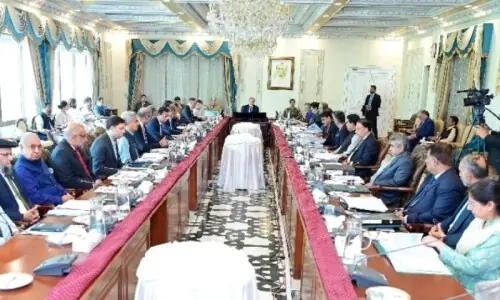
ISLAMABAD, Aug 29: The Economic Coordination Committee of the Cabinet (ECC) here on Thursday allowed the import of fuel oil by the traders.
The ECC which was presided over by Minister for Finance Shaukat Aziz, however, said the import of fuel oil would be subject to quality check, import schedule clearance by OCAC and the conditions laid down by the Ministry of Petroleum. Bulk import of diesel and furnace oil by consumers such as Railways and Wapda was also allowed.
According to an official announcement, it was decided to allow duty free import of CKD kits for buses, whether diesel or CNG under the regulatory control of Small and Medium Enterprise Development Authority (Smeda). The import of Polyester Staple Fibre under the Duty and Tax Remission Rules for Exports (DTRE) regime will not be permissible.
The meeting increased investment limit from $2 million to $5 million for resident Pakistani companies abroad. It also approved investment of $1.832 million by Packages Limited in its subsidiary Packages Lanka (pvt) Ltd.
The meeting allowed facility for remittance of royalty, franchise and technical fee or service charges to the financial sectors on the following lines:- a) The applications for remittances of such payments by the commercial banks as well as Non-Bank Financial Institutions (NBFIs) including leasing/modaraba companies and investment banks, to the foreign collaborators in respect of their branded financial products/services within the area of their authorized business, would be processed and approved by the State Bank of Pakistan, on a case-to-case basis, on submission of an attested copy of the agreement and other relevant information/documents. b) The lump sum upfront royalty/technical fee/franchise fee should not exceed $500,000. This would be allowed from the inter-bank market. c) Continuing royalty payments, service/technical charges/commission or handling charges/any other directly related charges not exceeding 0.25 per cent in aggregate of customers’ billing net of taxes/surcharges would be allowed which would either be recovered from the customers or met through the financial institution’s own resources. No foreign exchange would be provided/utilized for this purpose from the inter-bank market.
Previously, this facility was permissible to manufacturing, agriculture, social, infrastructure, services and Information Technology sectors.
The meeting allowed removal of the machinery etc., by MCC China to EPZ Sandak Project Centre without payment of duties and taxes. However, unusable machinery/equipment and vehicles will be auctioned under Custom Rules. Duty and sales tax will be recovered on appraised value.
The meeting decided to discontinue import of cars on concessional duty by the disabled persons. However, this facility would be available to them if they purchase locally assembled cars. This decision has been taken to protect domestic car manufacturing industry and to discourage misuse of this facility through import.
The ECC expressed satisfaction over gross foreign exchange reserves, which have touched $7.4 billion. It noted that exports during July were around $816 million registering an increase of 19 per cent over the corresponding period of last year. The imports were around $926 million registering an increase of over 17 per cent as compared to the same month last year. Imports of machinery increased by 51 per cent. This indicates rise in industrial activity and building production capacity. Non-food and non-oil imports increased by almost 22 per cent as compared to the same period last year.
It noted comfortable position of stocks of oil, sugar, vegetable ghee, wheat, fertilizer and other commodities. It also noted stability in the prices of essential commodities. Average prices of various commodities during the week ending August 22, 2002 were generally satisfactory. Average prices of 11 items registered decrease, of 13 increased and of 27 remained unchanged.
Salient items showing decrease in prices were: tomatoes 9.74% chicken (farm) 4.47%, bananas 2.05% and eggs (farm) 1.27%. The prices of gur, sugar, moong, gram, masoor and mash pulses and viol cloth (printed) decreased by less than 0.50 per cent. Charges for electricity (1-100 units) increased by 8.26%. Average prices of onions increased by 1.84%, wheat flour 1.63% and wheat 1.08%. The average prices of potatoes, rice basmati (broken), vegetable ghee (loose), petrol, red chilies (powdered), mustard oil, garlic, kerosene oil and fire wood increased by less than 1%. The average prices of items like beef, mutton, vegetable ghee (tin), cooking oil (tin), gas and telephone charges remained unchanged.
During 2001-02 (July-June), the rate of inflation measured through CPI (2000-01) was 3.54% as against 4.41% in 2000-01 and 3.58% in 1999-2000. The SPI during the year increased by 3.37% as against 4.84% in 2000-01 and 3.58% in 1999-2000. During July 2002, the CPI increased by 1.09%.
On an understanding extended by the president during his visit to Bangladesh, to further strengthen the trade links between the two countries, the meeting allowed duty free import of 10,000 tons of raw jute and tea under South Asia Preferential Trade Agreement (SAPTA) from Bangladesh to meet the objective of Free Trade Agreement recently concluded between the two countries. The ECC was informed that the Anomaly Committee has completed its work. The ECC endorsed committee’s recommendations.
The meeting, among others, was attended by the Ministers of Commerce, Communications, Agriculture, Labour, Privatization, Governor State Bank, Deputy Chairman, Planning Commission, Secretary General Finance and Chairman BoI.