



 0
0

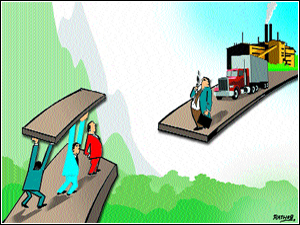 Trade promotion and development are primary objectives of the Economic Cooperation Organization (ECO). Its other priorities are transport, energy, telecommunications, agriculture, etc. Transport has always played a significant role in shaping the economies by linking not only markets but also people and cultures. As such it increases the elasticity of supply and demand, improves the efficiency of the market price system and permits the application of economies of scale in production and distribution.
The development of transport sector for regional cooperation assumes greater dimension. Seven, out of the 42 landlocked countries in the world, are located in the ECO region. The shortest distance for any of the landlocked countries to a coastal line is not less than 2500km. Being geographically disadvantaged, the new member-states continue to experience heavy adverse transport costs which they must absorb to penetrate export markets. The high transport costs negatively impacts imports as well as the prices of fuel, capital goods and intermediate inputs. As a result, the costs of domestic agricultural and industrial production go up. Consequent reduction in purchasing power inhibits diversification efforts to increase competitiveness of exports of such countries.
A recent World Bank study puts the transport costs at 50 per cent higher for a landlocked country. The cause and effect relationship between the availability of adequate transport services and the scope for trade-based development, therefore, needs to be studied to determine the causes for poor participation of the ECO region in the global trading system.
The question must have taxed the leaders, after the Central Asian Republics and Afghanistan joined the ECO in 1992, on as how to improve the transit environment including the construction, the maintenance and the improvement in transport, storage and other transit-related facilities and communications. A plethora of documents, plans of actions and policies have been created to reshape the transport system in the ECO to break the isolation of the new members. Most of the tangible progress has been achieved in the area of improvement in physical infrastructure — construction of new roads and missing links and the upgradation of tracks and infrastructure. Regretfully, the ECO has not been involved significantly in the implementation of these projects.
The challenges are clearly beyond the ECO capacity. The railway-intensive transport system in the CAR is in bad shape. The infrastructure is crumbling. International traffic worthy roads are scarce with missing links in the region. The situation is slightly better in other member states. Technical difficulties such as different gauges, different sizes of cargo bogies, lack of bogies change facilities at border crossing points, and the absence of a joint manufacturing and maintenance facility for rolling stock are gigantic. Additionally, introduction of new information technology in the region is required to bring the transport system of the landlocked developing countries to a minimum acceptable level of efficiency. The transport system needs huge investment to make it work efficiently. Unfortunately, the respective governments did not have adequate financial resources to maintain or modernize rail and road infrastructure.
To overcome these inherent handicaps, the ECO has adopted a three-pronged methodology. First, an attempt was made to identify the missing road and rail links to build adequate infrastructure. Since the Secretariat had no financial means to finance such a capital-intensive project, member states undertook to complete the missing links through their national budgets. Second, through an elaborate system of expert level groups, workshops and accession to international agreements and conventions were pursued to harmonize rules/regulations, build common rail tariff policy and initiate seamless passenger and container train, etc. Third, measures were undertaken to strengthen the institutional capacity both at the Secretariat and within the member-states to benefit from technical advice from the international rail and road associations as well as Unctad and Unescap.
The ECO has fared well in the field of transport. Given the odds and lack of funds, the achievements are substantive. The member states have achieved their long awaited goal of starting a container train from Almaty (Kazakhstan) to Istanbul (Turkey). It has become a physical functional reality. Assurance for cargo has been given by the European firms for onward journey to Germany. This development generated lots of interest in the European commercial world for the ECO transport operations.
More stunning achievement has been the start of the weekly passenger train from Kazakhstan to Turkey via Iran (Almaty-Tashkent-Turkmenabad-Tehran-Istanbul of Trans Asian Railway main line). The train will get passengers from Kyrgyz Republic, Uzbekistan, Tajikistan, Turkmenistan, Pakistan and is likely to carry passengers bound for Syria from Iran. The train will give a boost to regional tourism and small business all along the rail route.
Another significant achievement is the development of a Transit Transport Framework Agreement (TTFA) in May 1998. This agreement has the potential to serve as the key driver of all activities related to the removal of non-physical barriers such as the harmonization of operations and regulations, and the accession by member states to international transport conventions and standards. Measures envisaged in the TTFA, including mutual recognition of driving licenses, issuance of multiple entry visas for transport operators, harmonization of customs documentation and procedures, are expected to minimize delays related to border crossing.
Progress has also been made towards establishing the ECO’s Permanent Commission on Transport and Communications (PCTC). A multi-modal transport project in collaboration with the IDB is also in progress to provide competitive access to exporters from the CARs by reducing idling time at points of entry and exits along the borders of member states and their neighbours. Our cooperation with Speca, Unctad and Traceca is growing.
We have our weakness, too. In parallel, we have tried to follow “head to tail” as well as “bottom upward” approaches. Somewhere in between we have lost contact with the realities and in certain cases failed to reconcile the two strategies. We started off with mega projects such as the air cargo and the ECO shipping company. The results are not too satisfactory. There is a need to reconcile political ambitions with technical potentials as seen at the implementation level in each sector. Another flaw is that the ECO does not maintain a computerized database of detailed transport statistics, preventing effective planning, monitoring and follow-up. As a result the ECO has failed to encourage a regional approach to tackle with transport issues. A database is essential to reflect main trends in the development of transport and its infrastructure in the region.
We need to reflect how to provide more financial assistance to the ECO for carrying out its projects. Few people realize the ratio between the success of the ECO as an effective regional organization and its financial capacity to fulfil its obligations as a harbinger of regional cooperation. For instance, the ECO member states have agreed to accede to basic international agreements and conventions which stipulate the rules and procedures that promote transit facilitations and lay down minimum technical requirements for the construction and the maintenance of infrastructure and transit transport facilitation. Cost of adhering to the European norms and standards for construction and maintenance of infrastructure and transport facilitation is high. Even the installation or upgradation of signs and signals in line with the Convention on Road Signs and Signals (1968) would be expensive given the width and stretch of the region. Will the CARs ever emerge as a land bridge between Europe and Asia without incurring this cost? No way. The region needs and deserves financial and technical support from its trading partners and multilateral financial institutions.
Prospects for success remain minimal unless shipping organizations, freight forwarders, passenger organizations, customs authorities and insurance associations are not effectively involved in the whole process. We need to square up with the reality that the bureaucratic mindset can not fully substitute a more enterprising and promising attitude of private sector.
Road transit charges are exorbitantly high and multiple. It is a debilitating obstacle to efficient transit operations in the region. Add to it, are the high costs of transit visas and the associated logistic and political problems. No study has yet been done to computerize a) data handling tasks undertaken by individual suppliers of transit services, and b) to computerize the exchange of information among suppliers of transit services. A number of devices including the ASYCUDU (Automated System for Customs Data Entry Control and Management) are being considered to address these issues. Although the challenge is huge, prospects are not bad. Member states are committed to the ECO objectives in this important area. International community is also interested in reviving the old trade routes with alternative transport arteries linking Asia to Europe through the ECO region. Member states have to come out of their narrow national interests and embrace the ECO priorities. Also, users of transport, freight associations, shippers and insurances associations will have to be given their due role in the evolution of the ECO transport policies.
On September 26-27 the fourth ministerial meeting on transport and communications is being held in Izmir (Turkey).Pakistan is confident that the leaders would critically evaluate the ECO achievements in this sector. Without international community support, the ECO member states may not be able to realize the planned objectives in this capital-intensive sector. The ECO projects have to be discussed on regular basis. The time has come to give the road and railway users’ associations equal opportunity, alongside with government officials, to play an effective part in the evolution of regional transport framework in the ECO sub-region. For this, if we need an amendment in the ECO rules and procedures, it would be worth the effort.
The writer is the Deputy Secretary General, ECO




























