0
0

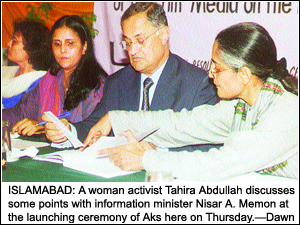 ISLAMABAD, Aug 22: There is a need to sensitise the society and ensure respectful portrayal of women in the media in deference to equal rights available to men and women, remarked Information Minister Nisar Memon.
He was speaking at the launching ceremony of a study on monitoring and sensitization of the print media on portrayal of women here on Thursday.
The study, entitled: Changing Images is a compilation of quantitative and qualitative analysis of women-related stories published in the print media of the country. The study has been conducted by Uks, a research, resource and publication centre of women and media.
It throws light on whether women are treated with consideration or given derogatory coverage. The project was conducted between September 2000 and August 2001.
The minister said he was shocked that women, who constituted half the country’s population should be subjected to ridicule and promised to issue appropriate instructions to the print and electronic media, to withhold publication of names of women who have been victims of rape and other indignities, violence and harassment.
Women activist forums should come forward in halting the heinous crime of Karo Kari and save women from this oppressive custom prevalent in Sindh.
He blamed the film and cable industries for vending obscene, and indecent programmes and vowed to talk to the two industries to adopt correct attitude.
He said fashion, cosmetic and glamour industries were equally projecting women as objects of desire. He was willing to stop releasing advertisements to publications which treated women unfairly but he would not do so for fear of being blamed of unfair advantage.
He suggested that more women should contest on general seats now that the government had ensured 60 seats for women so that women’s cause would get further support at the national level.
He also asked Uks to produce a weekly women’s programme to correct imbalance in the portrayal of women on the state television.
Director Uks, Ms Tasneem Ahmar referred to the difficulties of her associates while monitoring newspapers and magazines published in English and Urdu regularly for eight months.
According to her the national press used disparaging words while describing women lowering their dignity. As a corrective measure the print media was requested to adhere to a code of ethics while working on women related news and stories.
She announced annual rewards for those correspondents who would accord respect and fair treatment to women in their news reports. The award would be given from the current year, 2002.
Editor of The Nation, Ms Ayesha Haroon congratulated Ms Ahmar and her associates on the publication of the study. While going through it, she discovered, that news agencies and staff reporters were the main source of women related stories and advertisements and advertising provided copious information about the female gender.
She was surprised that women’s problems were rarely mentioned in editorials and there was hardly any rural based reporting of women affairs. ‘Women mostly featured in show business publications as well as on city pages and magazines.’
Talking about this aspect, assistant secretary general, PFUJ, Ms Fauzia Shahid said the trend of featuring women in city pages and portrayal of women in fashion magazines was initiated in an era when press was subjected to pre-censorship and newspaper circulation had declined significantly. This measure was resorted to by owners to increase readership and circulation.
She said as a journalist, she was often horrified at the language used while reporting on women. She had tried to enforce a Code of Ethics on journalists which was written in the Article 12 of PFUJ regulations.
An activist Ms Tahira Abdullah commended Ms Ahmar on producing a significant document. This could be prescribed as a reading material for courses in mass communication.
She lamented that only towns and cities were covered while writing the report and the women population in the rural areas were neglected. She recommended that proper justification should be provided for selection of newspaper and periodicals to be monitored for this purpose in the coming years.—Jonaid Iqbal