



 0
0

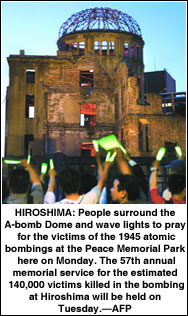 HIROSHIMA: “Atomic bombs are a matter of life and death for humanity and the leaders who talk of using them must come to Hiroshima to see how devastating the bombs are. Tell them that we can settle our disputes through peaceful means and live in peace and harmony.”
This message was given to the world by a survivor of the Hiroshima nuclear bombing, Sumao Tsuboi, while recalling his woeful story for journalists from Pakistan, Iran, Bangladesh and Turkey who attended a 14-day Foreign Press Centre Programme in Japan.
Speaking at the basement auditorium of the huge Hiroshima Memorial Museum, he explained how he had survived the bomb and fought death during these 57 years, regularly taking medicines, undergoing special treatment and surgery to get the strength to live with the deadly diseases caused by radiation.
Tsuboi made the journalists feel his exposed backbone at its base from where all flesh had been torn apart and showed the vial of sublingual tablets which he has been keeping in his pocket for the past 57 years to prevent a sudden heart attack.
He has been diagnosed with radiation-induced diseases such as chronic aplastic anaemia, angina and colon cancer which now has moved to his stomach. He is to take hematinic medicine all his life and given a drip once every two weeks. On September 25, 1945, he was told by a doctor that he would die at any moment.
But he has survived all these years, dying every moment of the horror of the atomic explosions. He has three children, one son and two daughters, and has grandchildren, all carrying emotional scars from the fateful day.
Tsuboi was a 20-year-old university student and was on his way to school from the hypocentre when the bomb, a totally unknown weapon at time, was dropped over Hiroshima.
“I received the full impact of the blast unprotected and saw a silver flash of light with red streaks. But my whole field of vision was blocked out by the flash. I was thrown backward nearly 10 meters,” he said.
The young boy passed out from the pressure of the blast from the nuclear explosion and when he regained consciousness it was dark all around.
“I got up and began to hurry towards the school. As I approached the campus, I saw that it was littered with hundreds charred bodies, people in the throes of death, sleepwalking people.... people, people. There was no-one to help them and the area was quickly becoming an ocean of flames,” he said.
Many drowned in the Motoyasu river whose Aioi bridge was the actual target, where they jumped into to drink water or to cool their burning bodies.
Around 50,000 people were directly exposed to radiation and, according to Tsuboi, no one knows how many actually died. The note books placed at the peace park mentions the names of 220,000 victims as against the estimated 350,000 people believed to have been in Hiroshima when it was bombed.
Tsuboi said atomic bombs were not a problem limited to Japan and America. It was an issue of life and death for all of humanity. “I feel no hatred towards America. Rather, I feel hatred toward the few people who exist in any society, who make wars. And of course, it goes out without saying, toward those who use nuclear weapons.”
He said those who survived the atomic bombings still have to live in pain and in a constant state of anxiety. It was unacceptable for what happened to them to even happen again. It was the earnest wish of all of humanity to rid themselves of nuclear weapons.
Tsuboi said several years ago, he visited several countries as part of the peace movement. In all of these countries he was deeply disappointed by the fact that the reality of the fallout of nuclear bombing was not known.
Tsuboi said he was happy to realize that in all the places he went there were people who agreed with the need to destroy all nuclear weapons. They well understood the foolishness, meaninglessness, and terror of nuclear weapons.
He said there was nothing more important for the future of human beings than the issue of international treaties. That was why human wisdom was needed in dealing with nuclear issues such as the full enforcement of the Nuclear Non-proliferation Treaty, the NPT, and the enforcement of the Comprehensive Test Ban Treaty, known as the CTBT. The abolition of nuclear weapons was an urgent problem, and the pledge against war must be honoured.
Achieving disarmament, Tsuboi said, which was a step toward the renunciation of war, will require, in concrete terms, a response from all of humanity. “I am placing my hope on the collective wisdom of humankind, transcending states, ethnicity, and religion.”
He said the bombings changed the lives of the Japanese and they continued to hate America for many years. “Now we have overcome the state of feeling bitter about America. There is no more vengeance. But I cannot forgive those who ordered the manufacture of atom bomb and those who decided to drop it over Hiroshima, and those who loaded and dropped it. This tragedy was a result of the wrong decision by only a few people and I do not want to blame the entire American nation for this,” he said.
Hiroshima had fallen victim to the world’s first atomic bomb at 8.15am on August 6, 1945. The entire city was virtually levelled and thousands upon thousands of people perished. Many of those who managed to survive suffered irreparable physical and psychological damage and those still alive suffer the effects to this day.
The bomb exploded approximately 580 metres above the city centre with a blinding flash. The heat and blast burnt and crushed nearly all buildings within two kilometres of the hypocentre. Those who managed to survive, their burnt and bloodied clothes hanging in tatters, clambered over the rubble to flee the city.
Hiroshima had died as a city. The survivors and the atomic orphans were devastated but soldiers home from the front, other returnees form overseas and those returning from evacuation sites, who were spared the bombing itself, had lost their houses and workplaces and their near and dear ones.
Yet, through the turmoil and bewilderingly painful ordeals that followed the bombing , Japan’s surrender, and the occupation, people never lost hope. They struggled continuously to get back on their feet.
Now, Hiroshima is again a bustling city, with modern buildings and infrastructure built by Japanese who afterwards dazzled the world by their economic progress. It looks like a phoenix which has arisen from its own ashes.
Japanese have not in fact forgotten the fateful day which they observe on August 6 every year, making appeals to the world leaders not to commit the folly ever again.





























