



 0
0

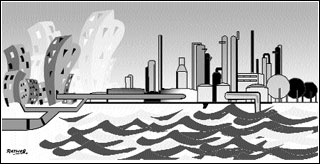 DESALINATION of water is one of the most important engineering task facing the coastal regions of Pakistan in general and the city of Karachi in particular. Lacking unlimited supplies of potable water, Pakistan has to depend on the desalination processes of brackish water and seawater to satisfy the ever-increasing demands.
These demands are expected to reach the 756 MGD (millions gallons per day) only for Karachi city in the year 2005. Apart from Karachi, for the coastal areas of Balochistan and Sindh, the only answer appears to be seawater desalination.
A concerted effort is required to produce potable water from the Arabian Sea as well as from high salinity wells in southern regions. The coastal regions of Sindh and Balochistan are also witnessing rapid urban and industrial growth, which require good quality water. Installation of large-size seawater desalination plants based on multi-stage flash distillation (MSF) and reverse osmosis (RO) should be considered seriously. It appears that desalination and water re-use may contribute almost 25 per cent of the water requirement in these areas.
In the late 80’s, scarcity of water started in the areas where natural sources of water were not available and only sub-soil water could be utilized. The first large size capacity desalination plant was installed in 1987 at Saindak Copper Mines, located in a small town, near Iranian border. It was a brackish water reverse osmosis (BWRO) plant supplied by an American water treatment company, Water Link. The production capacity was 200,000 US gallons per day (757 cubic meter per day or 32 cubic meter per hour). The source of water was well water with a salinity of approximately 4,500 milligram per liter from a 250 feet deep well. The product water was used for drinking and industrial application.
In 1990, the trend of installing desalination plant got an upward boost,especially in remote locations where no water source was available like Faisalabad and Dera Ismail Khan. In these areas, no canal or river water was available. For industrial application, two RO units of 250,000 gallons per day (946 cubic meter/day or 40 cubic meter per hour were installed at Lucky Power/Lucky Cement Plant, Pezo, Dera lsmail Khan. The supplier was an American Company, US Filter. The purpose of product water was industrial and drinking. Around the same time, two BWRO units were also installed in Faisalabad. One with a capacity of 100,000 gallons per day (380 cubic meter per day) at Sitara Textile Mills and another one at Crescent Textile Mills, which had a capacity of 200,000 gallons per day.
However, major desalination activity was carried out in Karachi and its suburbs. First RO plant was installed at Abu Dhabi Royal palace located in Clifton area, very close to sea. The source of water was a beach well of almost brackish water salinity. The capacity of this plant was 50,000 GPD and it was procured directly from the USA.
Later on, the beverage companies, Pepsi Cola and Pakola stepped into the market. In 1996, one RO plant was installed at Pepsi Factory, which had a capacity of 150,000 gallons per day and another one of 100,000 gallons per day at Pakola Factory. The American company, Water Link, supplied both plants. But the major contribution in the share of desalination capacity came from textile industries.
CAPACITY: Even though the desalination technology is nascent in Pakistan, however, there are approximately sixty medium sized plants in Pakistan and the total desalination capacity for RO plants, is approximately 10 MGD. Being the biggest industrial city, Karachi has the biggest share. Almost seventy- percent (70 per cent) plants are in Karachi or in the neighbourhood of Karachi.
Thermal desalination: It is very interesting that the thermal desalination process (TSP) has also been applied in Pakistan since 1992. The history of thermal desalination started when one 100,000 GPD plant was installed in Lahore in 1992. The plant was based on vapour compression process and was procured for Royal Palace of Abu Dhabi. The source of water for Lahore plant was a tube-well with a salinity of approximately 1,500 mg/l and the purpose of product was to supply domestic water other than drinking.
A similar vapour compression (VC) plant of 100,000 GPD capacity was commissioned in Rahim Yar Khan in 1993. This was also procured for Royal Palace of Abu Dhabi. The source of water is a canal, which has a salinity of approximately 2,000 mg/l. The fresh water is being used as plumbing water.
Reverse osmosis: The most popular process of desalination in Pakistan is RO.
Solar desalination: A non-governmental organization (NGO), NICE LINK has developed Solar Still for desalination of brackish water for desert and mountainous areas. The cost of a small solar still to produce potable water 200 liter per day capacity costs only Rs45,000 only.
Companies: There are a number of foreign companies which are actively involved in supply, installation and commissioning of desalination plants. All companies are providing RO plants. There is no company, which is supplying thermal (MSF, MED, VC) or electrodialysis (ED, EDR) plants.
Karachi scenario: The existing water supply depends on three sources. The oldest source, Dumlottee Wells was supplying 5 MGD but it is largely exhausted. The Hub System supplies 100 MGD from a multi-purpose dam on the Hub River via a conduit to Manghopir where it enters the primary distribution system. Hub source is unreliable.The balance of 435 MGD of existing supply is provided by the Greater Karachi Bulk Water Supply System (GKBWSS). The Dumlottee Well field was developed in 1884 and expanded in 1923. During the World War-II in 1942 it was supplying 15 MGD to the city. The current public supply to the metropolis is from two sources, Indus and Hub Dam totalling to 605 MGD. The unaccounted or loss of water in the supply system, however, is of enormous magnitude 40 per cent i.e. 242 MGD. The Karachi Water and Sewerage Board (KWSB) estimates the current demand at 820-MGD taking into account the losses. Therefore, there is a shortfall of 215 MGD, which constitutes 35.5 per cent of the supplied quantity.
The population of Karachi in accordance with 1998 census was 9.8 million projected to 11 million in 2000 at 5 per cent growth rate. The water demand at 54 gallons per capita per day (average domestic, industrial and commercial) comes as 594 MGD.
Future of desalination: The existing surface and groundwater sources in Karachi are not reliable. Moreover, the groundwater is contaminated and saline. The rainfall in Karachi and the surrounding area is low and extremely variable. The increased bulk water supply from Indus River will need large development investment, because of the distance of 170 km from the source. Therefore, in all probability substantial short fall in the water supply is going to persist in future. In any case the water supply is intermittent i.e., for 3 to 4 hours on alternate days.
Desalinated water certainly is not designed to compete with bulk water supply from a source like Indus River in terms of cost or in terms of a sizable share. However, it has a special strategic position, when one compares quality and reliability of water from the municipal piped system. The desalination plants become very attractive, as they dispense with the piping system because of their location at the point of use. The distribution system is vulnerable and undependable in times of emergencies. As a matter of contingency, the health support systems will always need continued potable water supply, which can only be assured by desalination plants distributed throughout the city. There are undoubtedly good prospects for installing dispensing stations just like petrol pumps, offering potable water at a reasonable cost to the citizens of Karachi. The RO technology also offers the added advantage of introducing mobile units to produce water on as and where required basis. The technology is ideally suited to provide water for survival in a scenario, when there is an overall breakdown of public services.
Coastal regions: The total straight length of seashore of Pakistan is 990 kilometre and if actual contour is measured then it comes out to be 1046 kilometre. The share of Balochistan is 670 kilometre and of Sindh is 320 kilometre. The major towns on the seashore of Balochistan are: Gawadar, Pasni, Turbat and Giwani.
The coastal regions of Sindh and Balochistan are full of promise for introducing desalination technology. There was a time when water for settlements on the coast used to be transported in launches plying from Karachi. One of the serious inhibiting factors in developing economic activities in the coastal region has been lack of fresh water. The desalination systems both thermal and reverse osmosis lend themselves eminently to the use of renewable sources of energy. There is plenty of sun available and mature technology for conversion of solar energy to electrical power via photovoltaic systems is also available. The RO desalination plants could be installed at point of use in the shortest possible time. Thermal desalination units based on the latest Evacuated Tube and Heat Pipe Collector technology could also be installed at places, where reasonable maintenance facilities are available. Efforts for poverty alleviation can become more meaningful, if dependable systems for at least drinking water for the people are provided at subsidized rates.
For Pakistan, the methods that are of current importance, Distillation and RO are best adapted to the desalination of seawaters while RO is also applicable to brackish water. In short, the desalination methods most frequently to be used would be RO (Seawater RO as well as BRO), multi-stage flash distillation (MSF) and vapour compression system (VC).
Large size thermal desalination plants and RO desalination plants require large capital cost. Private sector can not afford. In this background small size RO units between 100,000 GPD to 500,000 GPD seem to be most economic and viable.
The requirement for good quality water for major textile mills varies from 0.25 MGD to 1.0 MGD.
ULTIMATE GOAL: A total of 200 MGD of domestic and toxic sewage is produced in the city of Karachi. With plans underway to increase the bulk quantity of water under new project-plans, the sewage generation would further rise. The capacity of three existing sewage treatment plants is 151 MGD. At present the treated effluent is disposed in the sea.
The re-use of sewage effluent can be made through various types of treatment processes to achieve desired water quality. If conventional potable supplies were reserved for drinking, then treated sewage effluent could be available on demand for development of parks, roadside plantation. This would represent a reduction in the demand on conventional sources. Since the sewage contains pathogenic organisms like typhoid, cholera, parasitic, worms and viruses and as the municipal parks are used for resting there would be a high level of human contact with reclaimed effluent. Hence, any treatment facility must ensure that health risks are avoided and toxic components are removed before use as process water.




























