0
0

 PESHAWAR, July 30: The Grand Trunk Road has a rich past and a dazzling present but it is beset with a touching tragedy known only to those travelling through the length of the 2400-kilometre-long highway.
The Grand Trunk Road, popularly known as the GT Road, is the largest and most famous highway in South Asia running from Peshawar to Calcutta in Eastern India. The origin of the fabled highway is stretched back to the Maurya times in the third century BC when it served as the “royal road” connecting the Northwest with the Maurya capital at Patna in India.
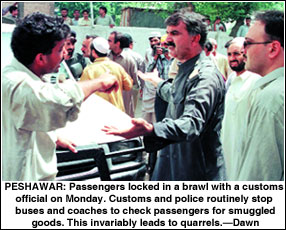
The scenic view and hustle bustle of life in the small hamlets, villages, towns and cities situated along the highway never provide a dull moment to the traveller no matter what the length of his journey might be. Thus lost in the ways of the mundane life coupled with the bounties of nature in the shape of steady flowing rivers and farms and orchards pregnant with seasonal crops, the unwary traveller is jolted out of his reverie by frequent halts caused by the machinations of the personnel of several law-enforcement agencies masquerading the highway.
These agencies claiming to be espousing and protecting the interest of the public are in addition to the conventional robbers and thugs who continue to operate on the GT Road with all the aplomb of their predecessors but with more sophisticated sinews to make the unsuspecting passengers surrender. The advanced machine age said to be the harbinger of luxury and comfort has thus brought additional misery on the gullible traveller, as he now has to grapple with the twin evils.
Far better must have been old times when Sher Shah Suri (1486- 1545), the founder of the Afghan Suri dynasty and the architect of the Grand Trunk Road built inns and wells along side the highway and ordered all poor travellers to be lodged and entertained at his own expense. Leave alone free entertainment, the present age has seen to it that poor as well as the not so poor travellers are both treated on par and both are striped of their sense of honour and dignity as during the course of their journey the Customs and police personnel unabashedly measure their waist lines to feel for any sign of, perhaps a refrigerator, being hidden somewhere in the under garments.
The GT Road was graded and metalled by the British from Lahore to Calcutta in 1830 and it is thus reported to have achieved its present appellation.
It was later extended from Lahore to Peshawar in 1850 and interestingly it is this portion of the highway which is deeply mired in controversies of all sorts as it is the most prone to the unscrupulous practices of the customs sleuths.
Rudyard Kipling, the British writer, was so carried away by the sights and sounds of the GT Road that he penned these down in great loving detail in his widely acclaimed novel, “Kim”. Kipling called the highway the “backbone” of India. If the enthusiasm of the customs personnel operating on the GT Road in search of smuggled goods in the present days is observed, one would be reasonably assured that these people are sparing no effort to prove Mr Kipling right by falling hard on those wretched youths with a thermos under their armpit or those haggard old ladies with a piece of cloth wrapped around their bellies with the intention of carrying them across the Attock bridge.
It therefore, goes without saying that the local industry and by virtue thereof the Pakistani economy owes its strong state of health to the Herculean efforts of the customs mobile squads and other allied agencies (sic).
And the cause celebre is the preemption of the outflow of foreign goods from one province of the country where these goods are legal to the other parts of the country where no such legal cover is available.
It indeed is the bane of the contemporary laws that goods, regardless of their origin can be sold in the local markets but the same cannot be carried on roads. The modus operandi adopted by the Customs and Excise squads is also dubious and fraught with serious hazards from the safety point of view. These squads which are normally led by an officer of the inspector level routinely hide themselves behind some vantage point and rear their heads suddenly striking at their targets at places where the authorised speed limit is 90 kilometres per hour.
The most enigmatic part of the drama being enacted on the GT Road day in and day out is the non-identification of the duties of the personnel of various departments. Thus one could easily observe police and drugs control-related agencies taking care of the bulbs and water flasks being transported and their brothers in arms, the customs officials seized with the task of maintaining law and order with absolute impunity.
The strain of the journey in the presence of these so-called custodians of law is equally troubling for those in the seats of power. A few years back a maverick provincial minister from the Frontier led a PTV team to the Attock checkpoint manned by the police of the said district and filmed the entire proceedings in the face of stiff resistance. The TV crew caught private youths selling nuts seized with the arduous job of checking the tide of smuggling. It therefore, remained no secret that the city chief police post was the hottest commodity till the checkpoint was dismantled courtesy the over zealous minister.
A second dismantling march against the checkpoint was led by a chief minister who too was incensed at their high-handedness noticed during his frequent trips between Peshawar and his hometown in Abbottabad.
This however, did not put a stop to the ordeal and humiliation of those travelling on the GT Road. The worst of it all was witnessed during the notorious Atta (flour) crisis of the late 90’s when labourers returning homes from their work places in the Punjab were off-loaded at the Attock checkpoints with their baggage consisting of five to 10 kg of wheat flour.
The Grand Trunk Road is at present being widened to facilitate the journey of the travellers. The Highway Authority has also deployed modern hi-tech traffic police on the highway, which has generally been welcomed by the commuters. One wonders how far will these steps go in alleviating the pain of the passengers by restoring the charming sights and sounds of the GT Road, which have so brazenly been stolen by the guardians of law.