



 0
0

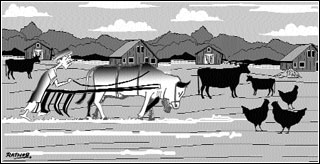 ‘ORGANIC AGRICULTURE’ is defined worldwide as ‘farming without the addition of artificial chemicals’. Today, many people are interested in organic produce and organic farming.
An agriculture scientist encourages all farmers, practising either organic or conventional farming, to farm in a sustainable way. ‘Sustainable agriculture’ refers to farming systems, which meet the present and future needs of society.
Most Australians farm conventionally, using chemical fertilizers and pesticides where and when appropriate. Generally, fewer chemicals are used on conventional farms in Australia than in the USA and in Europe.
On organic farms, no artificial chemicals are used. They are not used to prepare the soil, to grow the crop or to produce anything, on which the crop feeds, or to store, process or market the produce. In addition, animals are allowed to range as freely as is practicable.
Good organic farming is not a backward step. It combines the best of old knowledge and traditions with the best of modern science. It has much in common with other good management and need a high level of management, particularly of soils and pests.
Each certifying group has a code of standards, which is available to interested people.
Many farmers have their farms certified to reassure wholesalers, retailers and consumers that produce is organic. Consumer pressure and the fraudulent sale of uncertified produce are rapidly making certification essential. Each certifying group has a code of standards.
Different certifiers use different inspection methods and criteria, but the results are similar. Each certifier uses two levels of organic certification:
* The top level, Level A, is the fully organic level; the second level, Level B or in-conversion level, is the transition level.
Biodynamics: It refers to a set of principles laid down in the 1920s by Austrian philosopher Rudolf Steiner. Biodynamic farmers use special compost preparations, based on cow manure and other substances, as soil and plant activators. They believe these preparations increase soil biological activity, thus fertilizing soils and increasing crop growth. They also plant by the phases of the moon. Such farms are usually organic. There is a good market in Europe for biodynamic produce. Pests: What about pests? Don’t you need pest-killers? “The pests are my professors,” famously wrote Sir Albert Howard, founding father of the organics movement — pest attack simply showed him where the soil fertility needed attention. He’d fix it, the pests would vanish.
A ‘pest’ can mean a disease, a weed, an insect or a feral animal, which is not wanted on an organic farm.
Why farm organically?: People farm organically for many reasons:
* (Economics). Demand is growing for organic produce. Most organic farms need fewer inputs from outside the farm, which saves money for the farmer. Prices are often higher for organic produce, so profits may be satisfactory even if yields are lower.
* (Beliefs). Some people believe that organic farming is the ‘right’ way to farm or that it is better for the long-term future of the Earth.
* (Lifestyle). Not using any chemicals may lead to a more enjoyable lifestyle and better health. There may be more work to do, for example weeding with a scarifier or hoe instead of spraying.
How does organic farm differ? Conventional farmers use techniques and products, such as artificial fertilizers, insecticides, herbicides and fumigants, which are not available to organic farmers who therefore have to be cunning in handling potential problems, for example heading off pests before they become too great a problem. Organic farmers need to know the habits and life cycles of pests and apply this knowledge to pest control. They have to replace chemicals with labour and management.
Good organic farming, like any other good farming, requires a whole-farm approach. This means a crop or animal is managed as part of the whole farm rather than in isolation. Organic farmers must use long-term strategies and preventive measures, and balance their approaches carefully. For example, if cultivation to control weeds is carried out too frequently, the soil structure can be damaged.
Tactics: Organic farmers use many tactics to deal with potential problems and to improve soil, plant and animal management:
* Rotations help break disease cycles (for example, planting sunflowers alternately with cereal crops) and manage weeds (canola can shade out weeds so that fewer survive to cause problems for a following wheat crop). Rotations with legumes can increase soil nitrogen, particularly if the legume is ploughed in as a green manure.
* Green manure crops are ploughed in to increase organic matter and soil fertility.
* Beneficial microorganisms are used to facilitate and maintains the biodiversity.
* Cover crops protect young plants, reduce weeds and encourage predators of pests. * Plants with long taproots (for example, canola, safflower and sunflower) can help break up compacted soil and bring nutrients up from lower layers.
* Weeds can be controlled by hand weeding, cultivation, rotations, grazing management, and by using specialized tools such as brush weeders and flame weeders.
* Parasites of animals can be managed by selecting resistant animals, varying the stocking density, adopting suitable grazing strategies, and appropriately timing shearing and crutching.
* Trees act as windbreaks and provide shelter for birds and other animals which can help in pest management.
Farming without chemicals: Many people find it easier to manage pests with chemicals than by organic methods. But even without chemicals there are many techniques available. These include biological and physical controls and the use of natural chemicals and pheromones, which are scents used to confuse and intercept pests.
The certifying group decides which chemicals are allowed to be used. Some groups allow natural chemicals such as Bordeaux. Many groups allow rock phosphate, animal manure and waste from conventional farms. Most manures and wastes from conventional farms must be composted before use on an organic farm. Lime and gypsum from natural sources are often used to improve soil.
Organic farmers manage, rather than control, their pests. However, they may have to accept partial or even total crop loss from time to time.
Start with a small area to discover your limitations and identify possible problems. What are your constraints in terms of farming organically? Here are some of the aspects to look at:
* (Knowledge). Do you know enough about farming organically? Do you know where to find out more? Who can help?
* (Tools). Do you have the equipment you need? Some farmers need extra implements for weed management; others have all they need. The tools you need will depend on the size of your organic enterprise and on the crops you are planning to grow.
* (Labour/time). Can you get staff that will work with and understand organic methods? Most people find that organic farming is more time-consuming than conventional farming.
* (Inputs). Do you have access to suitable seed, livestock and other inputs such as manure? Note that organic farming is not a ‘no-input’ system.
* (Finances). Do you have the financial reserves to cover the drop in income, which usually occurs during conversion to organic farming? Do you know the costs and benefits of farming organically? If you are converting for other than financial reasons, how much income can you forgo to satisfy that need? For how long can you forgo that income?
* (Property). What are the likely problems given the history and surrounds of your farm? There may be patches of soil with high levels of chemical residues, or you may have poor fences, which allow neighbouring stock to pass diseases and parasites to your animals.
Never mind all the high ideals: do it for selfish reasons. Some people say: “But its so much more trouble.” In fact it’s so much less trouble to work with nature than to fight it. Why turn your garden into a battleground — a battle you can’t possibly win? And why poison your food?
Organic farming in Pakistan seems like someone’s garbage and someone’s treasure. As far as my knowledge is concerned, organic farming has been in practice in small pockets. People grow vegetables for their personal use in an organic way. Commercial agriculture produces can’t compete in any Pakistani market and in my candid opinion; organic farming can’t compete input based products. Marketing of commercial organic products would face some real tough time to replace or compete with its competitors. But I do see a big potential in organic farming to capture European or American markets. People in North America love to buy organic farm products and dine in organic restaurants.




























