



 0
0

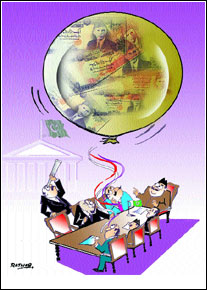 WHILE the constitutional amendments proposed by General Tanvir Naqvi of National Construction Bureau (NRB) empowers the President to hire and fire the Prime Minister, his cabinet, the provincial governments and all the assemblies, the one proposed by the Finance Minister Shaukat Aziz and his team of fiscal-cum-constitutional wizards gives the federal government (headed by the PM of course, but monitored by the President) the powers to withhold the salaries of the entire cabinet including that of the Prime Minister!
How ridiculous can you get!: Under the draft fiscal responsibility and debt limitation law, prepared by a committee comprising Dr Tariq Hassan, Dr Ashfaq Hassan Khan, Mr Rashid Naseem and Mr Aurangzeb Mehmood it has been proposed that: “Notwithstanding anything contained in sub-section(4) of section 3, if the federal government continuously fails to meet the target of debt to gross domestic product ratio prescribed in the debt reduction path for that year over the period of two years starting from the first report which states the failure of the federal government in meeting the prescribed target, the federal government shall take all necessary measures including the suspension of salaries of the cabinet members to return to the debt reduction path latest by the end of the next two years.”
The committee “after preparing and deliberating over several working drafts has submitted the draft law to the minister of finance” who in turn has put it on his ministry’s website to solicit comments before its finalization which is expected to be done by July 31.
The proposed law is loaded against the political governments which would come into being after October elections.
*the authors of draft law claim that draft law :
* provides measures to eliminate revenue deficit and minimize public debt to a prudent level by effective debt management;
* seeks to ensure medium-term and long term macro-economic stability in the country;
* is based upon the principles of sound fiscal and debt management.
* and will provide continuous and consistent guidelines to the government to achieve the objectives of this law; And what are these magical principles? 1. To eliminate revenue deficit to nil not later than 30th June 2007 and thereafter maintaining a surplus; 2. To minimize the public debt to sixty per cent of the estimated gross domestic product (GDP) by 30th June 2012; 3. To reduce the total public debt by not less than two and a half per cent of the GDP in every financial year, provided that the social and poverty related expenditures are not reduced below four per cent of GDP and; 4. To not issue new guarantees, including those on rupee lending, bonds, rates of return, output purchase agreements and all other claims and commitments that may be prescribed from time to time for any amount exceeding two per cent of the GDP.
The draft law says that the government can depart from these principles on grounds of unforeseen demand on the finances of the government due to national security or natural calamity which are required to be determined by the National Assembly.
Under the draft law the federal government shall, to maintain transparency in its performance, lay before the National Assembly in each financial year the following five economic policy statements:
a. the Medium-Term Budgetary Statement included in the annual budget statement (ABS); b. the annual fiscal policy statement included in the ABS; c. the annual debt policy statement included in the ABS; d. The mid-year economic report by the end of February; and e. the annual state of the economy report by the end of June.
The draft law further says that the economic policy statement shall incorporate to the fullest extent possible all government decisions which have a material effect on the economic situation of the country, except those that have been excluded for specified reasons by the finance minister.
Under the draft law, it has also been proposed to set up a debt policy coordination office (DPCO) to serve as a secretariat to achieve the objectives of this law. The office shall prepare a ten year debt reduction path which will be followed by the government and against which the performance of the government will be monitored and analyzed by the DPCO. The DPCO shall submit its annual reports to the cabinet after the approval of the Finance Minister.
And all the economic policy statements laid down before the national assembly under the proposed law shall be accompanied by a statement of the finance minister and secretary finance comprising the integrity of the disclosures contained therein and consistency with the requirements of the law.
All those aspirants for the offices of the PM and FM should read this draft law thoroughly before they put themselves up for the contest. If this law becomes a part of the constitution, then one could bet his bottom dollar that the salaries of the entire cabinets would remain suspended after every two years in office until the next elections because the law has been so designed as to make it impossible for any one even perhaps Mr Greenspan of the US if he were made the finance minister of Pakistan in the new dispensation to meet the target set by Drs Tarooq Hasan and Ashfaq Hasan for deficit and debt decline.
The draft law appears to be the handiwork of either those who are driven by scout boyish motives having no idea of how the finances of nations are managed, or perhaps it has been deliberately designed to give the President the required excuse to throw away a government after every three years, of course after withholding the salaries of the cabinet for one full year as a punishment for violating the law!!
In the first place why do you need a law to keep the debt and deficit down. There is no country in the world which has such a law. Secondly, if you do not want to borrow and want to keep the deficit down as well who is stopping you from doing so? Do it and set an example so that those who would follow you would be under moral and political pressure to emulate you and in fact if you had accomplished this miracle in any one of the three years that you have been managing the economy of this country, perhaps the nation would have had no objection to letting you continue after the elections? In the last three years, this so- called financially prudent and self-acclaimed good governors have been given waivers from the IMF both on revenue collection as well as budgetary deficit and all that cash which had poured into the country since 9.11 is not entirely dole. Part of it is loan, no matter how concessional. And despite the expanding deficits, the development budgets, especially the allocations for social sectors were drastically cut to keep the deficit from going beyond a point which would have been unacceptable for even the lenient IMF.
The most impossible condition in the proposed law is that of reducing the total public debt by not less than 2.5 per cent of the GDP in every financial year while not letting the social and poverty related expenditure to go below 4 per cent of GDP. The person who has proposed this condition is either living in a fools paradise or he has been told to propose totally impossible targets of both debt reduction and expenditure for social sectors and poverty reduction so as to make the elected governments appear totally incapable of managing the economy.
This government has actually achieved a miracle by accumulating foreign exchange reserves of $7 billion without boosting exports or borrowing from the commercial market. But this is a totally irrelevant achievement. And it could not cover up its total failure to bring the economy out of its recessionary bout. As a matter of fact the policies of this government have caused the recession to deepen further. Investment has disappeared, unemployment as gone up manifold and revenue collection is stagnating. Unlike the present government, the elected government would be answerable to the electorate and if they follow the same policies as those followed by the present government they would lose their mandate within no time. They would, therefore, have to do something about investments and employment and if resources for this cannot be generated by the economy on its own then they would have to borrow to kick start the economy. But in the presence of the proposed law which makes no economic or political sense this would be totally impossible. One only wishes that the team of economic and constitutional wizards which has proposed this draft law is given the responsibility of managing the country’s economy even after the elections. It will then perhaps dawn on the members of this committee that it is one thing to indulge in foolish fancies in the times of military rule and entirely another when it comes to selling such policies when in the transparent world of democracy.




























