0
0

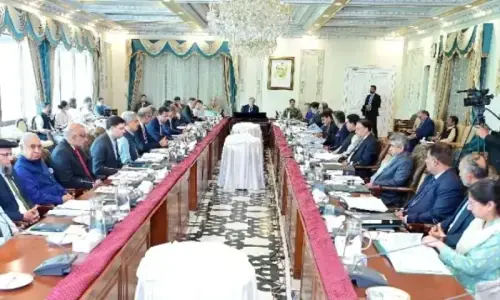
ISLAMABAD, July 16: The Sindh government and Federal Planning Commission on Tuesday unanimously opposed 16 per cent tariff increase and a 10-year formula for future tariff setting requested by the Karachi Electric Supply Corporation (KESC).
On the second day of public hearing of a KESC petition, the Sindh government, represented by its advisor Aijaz Nabi Abbasi, challenged the locus standi of the KESC to seek tariff increase because it had not yet obtained the distribution licence from the National Electric Power Regulatory Authority (Nepra)
He said it was surprising that KESC Managing-Director claimed that the losses were on the increase despite the fact that the organization was being run by serving brigadiers and army monitoring teams.
He further said that although the KESC was charging rental for meters, they failed to keep meters correct as required under the Section 26 of the Electricity Act, 1910, and in violation of the law, consumers were forced to pay the charges for replacement of defective meters.
He said the entire debt of the KESC had been converted into equity by the federal government and as such they were in a much better financial position now and as its privatisation was afoot, it would be better if the tariff issue was left to the new buyers to decide.
He said the impact of realisation of the late payment surcharge, fixed charges and power factor penalties was not reflected in the petition. If revenues on these accounts were also taken into account the financial status of the KESC would turn out to be better.
Abbasi said that the total losses as reflected in the petition were 40 per cent and on calculation they stood at Rs19 billion. He said that if these losses were to be brought down to 19 per cent there would be an annual saving of Rs10 billion and any rise in power rates would not be required. He said the reduction in losses from 40 per cent to 19 per cent could be done within a year as these pertained to theft.
Ghulam Haider, Energy Chief of the Planning Commission, stated that history showed that KESC had not been able to achieve targets to cut losses. He said technical losses should not be more than 16 per cent.
He pleaded that the KESC should not be allowed a 10-year tariff formula and the organization be directed to provide long-term investment plans and targets for efficiency.
He also opposed 16 per cent immediate tariff increase and said that even if an interim increase was allowed that should be made subject to adjustment in case of non-compliance with capital reduction and efficiency targets.
Adviser to Privatisation Commission Dr Matin Thobani supported the tariff hike and multi-year tariff formula and said the KESC had prepared the plea in consultation with the Commission.
He said that if tariff increase was not effected the federal government would have to continuously inject money into the utility which it was not in a position to do again and again.