0
0

 ONCE again the Central Board of Revenue (CBR) has set an ambitious collection target for itself while projecting the revenue income for the next year. While there is no likelihood of the total collection for the outgoing year crossing the Rs400 billion mark, the revised estimates for 2001-02 have projected a collection of Rs414 billion by June 30,2002.
There is,therefore, an over estimation of at least Rs14 billion in the projected collection for the current fiscal year. So instead of improving the collection by Rs46 billion or 11.11 per cent over what the CBR believes it would achieve by June 30, 2002, the actual improvement which the CBR would need to accomplish during the next year would be as much as Rs60 billion or 15 per cent over what it could actually collect this year.
The most ambitious of the targets within the overall revenue target has been fixed for the sales tax head. The CBR wants to collect as much as Rs35 billion more during the next year than what it believes it would collect under this head by June 30 this year. This is a jump of as much as 20.60 per cent if you go by the projected collection of Rs170 billion under sales tax during the current year. At best the actual collection of sales tax during the out going year would be Rs165 billion which would mean a jump of almost 25 per cent if the next year’s target of Rs205 is achieved—an impossible prospect.
The finance ministry wizards perhaps believe that if they kept the sales tax rates very high, say on an average at 20 per cent or over, the network of the GST which they believe they have successfully put in place would ensure the yield they have projected under the sales tax head for the next year. What perhaps they have not taken into consideration is the response of the consumer himself to the high rates and the ingenuity of the traders.
Even in those countries where the sales tax on an average is no more than 7-5 per cent ‘flea’ markets do roaring business as things sold in these markets do not carry any sales tax. And such outlets are in abundance in this country in the shape of Sunday, Juma and Mangal bazaars And one cannot also rule out the possibility of the consumer reducing his consumption to balance his home budget depressing further the overall demand which in turn would further add to the already deepening recession in the country. The projection of an additional income of Rs6 billion or a 12 per cent increase in the flows from custom levies also appears on the higher side.
As it is, the declining trend in the imports has not stopped and the rupee continues to hold a high ground vis-a-vis the dollar. Therefore, this level of increase in the income from customs appears rather impossible. More so, because even the projection of collection for the current year under this head appears higher by at least Rs5 billion which would mean that the real increase next year would need to be an impossible 22 per cent if the CBR were to collect the estimated Rs56.5 billion from customs head. And it would appear to be more difficult to achieve this target in view of the reduction in the highest slab of customs duties from 30 to 25 per cent. On the income tax front, however, the CBR appears to have for the first time in many years projected a highly realistic income estimates of Rs143 billion against the projected income of Rs142 billion in the outgoing year, an increase of mere 0.70 per cent. This seems achievable indeed. Even if the actual collection from income tax for the outgoing year turned out to be about Rs4 billion off, the improvement needed is no more than nearly 3 per cent over the actual collection. Also, since a number of income tax rates have been readjusted downwards, income from this head is likely to be affected rather significantly.
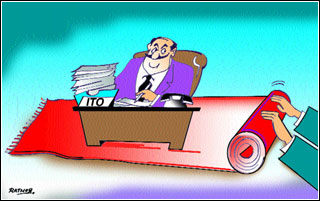
Despite this it looks achievable because for the first time in the history of this country, the forlorn hope of seeing the dreaded ITO disappear from the tax system appears a real possibility following the introduction from this year the new Self Assessment Scheme (SAS) for the assessment year 2002-2003. If this scheme is enforced in its present shape and form, it would certainly be revolutionary step. The following seven categories of filers have been justifiably kept out of the SAS: 1. All cases where loss has been declared; 2. All cases where income has been arrived at by making a lumpsum addition; 3. All cases of non-residents; 4. All cases of modarbas and companies engaged in the banking and leasing business; 5. All cases, where a legal issue is pending in any appeal in respect of a previous assessment and the same issue exists in the current year, unless the appeal/ reference is withdrawn either by the taxpayer or the Department, as the case may be, before the filing of return under the Scheme; 6. All returns where there is evidence of concealment of income and; 7. All returns selected for total audit.
All returns filed by tax-payers, other than the above will qualify for acceptance under the SAS and no one would bother the taxpayer subject to the fulfilment of some not very tough conditions which may appear to be extortionist to some. Tax is something which no one pays willingly, not even in the civilized world and not even by the most patriotic elements in a country. Every one regards at least the income tax to be something wrong. Indeed, when one is forced to pay part of his hard-earned income for something vague like the needs of the state and society, one naturally would feel like being subjected to extortion.
That is the reason why, even in the most civilized societies it is legitimate to find legal loopholes in the tax laws and bend them to save on taxes. But then those caught bending these laws beyond the recognized grey areas or breaking them when caught are meted out exemplary punishment.
A Vice President in the US lost his office when it was found out that he had evaded his taxes. In the same country the dreaded criminal Al Capone was brought to book by the tax investigators. In Pakistan stringent laws have existed against tax evaders all through these last 53 years, but none of the tax criminals and there are perhaps millions of such white collar criminals, have ever been brought to book.
In fact, many of the big business houses in this country have made their profits by robbing the exchequer white. As it is the private sector in Pakistan has thrived on contacts, influence, licenses, permits, protection, inefficiency and cost plus profit business. Many of them have never functioned as an honest to goodness entrepreneur. It was the private sector which had spoiled the ITO by tempting him first with small gifts and entertainment, then as the stakes went up, the gifts also became expensive and then cash itself was given and taken in broad day light.
Well known and respected businessmen were seen calling on the lowly ITOs and obliging them with generous bribes without feeling any qualms. After some years, the ITO started claiming his share in the evaded taxes as his right. Then he started showing the new comers the ropes. And perhaps, by the end of the decade of 1960s ,he had become a menace.
After that even if you had wanted to pay your taxes honestly, he would let you do it and use the relevant laws to ruin you, if you did not fall in the line. With the introduction of the SAS one hopes that the business community would be liberated from the menace of the ITO. But then would they pay their taxes honestly once this scheme gets into gear? As of today this looks highly improbable.
Pakistan’s business community has never been famous for its integrity. Therefore, the government would do well to impose punishing penalties against those who would be found evading their legitimate dues to the exchequer even after the introduction of the SAS. There should be no exemptions or exception to this rule. In fact since it would be the members of the moneyed classes (who have always been a part of the ruling elite in this country) who would be committing this crime, not the poor man who does not even earn taxable income, there would certainly be a lot of pressure on the enforcers of this law to be lenient with the so-called ‘respected’ members of the society.
And if the enforcers succumb to this pressure then the income under the head of Income Tax would fall even beyond what was being collected through the and there would then be an outcry for the return of the ITO. It would, therefore, be in their own interest if the moneyed classes would strictly abide by the SAS rules and willingly gave up the habit of evasion.